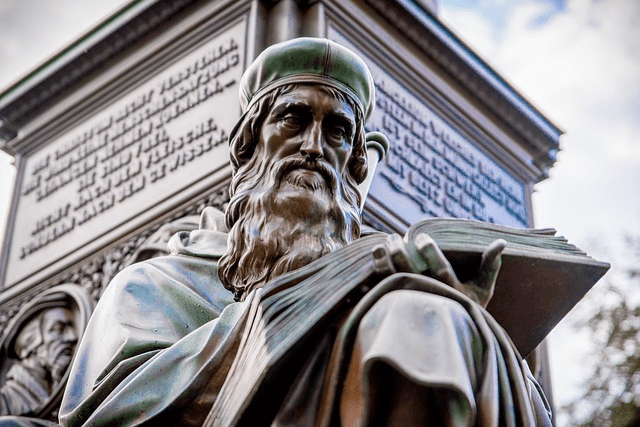
When considering the Bible in English, we have to begin in England. Christianity’s arrival in England is alleged to have occurred in the first century but is attested to by AD 200 (Tert., Adv. Judaeos 7). According to tradition, Aristobulus was sent by the Church at Tyre to Britain in AD 37. In Wales, there’s a town named after him, and Eusebius and Hippolytus attribute him as the first bishop in Britain. The first British Christian martyr was St. Alban in AD 304. Later, in AD 313, three bishops from London, York, and Lincoln (maybe?) attended a conference in Arles, France.
The Latin Vulgate was the standard Bible since AD 400, but translations into local vernacular were emerging. English derives from the West-Germanic and Indo-European language family. Among the earliest English manuscript is the Anglo-Saxon Proto-English that dates to AD 995. As a matter of consistency, John 3:16 will be used to compare the evolution of the language.
God lufode middan-eard swa, dat he seade his an-cennedan sunu, dat nan ne forweorde de on hine gely ac habbe dat ece lif.
The fourteenth-century Oxford scholar John Wycliffe produced the first English manuscripts of Scripture. He opposed the established church because he believed it was contrary to Scripture, so the Bible in English for the common man to read became a goal.
For god loued so the world; that he gaf his oon bigetun sone, that eche man that bileueth in him perish not: but haue euerlastynge liif.
His manuscripts were produced from the Latin Bible, the only source available. Wycliffe so angered the Pope that he had his remains dug up, crushed, and scattered in the river forty-four years after he died. One of Wycliffe’s followers, John Hus, continued his mission and advocated that people should be able to read the Bible in their language and he opposed the tyranny of the Roman church. Hus was burned at the stake, and Wycliffe’s manuscripts were used as kindling for the fire. The year was 1415, and Hus’ last words were, “In 100 years, God will raise up a man whose calls for reform cannot be suppressed.” In 1517, Martin Luther nailed his famous ninety-five theses to the door at Wittenberg—an act often regarded as the spark that began the Reformation.
Many others would follow in this endeavor, but William Tyndale was the first to print the New Testament in English. At the time, this was forbidden, so he took these to be printed in Cologne.
However, his intention was discovered, and the printing was halted while he fled. Around 1526, he had 3,000 copies produced in Worms. Tyndale was strangled and burned at the stake in October 1536. Only three copies of his Bible exist today. One of Tyndale’s disciples, Myles Coverdale, continued his work, translating the Old Testament and producing the first complete Bible in English in 1535—Coverdale Bible.
The Great Bible was an English translation authorized by the Church of England in 1539, but a more significant English translation followed—the Geneva Bible (c. 1560). It was the first Bible to add numbered verses and chapters for quick reference—the works of Shakespeare quote from this translation. This was the standard version for over 100 years. It retained over 90% of Tyndale’s translation and was a significant source for the King James Bible (c. 1611). The Geneva Bible was the first English translation taken to America by the Puritans and Pilgrims. Nevertheless, when the King James Bible was published, they were so large that they were chained to the pulpits in every church in England. It was decades before King James surpassed the Geneva Bible. Here’s how it read when published in 1611:
For God so loued the world, that he gaue his only begotten Sonne: that whosoeuer beleeuth in him, should not perish, but haue everlasting life.
A note of interest: the first Bible printed in America was in the native Algonquin language by John Eliot in 1663.
Noah Webster, after whom Webster’s Dictionary is named, translated the Bible into the vernacular in 1833. Many remained loyal to the 1611 edition of the KJV and refused Webster’s version. Yet, in the 1880s, England produced the Revised Version to replace the KJV. More ancient manuscripts were discovered by this time, making a revision necessary. Until this time, the Bible had eighty books. In the 1880s, the Apocrypha was eliminated, giving us the sixty-six books we now have. Americans produced the American Standard Version in 1901 in response to the Revision Version. This was the standard version until 1971 when the New American Standard was printed. The NASB was considered the best word-for-word translation of the Bible from Hebrew and Greek into English that has ever been produced. In the same year, the first paraphrase of the Bible was created—The Living Bible. Another translation philosophy had arisen.
A couple of years later, critics of the direct and literal translation wanted something they believed would flow better in English, so the NIV was produced. Until this time, the philosophy that guided translations was formal equivalence which aimed at matching the form and structure of the original as close as possible. The NIV translation philosophy would be dynamic equivalence, translating the ideas into contemporary language. Wherever there are poetic or archaic-sounding ideas, dynamic equivalence puts that into modern parlance for the reader’s sake. This new philosophy would make it so that a junior-high student could read and understand what the Bible was saying.
The New King James Version was created in 1982 to update the wording for KJV loyalists. In 2002, an attempt was made to synthesize the NIV’s readability and the NASB’s precision, producing the English Standard Version—deriving from the NRSV. Next, we’ll explore some challenging passages to translate and how they’re resolved.

 A Minister's Study