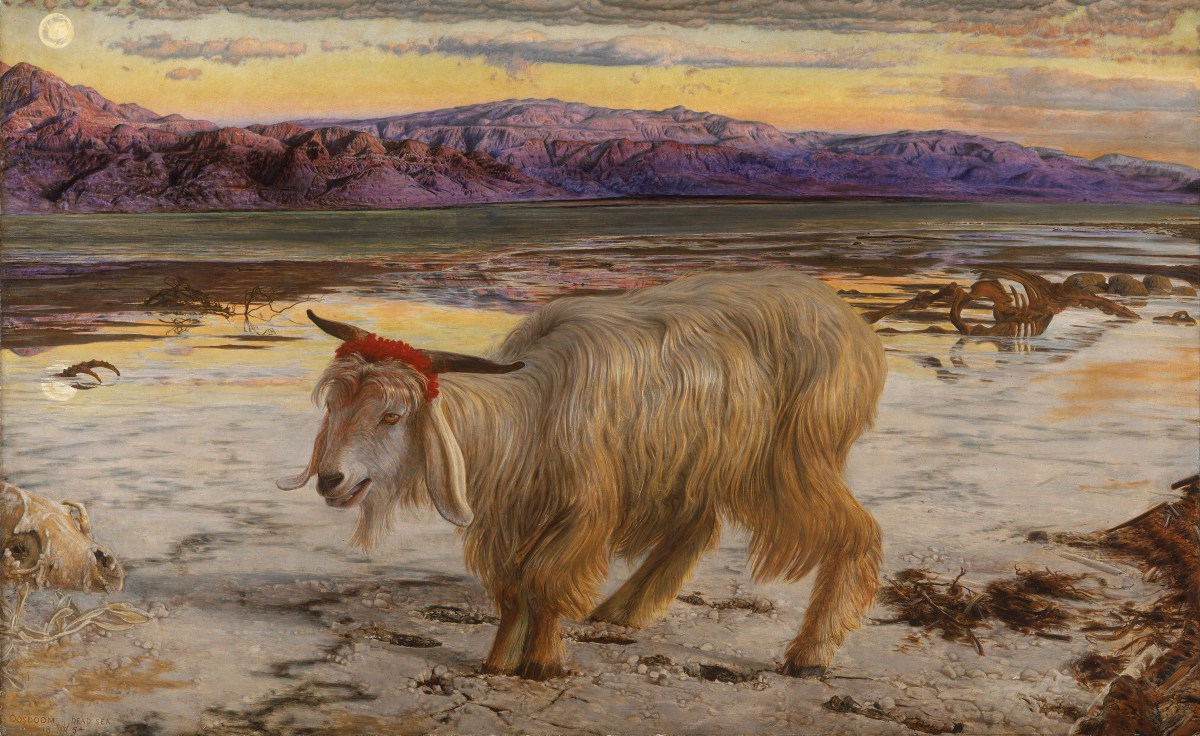
The High Priest was to perform certain rituals for himself and Israel on the Day of Atonement, but one fascinating is the scapegoat, one of two goats chosen by lots upon whom the High Priest would recite all the sins of Israel and then send it out into the wilderness. This is how many English translations render this term, but in Hebrew, it’s “Azazel” (Lev. 16:8–10), a name likely meaning something along the lines of “El is strong” or “the rage of El.” “El” is a name often used for God in the Hebrew Scriptures, but El was also the chief Canaanite deity. That’s not to say that the two are the same. They share a name; that’s all. The Canaanite El was associated with the epithet “bull” (cf. Num. 23:22; 24:8). It makes you wonder about that golden calf Aaron made to appease Israel (cf. Gen. 35:2; Josh 24:14–15; 2 Kings 23:24)! In Canaanite mythology, Baal is El’s son, for a point of reference.
There’s uncertainty about whether Azazel is a goat, demon, place, or deity (of a neighboring mythology). One interpretation is that the scapegoat is sent into the wilderness because the desert is associated with the chaos before God gave order to creation. One goat is given to God, and the other to Azazel. In Hebrew, the phrasing is that the goat is given to Azazel. Aaron does this for himself and Israel (Lev. 16:21). This goat to be sent to Azazel is, first, presented to God, showing the latter’s superior status (Lev. 16:7). God receives the other goat as a sacrifice, whereas no sacrifice is given to Azazel. God resides in his tabernacle/temple, and Azazel is in the desert. The two aren’t on equal footing.
I found it interesting how the Septuagint translates this corresponding term: “the one who eliminates” or “the one who wards off evil.” In Greek literature, the phrase hoi ampopompaioi typically denoted divine agents. In 1 Enoch, he is said to teach humans to make instruments of war, jewelry, and cosmetics, leading to war and fornication (8:1–2). The angel Raphael is said to have banished him to the desert, where the scapegoat goes (1 Enoch 10:4–8). In some versions of Enoch, the sins carried by the scapegoat are written upon him. Philo refers to Azazel as “the banished creature” and “the scapegoat” (Her. 179).
Later, in the second century AD, in Midrash Avkir, Azazel is identified as Azael. Other texts say more about him. For example, the Apocolypse of Abraham says he is the devil (31:5). The Talmud refers to it as “Azazel—the land” (b. Yoma 67b). In the same passage, the goat is supposed to be pushed off a jagged, rocky cliff; Azazel is said by another rabbi to be connected to two wicked angels, Uzza and Azael, who were believed to have been a part of the story in Genesis 6:1–4.
To complicate matters further, some early Christian amulets and jewelry depicted him as a figure who could protect them by having the power to avert evil. Who or what Azazel is remains unsolved. It is a versatile creature that takes on many forms at different times. This is one instance where a “clear reading of Scripture” isn’t always all that clear. We have relied on translators to do the best for us, but since the Septuagint, “scapegoat” seems to have been the preferred translation, thus overlooking a critical aspect in the context.

 A Minister's Study