A Crisis of Faith that Birthed a Movement

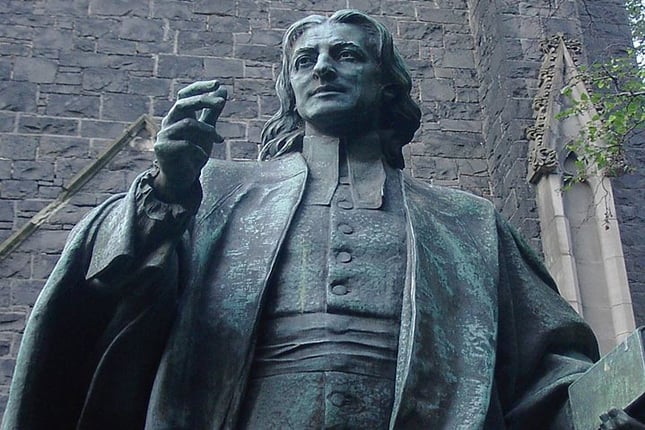
John Wesley was an Anglican priest who traveled to Georgia to evangelize the natives. While en route, the ship encountered a storm that threatened the lives of all souls aboard. Also aboard the vessel were Moravians. This church has its history in Bohemia and Moravia, the present-day Czech Republic (Czechia). In the mid-ninth century, two Greek Orthodox missionaries took the gospel to the area. They also translated Scripture into the people’s language. Still, in the centuries that followed, this area gradually fell under the ecclesiastical jurisdiction of Rome, leading some of the people to protest. John Hus, an admirer of John Wycliffe, led the charge a century before Martin Luther’s reformation. The Moravians were also going to Georgia at the behest of General Oglethorpe’s philanthropic endeavor. As the storm raged, Wesley became increasingly worried about himself. Meanwhile, the Moravians sang hymns throughout the storm, impressing Wesley. Given their calm and worshipful demeanor through the storm, Wesley was convinced that his faith wasn’t as strong as he believed and began to have a crisis of faith. 

When John was at university, he joined a group his brother Charles and some friends founded. They covenanted to lead a holy and sober life, to take communion once per week, to be faithful in private devotions, to visit prisons regularly, and to spend time together each afternoon to study the Bible. John was the only ordained minister in the group, so he often took the lead. Outsiders mocked them as a “holy club” and “methodists.” The young priest doubts his faith in Georgia but keeps doing the work. He returned to England feeling adrift, so he contacted the Moravians, and Peter Boehler became his counselor. Boehler urged him to keep preaching the faith until he had it and to continue preaching once he had it. One night, he was with a group where Luther’s preface to Romans was being read. The reader spoke about the change that God works in the heart through faith in Jesus, and Wesley writes, “I felt my heart strangely warmed. I felt I did trust in Christ, Christ alone for salvation: And an assurance was given me, that he had taken away my sins, even mine, and saved me from the law of sin and death.” The notion of having a “feeling” or warmness of heart is something that is seen at the Cane Ridge Meeting in  1801. In early America, and in the major denominations, one told of their “experience” and were then baptized and accepted as members. This is something that Alexander Campbell would later argue was unbiblical in conversion.

A fellow preacher of Wesley’s, George Whitefield, began preaching in a fiery manner. When he asked Wesley to fill in for him when he went to America, Wesley wasn’t as fiery a preacher as Whitefield. During his preaching, he noticed people moaning and weeping aloud. Others collapsed in anguish. Wesley was more suited to a solemn atmosphere, but he decided that such displays were a struggle between Satan and the Holy Spirit. Wesley was Arminian and not Calvinistic. Whitefield was the latter, so they parted ways, and Wesley remained an Anglican priest, holding meetings outside the worship of the Church of England that became dubbed Methodist. His Methodist meetings were meant to prepare people for Anglican worship and communion. 

Wesley didn’t intend to establish another church, but his followers were organized into societies that met in private homes until they required a building. As the movement grew, they were divided into classes that had eleven members and a leader. They met weekly to read Scripture, pray, discuss religious matters, and collect funds. To be a leader, one didn’t need to have the credentials of an Anglican priest, so it allowed people to serve who otherwise felt unequipped in Anglicanism. However, a few Anglican priests joined over time. Lay preachers became familiar and were seen as God’s answer to the movement’s need for preachers. They didn’t replace clergy and couldn’t offer communion. Wesley held periodic meetings among the priests who had joined and the lay leaders, and this became the Annual Conference, where each was appointed to serve a circuit for three years. English law was changed to allow non-Anglican services and buildings, but they had to be registered. By doing so, it meant that they weren’t Anglican. Wesley reluctantly did so, taking the first legal step of creating a separate church. In the same way that Luther didn’t want to establish a new church but was forced to, so was Wesley.  

After the Revolutionary War, Wesley wanted representatives in the United States, so he appointed Thomas Coke as superintendent—using the word translated as “bishop” for the role. He later sent Francis Asbury, a driving force in spreading Methodism westward into the American frontier. American Methodists became their church because they didn’t feel the need to follow Wesley, so the American church became the Methodist Episcopal Church. Coke and Asbury began calling themselves bishops, contrary to Wesley’s use of “superintendent.” This group merged with the Evangelical United Brethren Church in 1968 to form the United Methodist Church. The Evangelical United Brethren Church rose around the same time as the Methodist Church did in the United States. It was primarily made up of Germans who immigrated to the colonies. Its two heads were Philip William Otterbein (German–Reformed) and Martin Boehm (Mennonite), so two other denominations had united to form the Evangelical United Brethren Church. 

In recent years, the United Methodist Church has split primarily over LGBTQ+ rights. Whether or not to ordain gay clergy and perform same-sex marriages has caused a divide, with many churches buying out of the Methodist Conference. Since 2019, over 7,000 congregations have left the church. That’s about a quarter of all Methodist churches. The debate had been ongoing for a decade as to operating with “inclusion” as a part of their culture while homosexuality had not been congruent with their teachings. Some have remained Methodist but are now Global Methodists, adhering more to the teachings of John Wesley. Others have simply remained autonomous congregations, operating as they see fit.

Not Far Enough for John Smyth

Many didn’t believe the church went far enough when England became Protestant. Those who read Scripture and applied it rather stringently were called Puritans. While some Puritans argued against episcopacy, others saw it as applicable but not divinely ordered. They argued for elders in each congregation; among those who argued for this, some believed congregations should be independent, and they were called Presbyterians. Baptists arose among the independents at the behest of an Anglican priest, John Smyth. Because of their views, they were persecuted by Mary Tudor, which led to their exile in Amsterdam. 

While in Amsterdam, Smyth studied Scripture and determined that infant baptism was invalid, so he took a bucket and ladle and poured water over his head and that of his followers. The early custom of the Baptists wasn’t immersion but pouring over a believer’s head. Returning to England, they established the first Baptist Church in 1612. Two schools of thought arose between Baptists—many agreed with John Calvin’s doctrine of predestination. Others followed the belief of Jacobus Arminius, who rejected predestination and advocated that God had limited control concerning man’s freedom and response. These were called Arminians and were known as General Baptists. The other group was referred to as “Particular Baptists.” 

Today, there are a variety of Baptist Churches. 

  1. Independent Baptists are autonomous as opposed to Southern Baptists, who are primarily governed by the decisions of the Southern Baptist Convention. Those that aren’t independent send a percentage of their funds to a general fund overseen by the convention or association to which it belongs. The convention determines the financial and spiritual priorities of the congregations under their umbrella. 
  2. Primitive Baptists are largely Calvinist and can somewhat resemble Pentecostals. They trust the Spirit to move in their worship, which can take a person anywhere. There is a Pentecostal Free Will Baptist church that believes in free will. Then again, there are Free Will Baptist Churches, too. 
  3. Seven-Day Baptists hold the Sabbath as sacred and binding. This type of Baptist Church was first established in America in Newport, Rhode Island, in 1671. 
  4. Missionary Baptist Churches focus on evangelism and helping the local community. 
  5. Baptist Churches that are called “First Baptist Church” are to suggest that they were the first in the town or community. 
  6. There are more than 65 Baptist denominations, but the majority belong to just five. 

Many churches have eliminated denominational titles because they indicate division and the bad press associated with things that have occurred. One of the hallmarks of many evangelical groups, with which Baptists are often associated, is the sinner’s prayer. In 2012, David Platt, a Baptist minister, criticized the sinner’s prayer as unbiblical and superstitious. 

Thomas Kidd informs that Anglo-American Puritans and evangelicals used the phrase “receive Christ into your heart” in the seventeenth and eighteenth centuries. The phrase became more formalized during the nineteenth-century missionary movement and was a helpful way to explain that a person needed to make the personal decision to follow Jesus. This phrase’s commonality rose in the 1970s. Kidd also notes that George Whitefield published a hymn called “A Sinner’s Prayer.” 

God of my salvation, hear, and help me believe:

Simply would I now draw near, thy blessings to receive.

Full of guilt, alas I am, but to thy wounds for refuge flee; 

Friend of sinners, spotless lamb, they blood was shed for me.

One thing they believe that’s a significant divergence from us is that you can be saved before baptism. Also, they don’t partake in the Lord’s Supper weekly and use instruments. On this last point, this development is only 200 years old. Even some of their number opposed instruments.

“I would just as soon pray with machinery as to sing with machinery.” —Charles Spurgeon (Baptist) on Psalm 42

“Staunch old Baptists in former times would have as soon tolerated the Pope of Rome in their pulpits as an organ in their galleries. And yet the instrument has gradually found its way among them and their successors in church management, with nothing like the jars and difficulties which arose of old concerning the bass viol and smaller instrument of music.” —David Benedict (Baptist Historian) “Fifty Years among the Baptists”

Preceding Baptists, Mennonites, and Quakers was a group referred to as Anabaptists. As far back as the fifth century, when infant baptism was made the standard, as seen in the fifth Council of Carthage (ca. AD 401), dissidents who would be baptized as adults after being so as infants were called such. Their congregations grew and did well during the Roman Empire despite Catholicism persecuting them. Many were called Novatianists (third-century), Donatists (fourth-century), Albigenses, and Waldenses. Baptists often consider themselves inheritors of this history.

After King Henry VIII Left Catholicism

Last week, we concluded with the Lutheran Church and the Church of England (Anglicanism). We must understand that our separation of church and state exists for the reasons we’ll see as we go along. When King Henry VIII died, there was a bit of an issue with succession. At the time, the king’s male heir was to become king regardless of birth order. The late King Henry VII’s great-granddaughter was the Queen of the Scots, Queen Mary Stuart. This is important because of the line of succession: it went Edward, Mary Tudor, Elizabeth, and Mary Stuart (Queen of the Scots). Why this is important is discussed below.  

The reformer John Knox had spread the Reformation wide over the English island. Knox was located in Scotland and was the leader of the Scottish Reformation. While Edward reigned, Knox was given liberty from the French, who had pinned the reformers down at St. Andrews. Edward died at fifteen due to tuberculosis. Edward had named his mother his successor, but it didn’t work like that. Mary Tudor became monarch and was named “Bloody Mary” by protestant opponents for the apparent reason of persecution. So, Henry VIII left Catholicism. His son Edward was the first king raised as a protestant, but Mary Tudor was Catholic. She was the remaining daughter of his first wife, Catherine of Aragon. Elizabeth was the daughter of his second wife, Anne Boleyn, and Edward was the son of his third wife, Jane Seymour.  

Mary Tudor resumed the persecution of protestants, and Knox fled to Switzerland, where he met and learned from John Calvin. Mary Stuart, Queen of Scotland, wed the heir to the French throne and, at the age of sixteen, was queen consort of France and queen of Scotland. When Mary Tudor died in 1558, her half-sister Elizabeth succeeded her. Catholics claimed that Elizabeth was illegitimate, which would nullify her claim to the throne. If this was the case, the throne belonged to Mary Stuart, who began proclaiming herself the queen of England while in France. The protestants who had organized among Scotland and England sent word for Knox to return. 

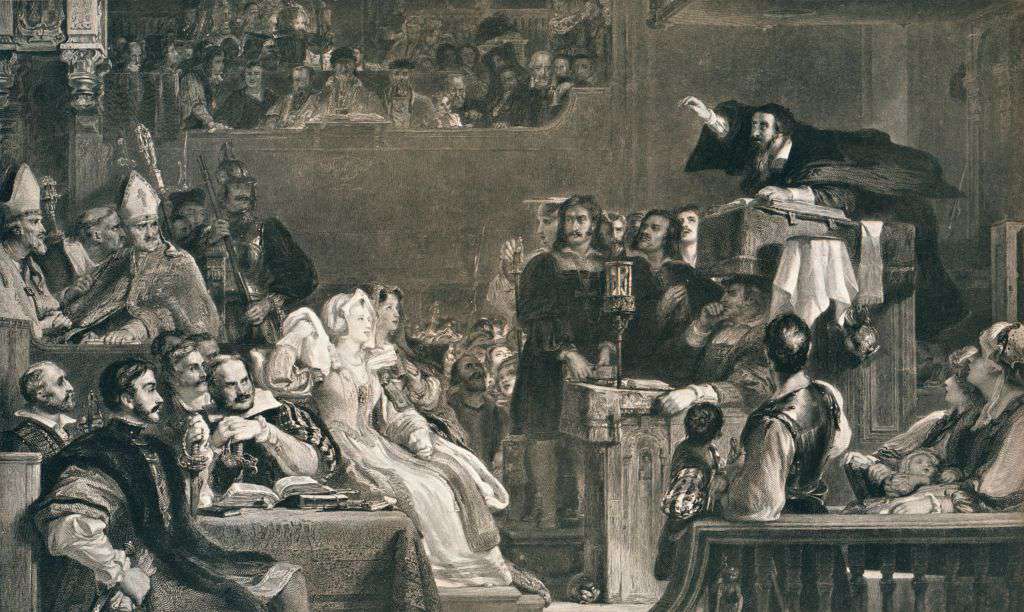
Knox returned to Scotland while Elizabeth reigned. Mary Stuart’s husband died, and she was requested to return to Scotland to reign since her regent had also passed. Mary had mass celebrated in her private chapel, and Knox preached against the “idolatry” of the “new Jezebel.” He and other reformed leaders organized the Reformed Church of Scotland. Each congregation elected elders and a minister, the latter examined by fellow ministers before being appointed. They were governed by the Book of Discipline, the Book of Common Orders, and the Scots Confession. Mary’s meddling in affairs alienated her from her lords so much that her army refused when she attempted to use them against the lords. Forced into exile, her cousin, Queen Elizabeth, gave her a castle residence. Yet, she conspired to have Elizabeth murdered so that she could sit on the English throne and restore Catholicism. She went so far as to include Spanish troops to aid her cause, but when the conspiracy was discovered, Mary was tried and condemned to death. 

Years later, when Elizabeth died, her nephew, who was already the King of Scotland, became king of England. He united the two crowns in the act of unification, but the church looked different in each country. In Scotland, it was called Presbyterian because each congregation had elders, presbyteros being the Greek term translated as “elder.” In England, their leadership style was called episcopal, episcopos translated as “bishop.” King James, after whom the King James Bible was given, favored the episcopal form because it better supported the king as the head of the church, while Presbyterians did not. 

Presbyterianism was among the most prominent denominations in early American history, with Baptists and Methodists equally present. The theology of John Calvin primarily led to Presbyterian dogma. An acronym arose to sum up his doctrine: TULIP. These stand for total depravity, unconditional election, limited atonement, irresistible grace, and preservation of the saints. The sovereignty of God overshadows the doctrine of them all. His magnum opus is Institutes of the Christian Religion, wherein he repeatedly quotes Augustinian views. 

Their central tenets revolve around their definition of the sovereignty of God, the authority of Scripture, justification by grace through faith, and the priesthood of all believers. They traditionally lived by the Westminster Confession of Faith, but today, they have The Book of Confessions and The Book of Order. The former contains: 

  1. The Nicene Creed
  2. The Apostles’ Creed
  3. The Scots Confession
  4. The Heidelberg Catechism
  5. The Second Helvetic Confession
  6. The Westminster Confession of Faith
  7. The Shorter Catechism
  8. The Larger Catechism
  9. The Theological Declaration of Barmen
  10. The Confession of 1967 (a revision of the Westminster Confession)
  11. The Confession of Belhar   

The latter is regarded as the Constitution of the Presbyterian Church and contains the foundations of polity, form of government, directory for worship, and church discipline. The Presbyterian Church practices infant baptism has female clergy and uses instruments in worship. Recent activity has included social justice issues.