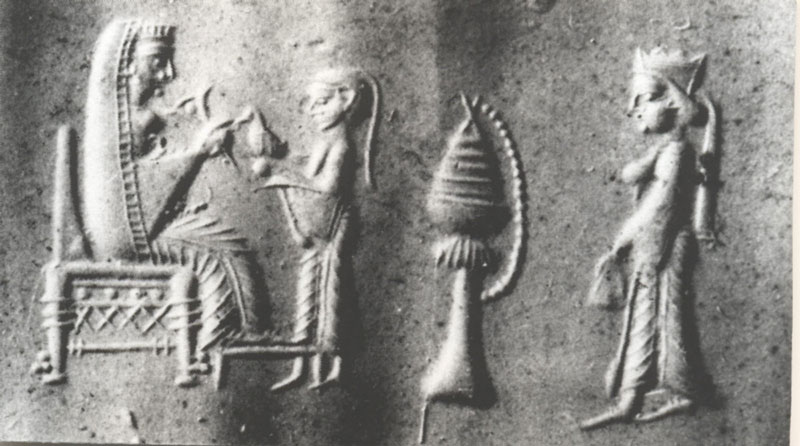
Between Esther I and II, Xerxes unsuccessfully attempted to subdue Greece. With his tail tucked between his legs, he has returned to Persia, and the loss has overshadowed his wrathful feeling born from Vashti. Yet, he returns a king with no queen to greet him. As with Chapter I, advisers urge the king on what to do. Xerxes appears to be a passive king, led by his advisers. A beauty contest will be held to decide who will be the next queen, and she’ll be quartered in the king’s harem. It may seem odd that he wouldn’t take a Persian queen, but it isn’t without precedent—Artaxerxes I and Darius II had Babylonian queens.
“Mordecai” and “Esther” are Babylonian names; the former is a play on Marduk, and the latter is from Ishtar. Mordecai’s father’s name is Hebrew, so this only shows how much exiled Jews assimilated. This isn’t a statement on their fidelity to God because Daniel and his compatriots were given pagan-based names as well. They may have had Hebrew names used within their Jewish community (Hadassah means “myrtle”). Mordecai’s lineage traces back to Israel’s first king. The term translated as “son” can mean descendant. The author shows us that these two characters belong to a prominent Benjamite family. Mordecai adopted his first cousin, some suggesting he was in his thirties and she was in her late teens. In verse seven, Esther is described precisely how Joseph was (cf. Gen. 39:6). Many similarities exist between Esther and Joseph in the story. For example, their stories are rags-to-riches. They are both attractive Hebrews and find favor with courtiers; they also have archenemies to overcome and reach the inner palace circles.
The “cosmetics” the women underwent were to make them as unblemished and attractive as possible. Spending a night with the king has its own implications that need not be discussed. Suffice it to say, this was trial by bedding. However, because of who she was and how she was, finding favor with all she encountered won her a king. As the story goes, we’re not told why the two eunuchs became enraged, but their plot is foiled when Mordecai informs the queen of their intentions. These men weren’t “hanged” as we would envision a noose. They were impaled and displayed for the public.
Esther reminds me of the passage from 1 Peter, “Rather, let your adornment be the inner self with the lasting beauty of a gentle and quiet spirit, which is very precious in God’s sight” (3:4). God’s providence is witnessed in this passage: “The King’s heart is in the hand of the LORD, like the rivers of water; He turns it wherever He wishes” (Prov. 21:1). Even though the Persian king doesn’t worship God, it still doesn’t remove him from God’s soverignty. God gave his own people into the hands of the Assyrians, the Babylonians, and the Persians. Even those not necessarily aligned with God can still be used by him. That’s the whole point of Habakkuk—God would use the Babylonians’ swiftness and conquering to humble his people. Yet, because of the Babylonians’ actions, God used the Persians to overcome them. Cyrus the Great was tolerant of other religions and allowed the Jews to return to the Promised Land to rebuild.

 A Minister's Study