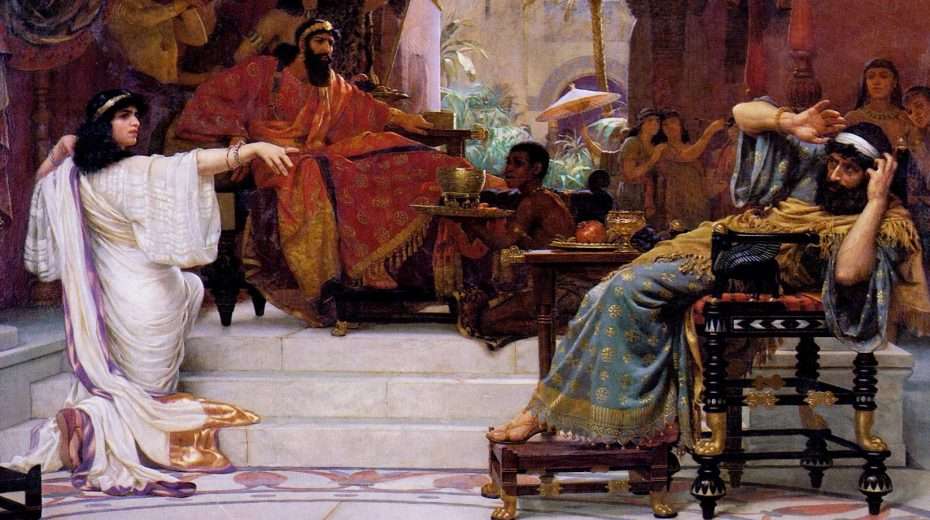
A Reversal of Fortunes (Esther 5-7)

After three days of fasting, Esther presents herself to the king. Unlike Mordecai, she wears her royal robes. The royal palace of Susa has been excavated, and the audience hall was over 350 feet square and divided into several chambers. Whatever separated them for thirty days, the king looks favorably upon her. Banquets figure into this story a lot. It began with a banquet that evolved into a second one, where the king grew upset with his queen. Esther’s banquet is already prepared in anticipation of a positive answer, and this will lead to a second banquet where the king’s ire turns to his right-hand man, Haman. The Greeks observed that the Persians made most of their important decisions while drunk, and when they drank wine, Ahasuerus asked what Esther requested. 

Haman is touched to be included, but his delight turns to rage when Mordecai refuses to stand when he walks by. Haman goes so far as to state his extensive wealth, sons, and the king’s esteem as prizes he possesses. However, the one thing that means the most to him is what Mordecai won’t give—homage. When is it enough? So what if that one guy doesn’t do what you want him to do? You even stated all you have, so take the wins and move on. Psychologists would say that Haman is a narcopath. “A ‘narcopath’ is a term sometimes used to describe individuals who display a combination of narcissistic and sociopathic traits, characterized by grandiosity, lack of empathy, a need for admiration, and manipulative, antisocial behavior,” according to Google’s AI overview. 

As the story progresses, the king’s sleepless night works to Mordecai’s favor. Haman has spikes prepared to impale him. Meanwhile, the king reads the annals and he hears what Mordecai had done and wishes to reward him, so since Haman was on his way to ask this of the king, he is selected to give the king’s honors to Mordecai. Because he’s so self-absorbed, he thinks the king is talking about Haman when he asks what shall be done for whom the king wishes to honor. Haman’s plan, which he believed to be for himself, is charged with implementing it on the man he hates. 

At the second banquet, the king asks her request, and Esther finally discloses that she is Jewish. As an alternative to being slaughtered, she uses the price Haman offered against him by saying that they could have been sold into slavery. After all, they were conquered by the Babylonians, who then fell to the Persians. Slaves were often composed of conquered people, and Haman has already referred to them as rebellious (Esth. 3:8). Haman either falls on the couch or the queen. Whatever it was, his actions were seen as an assault on the queen. Assyrian law prohibited coming closer than seven paces of the king’s harem, so something like this may have been in mind. Before the Japanese surrendered in WWII, it was prohibited for anyone to walk on the Emperor’s shadow. To try to lie with the queen, which he is accused of, is to lay claim to the throne too. Ahasueras feels betrayed by his most trusted minister. Neither knew of Esther’s ethnicity, but the king expected that Haman should have. 

For Such a Time as This (Esther 4)

Now that news of the impending slaughter has made its way around, Mordecai displays grief in a standard way in antiquity. Sackloth is a rough, coarse material that was uncomfortable to wear. Grief was often expressed in dramatic ways, such as wearing this garment, rolling in ashes, or placing ashes on the head. Mordecai cries bitterly while Jews throughout the empire add fasting. Though prayer to God isn’t outright mentioned, we might assume that it accompanies fasting. Because Persian monarchs were somewhat self-serving, bringing grief to them is prohibited (cf. Neh. 2:2), so Esther sends proper garments so Mordecai can pass through the king’s gate. Yet, he refuses. 

Mordecai’s refusal of appropriate attire brings in an intermediary to go between the adoptive father and daughter. How Mordecai came to learn of the plot has been debated. It was sent throughout the entire empire. Still, one theory suggests that he was a scribe for the palace and translating this in Aramaic gave him firsthand exposure (cf. Esther 8:9–10). Eunuchs weren’t just errand boys for the palace. Many of them were highly educated, so Hathach may have needed to read the edict to a presumably illiterate Esther. 

Knowledge of court practice was widespread. Mordecai likely knew this, and Esther knew that if she went before the king presumptuously, it could end with her death. Her hesitation to do so may indicate that she was no longer in the king’s favor and that by doing so, she was gambling a 50/50 chance. Furthermore, if she does nothing, her head will be on the chopping block. Mordecai expresses his faith when he says that deliverance will arise from elsewhere. He’s most likely acquainted with the promises God made to Abraham, and God will not allow his chosen people to be blotted out from the earth. Mordecai and Esther demonstrate a measure of faith. He believes in God’s promises, and she resigns herself to the possibility of death. At least she can take the shot and try to stop what is inevitable. To further add to this, she asks her countrymen to host a three-day fast in preparation for her actions. 

There are two main lessons from this chapter: 1) speak faith to your problems, and 2) never underestimate your ability to make a change. To the first point, Mordecai believed in God’s promises to Abraham, although this isn’t mentioned in the story, but he was confident that deliverance would come for the Jews. Did he wail and bemoan the state of affairs? Absolutely, but he still spoke faith to his problems. Abraham, likewise, spoke faith to his situation. When God asked him to take Isaac and sacrifice him on Mount Moriah, Abraham told his servants, “The boy and I will go over there; we will worship, and then we will come back to you” (Gen. 22:5). He didn’t know how things would play out, but he trusted God. Even in the face of sacrificing the promised son through whom many would be blessed, he spoke faith in his situation. When Daniel’s three friends were threatened with the fiery furnace, the king asked, “Who is the god that will deliver you out of my hands” (Dan. 3:15). Their reply is an epic example of speaking faith to one’s circumstances. 

O Nebuchadnezzar, we have no need to present a defense to you in this matter. 17 If our God whom we serve is able to deliver us from the furnace of blazing fire and out of your hand, O king, let him deliver us. 18 But if not, be it known to you, O king, that we will not serve your gods and we will not worship the golden statue that you have set up. (Dan. 3:16–18). 

Adding to this, we can also always take our problems to God. “Cast all your anxiety on him, because he cares for you” (1 Peter 5:7). Speaking faith to your situation, accompanied by prayer, is living by faith, and faith is the victory that overcomes the world (1 John 5:4)

To the second point, Esther initially didn’t believe she could be the difference between annihilation and survival. There are many stories throughout Scripture where one person made a difference. The Ethiopian Eunuch had Phillip; Nineveh had Jonah. Even Peter had Andrew. Andrew is often forgotten because Peter eclipsed him, but Andrew brought his brother to Jesus. Never sell yourself short. We may never know when and how God will use us.