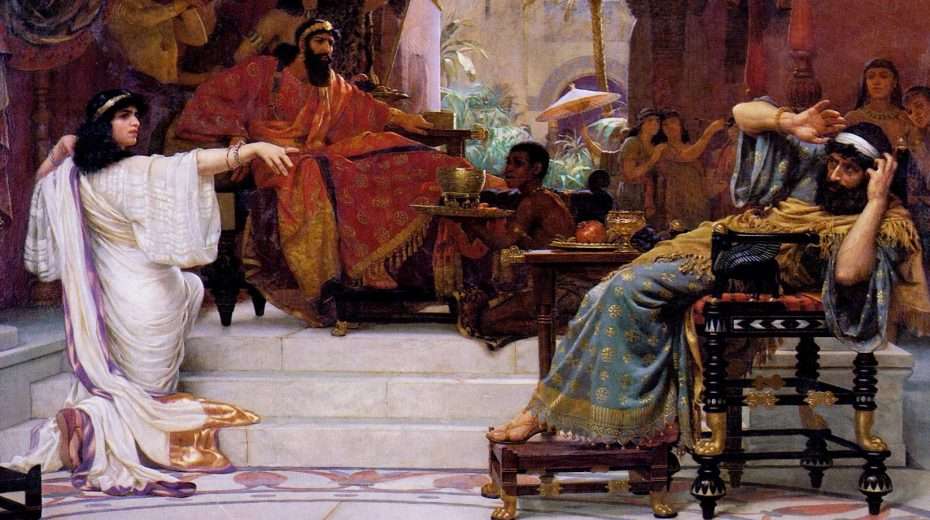
After three days of fasting, Esther presents herself to the king. Unlike Mordecai, she wears her royal robes. The royal palace of Susa has been excavated, and the audience hall was over 350 feet square and divided into several chambers. Whatever separated them for thirty days, the king looks favorably upon her. Banquets figure into this story a lot. It began with a banquet that evolved into a second one, where the king grew upset with his queen. Esther’s banquet is already prepared in anticipation of a positive answer, and this will lead to a second banquet where the king’s ire turns to his right-hand man, Haman. The Greeks observed that the Persians made most of their important decisions while drunk, and when they drank wine, Ahasuerus asked what Esther requested.
Haman is touched to be included, but his delight turns to rage when Mordecai refuses to stand when he walks by. Haman goes so far as to state his extensive wealth, sons, and the king’s esteem as prizes he possesses. However, the one thing that means the most to him is what Mordecai won’t give—homage. When is it enough? So what if that one guy doesn’t do what you want him to do? You even stated all you have, so take the wins and move on. Psychologists would say that Haman is a narcopath. “A ‘narcopath’ is a term sometimes used to describe individuals who display a combination of narcissistic and sociopathic traits, characterized by grandiosity, lack of empathy, a need for admiration, and manipulative, antisocial behavior,” according to Google’s AI overview.
As the story progresses, the king’s sleepless night works to Mordecai’s favor. Haman has spikes prepared to impale him. Meanwhile, the king reads the annals and he hears what Mordecai had done and wishes to reward him, so since Haman was on his way to ask this of the king, he is selected to give the king’s honors to Mordecai. Because he’s so self-absorbed, he thinks the king is talking about Haman when he asks what shall be done for whom the king wishes to honor. Haman’s plan, which he believed to be for himself, is charged with implementing it on the man he hates.
At the second banquet, the king asks her request, and Esther finally discloses that she is Jewish. As an alternative to being slaughtered, she uses the price Haman offered against him by saying that they could have been sold into slavery. After all, they were conquered by the Babylonians, who then fell to the Persians. Slaves were often composed of conquered people, and Haman has already referred to them as rebellious (Esth. 3:8). Haman either falls on the couch or the queen. Whatever it was, his actions were seen as an assault on the queen. Assyrian law prohibited coming closer than seven paces of the king’s harem, so something like this may have been in mind. Before the Japanese surrendered in WWII, it was prohibited for anyone to walk on the Emperor’s shadow. To try to lie with the queen, which he is accused of, is to lay claim to the throne too. Ahasueras feels betrayed by his most trusted minister. Neither knew of Esther’s ethnicity, but the king expected that Haman should have.

 A Minister's Study