Not Far Enough for John Smyth

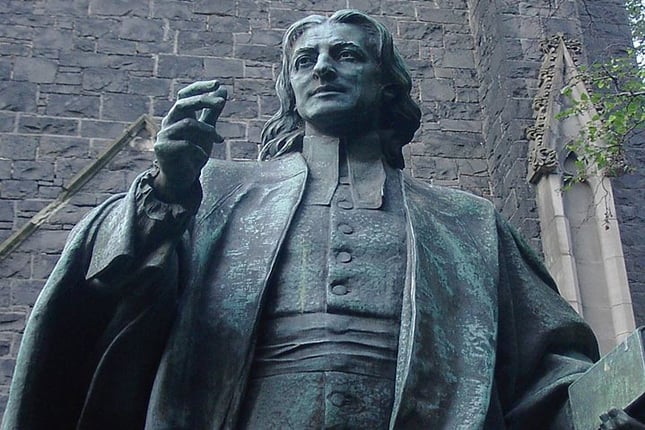
Many didn’t believe the church went far enough when England became Protestant. Those who read Scripture and applied it rather stringently were called Puritans. While some Puritans argued against episcopacy, others saw it as applicable but not divinely ordered. They argued for elders in each congregation; among those who argued for this, some believed congregations should be independent, and they were called Presbyterians. Baptists arose among the independents at the behest of an Anglican priest, John Smyth. Because of their views, they were persecuted by Mary Tudor, which led to their exile in Amsterdam. 

While in Amsterdam, Smyth studied Scripture and determined that infant baptism was invalid, so he took a bucket and ladle and poured water over his head and that of his followers. The early custom of the Baptists wasn’t immersion but pouring over a believer’s head. Returning to England, they established the first Baptist Church in 1612. Two schools of thought arose between Baptists—many agreed with John Calvin’s doctrine of predestination. Others followed the belief of Jacobus Arminius, who rejected predestination and advocated that God had limited control concerning man’s freedom and response. These were called Arminians and were known as General Baptists. The other group was referred to as “Particular Baptists.” 

Today, there are a variety of Baptist Churches. 

  1. Independent Baptists are autonomous as opposed to Southern Baptists, who are primarily governed by the decisions of the Southern Baptist Convention. Those that aren’t independent send a percentage of their funds to a general fund overseen by the convention or association to which it belongs. The convention determines the financial and spiritual priorities of the congregations under their umbrella. 
  2. Primitive Baptists are largely Calvinist and can somewhat resemble Pentecostals. They trust the Spirit to move in their worship, which can take a person anywhere. There is a Pentecostal Free Will Baptist church that believes in free will. Then again, there are Free Will Baptist Churches, too. 
  3. Seven-Day Baptists hold the Sabbath as sacred and binding. This type of Baptist Church was first established in America in Newport, Rhode Island, in 1671. 
  4. Missionary Baptist Churches focus on evangelism and helping the local community. 
  5. Baptist Churches that are called “First Baptist Church” are to suggest that they were the first in the town or community. 
  6. There are more than 65 Baptist denominations, but the majority belong to just five. 

Many churches have eliminated denominational titles because they indicate division and the bad press associated with things that have occurred. One of the hallmarks of many evangelical groups, with which Baptists are often associated, is the sinner’s prayer. In 2012, David Platt, a Baptist minister, criticized the sinner’s prayer as unbiblical and superstitious. 

Thomas Kidd informs that Anglo-American Puritans and evangelicals used the phrase “receive Christ into your heart” in the seventeenth and eighteenth centuries. The phrase became more formalized during the nineteenth-century missionary movement and was a helpful way to explain that a person needed to make the personal decision to follow Jesus. This phrase’s commonality rose in the 1970s. Kidd also notes that George Whitefield published a hymn called “A Sinner’s Prayer.” 

God of my salvation, hear, and help me believe:

Simply would I now draw near, thy blessings to receive.

Full of guilt, alas I am, but to thy wounds for refuge flee; 

Friend of sinners, spotless lamb, they blood was shed for me.

One thing they believe that’s a significant divergence from us is that you can be saved before baptism. Also, they don’t partake in the Lord’s Supper weekly and use instruments. On this last point, this development is only 200 years old. Even some of their number opposed instruments.

“I would just as soon pray with machinery as to sing with machinery.” —Charles Spurgeon (Baptist) on Psalm 42

“Staunch old Baptists in former times would have as soon tolerated the Pope of Rome in their pulpits as an organ in their galleries. And yet the instrument has gradually found its way among them and their successors in church management, with nothing like the jars and difficulties which arose of old concerning the bass viol and smaller instrument of music.” —David Benedict (Baptist Historian) “Fifty Years among the Baptists”

Preceding Baptists, Mennonites, and Quakers was a group referred to as Anabaptists. As far back as the fifth century, when infant baptism was made the standard, as seen in the fifth Council of Carthage (ca. AD 401), dissidents who would be baptized as adults after being so as infants were called such. Their congregations grew and did well during the Roman Empire despite Catholicism persecuting them. Many were called Novatianists (third-century), Donatists (fourth-century), Albigenses, and Waldenses. Baptists often consider themselves inheritors of this history.

After King Henry VIII Left Catholicism

Last week, we concluded with the Lutheran Church and the Church of England (Anglicanism). We must understand that our separation of church and state exists for the reasons we’ll see as we go along. When King Henry VIII died, there was a bit of an issue with succession. At the time, the king’s male heir was to become king regardless of birth order. The late King Henry VII’s great-granddaughter was the Queen of the Scots, Queen Mary Stuart. This is important because of the line of succession: it went Edward, Mary Tudor, Elizabeth, and Mary Stuart (Queen of the Scots). Why this is important is discussed below.  

The reformer John Knox had spread the Reformation wide over the English island. Knox was located in Scotland and was the leader of the Scottish Reformation. While Edward reigned, Knox was given liberty from the French, who had pinned the reformers down at St. Andrews. Edward died at fifteen due to tuberculosis. Edward had named his mother his successor, but it didn’t work like that. Mary Tudor became monarch and was named “Bloody Mary” by protestant opponents for the apparent reason of persecution. So, Henry VIII left Catholicism. His son Edward was the first king raised as a protestant, but Mary Tudor was Catholic. She was the remaining daughter of his first wife, Catherine of Aragon. Elizabeth was the daughter of his second wife, Anne Boleyn, and Edward was the son of his third wife, Jane Seymour.  

Mary Tudor resumed the persecution of protestants, and Knox fled to Switzerland, where he met and learned from John Calvin. Mary Stuart, Queen of Scotland, wed the heir to the French throne and, at the age of sixteen, was queen consort of France and queen of Scotland. When Mary Tudor died in 1558, her half-sister Elizabeth succeeded her. Catholics claimed that Elizabeth was illegitimate, which would nullify her claim to the throne. If this was the case, the throne belonged to Mary Stuart, who began proclaiming herself the queen of England while in France. The protestants who had organized among Scotland and England sent word for Knox to return. 

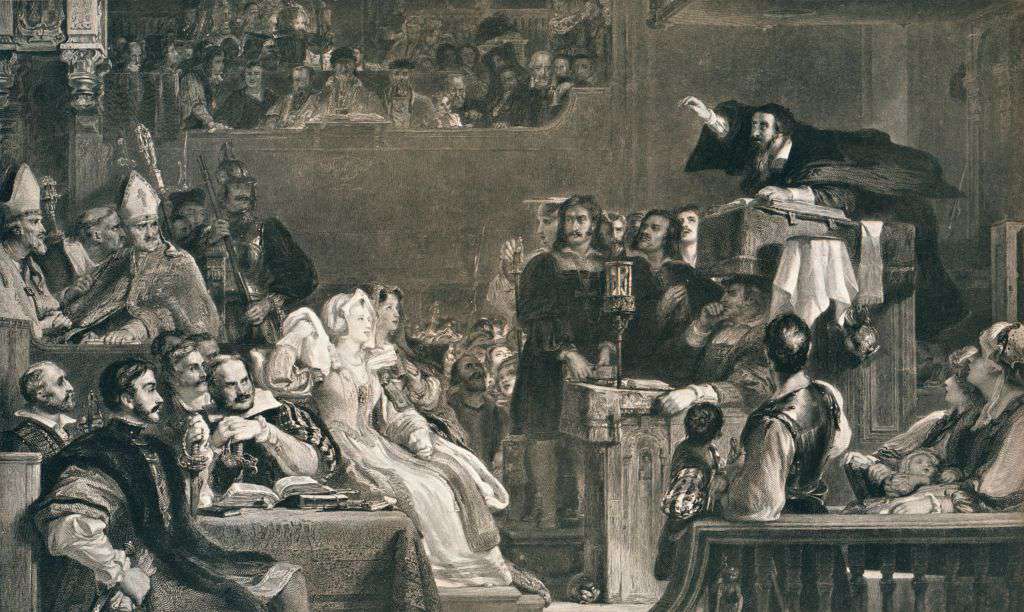
Knox returned to Scotland while Elizabeth reigned. Mary Stuart’s husband died, and she was requested to return to Scotland to reign since her regent had also passed. Mary had mass celebrated in her private chapel, and Knox preached against the “idolatry” of the “new Jezebel.” He and other reformed leaders organized the Reformed Church of Scotland. Each congregation elected elders and a minister, the latter examined by fellow ministers before being appointed. They were governed by the Book of Discipline, the Book of Common Orders, and the Scots Confession. Mary’s meddling in affairs alienated her from her lords so much that her army refused when she attempted to use them against the lords. Forced into exile, her cousin, Queen Elizabeth, gave her a castle residence. Yet, she conspired to have Elizabeth murdered so that she could sit on the English throne and restore Catholicism. She went so far as to include Spanish troops to aid her cause, but when the conspiracy was discovered, Mary was tried and condemned to death. 

Years later, when Elizabeth died, her nephew, who was already the King of Scotland, became king of England. He united the two crowns in the act of unification, but the church looked different in each country. In Scotland, it was called Presbyterian because each congregation had elders, presbyteros being the Greek term translated as “elder.” In England, their leadership style was called episcopal, episcopos translated as “bishop.” King James, after whom the King James Bible was given, favored the episcopal form because it better supported the king as the head of the church, while Presbyterians did not. 

Presbyterianism was among the most prominent denominations in early American history, with Baptists and Methodists equally present. The theology of John Calvin primarily led to Presbyterian dogma. An acronym arose to sum up his doctrine: TULIP. These stand for total depravity, unconditional election, limited atonement, irresistible grace, and preservation of the saints. The sovereignty of God overshadows the doctrine of them all. His magnum opus is Institutes of the Christian Religion, wherein he repeatedly quotes Augustinian views. 

Their central tenets revolve around their definition of the sovereignty of God, the authority of Scripture, justification by grace through faith, and the priesthood of all believers. They traditionally lived by the Westminster Confession of Faith, but today, they have The Book of Confessions and The Book of Order. The former contains: 

  1. The Nicene Creed
  2. The Apostles’ Creed
  3. The Scots Confession
  4. The Heidelberg Catechism
  5. The Second Helvetic Confession
  6. The Westminster Confession of Faith
  7. The Shorter Catechism
  8. The Larger Catechism
  9. The Theological Declaration of Barmen
  10. The Confession of 1967 (a revision of the Westminster Confession)
  11. The Confession of Belhar   

The latter is regarded as the Constitution of the Presbyterian Church and contains the foundations of polity, form of government, directory for worship, and church discipline. The Presbyterian Church practices infant baptism has female clergy and uses instruments in worship. Recent activity has included social justice issues.  

A Primer on the Reformation

The Latin Vulgate was the standard Bible in the West since AD 400, but translations into local vernacular were emerging. The fourteenth-century Oxford scholar John Wycliffe produced the first English manuscripts of Scripture. He opposed the established church because he believed it was contrary to Scripture, so the Bible in English for the common man to read became a goal. His manuscripts were produced from the Latin Bible, the only source available. Wycliffe so angered the Pope that he had his remains dug up, crushed, and scattered in the river forty-four years after he died. One of Wycliffe’s followers, John Hus, continued his mission and advocated that people should be able to read the Bible in their own language. He opposed the tyranny of the Roman church. Hus was burned at the stake, and Wycliffe’s manuscripts were used as kindling for the fire. The year was 1415, and Hus’ last words were, “In 100 years, God will raise up a man whose calls for reform cannot be suppressed.” In 1517, Martin Luther nailed his famous ninety-five theses to the door at Wittenberg—an act often regarded as the spark that began the Reformation.

In the spring of 1517, Martin Luther encountered Johann Tetzel, a preacher of indulgences. Luther was an Augustinian monk, and Tetzel was a Dominican friar. To be an Augustinian monk meant you were a member of a community that followed the Rule of Saint Augustine, a fifth-century Christian scholar. Similarly, the Dominican order followed the teachings of the priest Dominic de Guzman. 

In Catholicism, there are several sacraments. These are considered holy acts one can perform. One of them is the sacrament of penance. An indulgence was a remission of sin, so Tetzel taught that paying a fee could lessen the suffering of a departed loved one being punished in purgatory. Usually, the pope initiated indulgences that were traditionally used to pay for pet projects. Tetzel’s indulgences and others paid off a bank loan a bishop had taken out for a second estate and rebuilt St. Peter’s basilica. There were tales of Tetzel’s rhyme: “When the coin in the coffer rings, the soul from purgatory springs.” Luther saw this as an abuse of penance, and on October 31, 1517, he nailed his 95 theses on the door of the Castle Church in Wittenberg, Germany. This is referred to as the spark that ignited the Reformation. Eventually, the protestations of Luther birthed the Lutheran Church. They view Christ as the head of the church, Scripture alone determines doctrine, a person is saved by grace through faith alone, rejects transubstantiation, and does not regard Mary and the saints as intercessors. They also do not believe in purgatory. To learn more, look up and read the Augsburg Confession. 

Martin Luther’s reading of Romans during the Reformation changed the book’s Western interpretation for centuries. John Wesley, of Methodist notoriety, obliged Luther’s translation. Luther’s reading of Romans led to justification by faith alone. In Romans 3:28, Luther added “alone” after faith. Because he was an Augustinian monk, undoubtedly following Augustine’s interpretation of verses 22 and 26 as “faith in Christ” rather than “the faithfulness of Christ,” Reformation theology followed a chain of error. First, with Augustine, who was Ambrose’s protégé, then Luther, an Augustinian monk, and throughout the West and centuries, Reformed theology has taught this way. Romans, however, in the rendering of the syntax, doesn’t altogether disagree with it. Still, even Luther admitted that “alone” or “only” wasn’t present in the text in his 1530 Translating: An Open Letter.

In 1534, King Henry VIII wanted to divorce his wife, Catherin of Aragon, to marry his mistress, Anne Boleyn. The pope refused to grant it, but Henry had reformers in his court—Thomas Cromwell and Thomas Cranmer. They argued that he shouldn’t be subjected to the pope’s jurisdiction, so Henry made Cranmer Archbishop of Canterbury, and in 1534, Parliament passed the Act of Supremacy, solidifying a break from the Catholic Church. All Catholic property (e.g., monasteries) reverted to the Crown, so Henry distributed them to loyalists. Though they look a lot alike, Anglicans don’t believe in the doctrine of transubstantiation; they allow women to be ordained as priests, and they may diverge on marriage and divorce and issues of morality. 

Some Developments in Early Christianity (and later)

Catholicism and Orthodoxy were the same for centuries, claiming to be the original church. A split came in the Great Schism in 1054. They share seven ecumenical councils and adhere to the decisions that are derived from them (kind of). However, the Roman Catholic church changed the Nicene Creed (AD 325) to add filioque (“the son”), which upended the doctrine of the Trinity. What changed was that the creed said the Holy Spirit came from God the Father, but by adding the filioque, it read that the Holy Spirit came from the Father and Son, thus making the Spirit subjective to both and lessening his standing in the Trinity. Orthodoxy does not acknowledge this change that was added in the Middle Ages (AD 589).  

Roman Catholicism also added doctrines through the pope’s primacy: purgatory, immaculate conception, stigmata, and praying the rosary, among others. They differ on original sin. Catholicism teaches that every person born is tainted with the guilt of the sin of Adam. This is why they “baptize infants.” Actually, they sprinkle them. “Baptize” means to immerse, which they don’t do. There’s a Greek term for sprinkling seen in Hebrews concerning the blood of bulls and goats (Heb. 9:19-21). That term is rhantizo. Orthodoxy views original sin as having the proclivity to sin because we are all born in the flesh. Still, newborns are innocents who will someday act upon that proclivity and invite sin into their lives. They immerse infants for around forty days of life. 

Ignatius of Antioch was the first to mention the catholic church (Smyrneans 8; ca. AD 107), and he did so as a call to unity around the congregational bishop who was to protect the church from heresy. The usage of “orthodox” was prevalent by the fourth century to distinguish those of the apostolic tradition from heretics. Here are changes that occurred that varied from apostolic teaching:

  • In the early second century, the local congregation’s leadership went from elders, deacons, and ministers (1 Tim. 3) to one elder being chosen as bishop among his fellow elders. Jerome later regarded this change as a “result of tradition, and not by the fact of a particular institution by the Lord” (Comm. Titus 1.7; cf. Did. 15.1; 1 Clement 42.4; Poly., Phil. 5-6; Shep. Herm. vis. 8.3). This bishop was over the elders, deacons, and congregation. At times, you couldn’t take the Lord’s Supper unless the bishop was present to preside over it unless he appointed a proxy in his absence from among the elders. More and more became tied to the bishop, so he performed baptisms exclusively (see Ignatius, Mag. 2; Trall. 2; Smyrn. 8).
  • The Protoevangelium of James is a second-century apocryphal Christian text, considered to be an “infancy gospel,” that narrates the birth and early life of Mary, the mother of Jesus. It includes details not found in the canonical New Testament, most notably the idea of her perpetual virginity; it is believed to have been written sometime around the mid-2nd century. This is the earliest evidence of special attention given to Mary, which would give rise to the practice of venerating her. 
  • By the third century, Cyprian of Carthage (ca. AD 200–258) wrote about baptizing infants as a passing matter (Epistle 58; cf. Acts 8:12, 36–37; 16:29–33), which suggests the practice was entirely common by his time. Discussions of the matter appear as early as Irenaeus (ca. AD 120/140–200/203; Contra Haer. 2.22.4) and Tertullian (ca. AD 200; On Baptism 18). 
  • In the latter third century, veneration of martyrs on the anniversary of their deaths became common. For Origen (ca. 185–254), explicitly, veneration stood with Jesus and not in competition with him (1 Tim. 2:5; cf. Lev. 19:31; Is. 8:19; Eccl. 9:5–6). In the fourth century, they were regarded as sancti, from which “saints” arose. 
  • The Council of Elvira imposed celibacy on clergy (canon 33; ca. AD 300–310), contrary to 1 Timothy 4:3. 
  • By AD 428, Pope Celestine rebuked bishops for not wearing distinguishing attire, which means clerical garbs arose sometime before then (cf. Matt. 23:5). 
  • Owing to their view of original sin, they celebrated Mary’s immaculate conception as early as the fifth century. This doctrine teaches that she was conceived without original sin so that she could bear Jesus. The doctrine was officially defined in 1854.
  • The term “mass” appears around AD 604. It derives from the Latin term missa, meaning “to go.” It was pronounced at the end of worship and is closely associated with “mission.” 
  • In AD 595, the Patriarch of Constantinople, John the Faster, assumed the title “Ecumenical Patriarch.” Gregory the Great, or Pope Gregory I, wrote to the emperor, begging him not to acknowledge it. Emperor Maurice accepted it. A few years later, Emperor Maurice was slain by a usurper—Phocas. Pope Gregory sent letters of praise to the new emperor. However, in AD 606, Phocas transferred the title “Universal Bishop” to Boniface III, the bishop of Rome, thus establishing the modern-day Catholic Church of Rome.
  • The doctrine of transubstantiation, elaborated by Scholastic theologians from the 13th to the 15th century, was incorporated into the documents of the Council of Trent (1545–63). This doctrine taught that when the priest blessed the bread and wine, it became the literal body and blood of Jesus. 
  • Papal infallibility was established in 1870. 

Perhaps the most significant difference between us is our views on Scripture. They contend that the church created the canon, thus exercising authority with and greater than Scripture. To them, the church is the proper interpreter of Scripture. I believe writings were already acknowledged as Scripture in the New Testament (2 Peter 3:15-16). Paul quoted Luke 10:7 in 1 Timothy 5:18. We also note that unanimity was taught in all the churches (1 Cor. 4:17; 7:17; 16:1). Also, New Testament writings were circulated among the churches (cf. Col. 4:16; 1 Thess. 5:27; 1 Peter 1:1; Rev. 1:4). Here are a few other factoids:

  • Didache (AD 50–60) refers to the Lord’s Prayer as it appears in Matthew. 
  • The letter 1 Clement was written near AD 95, and he alludes to the writings of Paul as Scripture and Matthew, Luke, Acts, James, and 1 Peter. 
  • In AD 110, Ignatius alludes to Matthew, Luke, and John. 
  • Polycarp, in AD 110, called Ephesians Scripture. He also references Romans, 1 Corinthians, Galatians, Philippians, 2 Thessalonians, and 1 & 2 Timothy; he quotes Matthew, Mark, and Luke.

I wouldn’t say the church created the New Testament. I would contend that they acknowledged and compiled the books identified as Scripture since the apostolic age. This was done as a reaction to proposed canons, some of which omitted the inspired books. This may have begun with Marcion, the second-century heretic who omitted all of the Old Testament and only recognized Luke’s gospel and some of Paul’s epistles as Scripture. In addition, we have Bryennios’ List, the Muratorian canon, Melito’s canon, Origen’s commentaries, and others. Many of these agree with minor variations, but they didn’t create them so much as to recognize what was a part of the apostolic tradition.

What is “Sound Doctrine?” 

The term “doctrine” derives from Latin and is related to the word “doctor,” which means “teacher.” When we think of doctors today, we think of medical practitioners, but in the Roman Empire, doctors were instructors in a specific field. Therefore, “doctrine” means “teaching.” The Greek term is also fitting for this translation. Christian doctrine derives from commandments focused on “love from a pure heart, a good conscience, and from sincere faith” (1 Tim. 1:5). Paul uses “sound doctrine” (1 Tim. 1:10) to describe how the law ought to be used, and it’s connected to one’s behavior. In Titus 2:1, Paul wrote, “But as for you, speak the things which are proper for sound doctrine.” The term “sound” also refers to those who are physically well instead of sick (Luke 5:31; 7:10; 3 John 2). When the prodigal son returned, he was received safe and “sound” (Luke 15:27). All other usages refer to doctrine, not physical health. Still, there’s a lesson herein: those who are physically healthy are sound, or well, so it may reasonably follow that those who are spiritually healthy are sound too.

Many people denounce doctrine as too divisive. It can be, but it ought not to be. Some people exclaim, “I just want Jesus, don’t give me doctrine.” The fault in that statement is that we cannot separate the truths of Jesus from the Person of Jesus, so without sound doctrine, we have no Jesus. John contended with this in his day, “By this you will know the Spirit of God: Every spirit that confesses that Jesus Christ has come in the flesh is of God, and every spirit that does not confess that Jesus Christ has come in the flesh is not of God. And this is the spirit of the Antichrist, which you have heard was coming, and is now already in the world” (1 John 4:2–3). The way some are today might have said, “Just give me Jesus. I don’t want doctrine,” but for John, it mattered whether or not Jesus appeared in the flesh as a matter of orthodoxy. We tend to dismiss such issues because they seem so minor. There are times when matters are minor, but there are also times when they aren’t. Paul was concerned with sound doctrine, too, and this was what Timothy was to teach and uphold. 

Those who lead sinful lives did not order their lives according to “sound doctrine” (1 Tim. 1:8–11; 6:1–5; 2 Tim. 4:3–5; Titus 2:1–10). When one reads all of these passages, we’re struck by how when sound doctrine is mentioned, behavior should follow. We can see here that those behaviors do not accord with sound doctrine, and anyone claiming to represent God is to call things what God calls them and exhort others to order their lives around sound doctrine. Sadly, many fear calling specific actions, lifestyles, or choices sinful, so we dilute orthodoxy to avoid hurting feelings. We can and should be able to call sin what it is and simultaneously be compassionate and loving towards sinners, among whom we are also counted. Sound doctrine, therefore, is spiritual health. When one is healthy, one manifests that in one’s actions. The spiritually healthy person formed by sound doctrine does the things that please God.

How do we get doctrine? Commandments, prohibitions, and examples are a few ways. When God commands something through one of his chosen prophets or mediums, we must do what is commanded. If he prohibits something the same way, we should not do what’s forbidden. If we note patterns of behavior that are commendable, we can mimic the action and know we are not doing wrong. The problem comes when we bind something that God has not bound.

Though Scripture is inspired, interpretation is not. We conclude when we take a topic and study it as a whole. Some conclusions are rather logical and can be taken at face value, but if an interpretation is questioned, there ought to be answers to justify it, or adjustments should be made. For example, “Abstain from every form of evil” (1 Thess. 5:22). In churches of Christ, I have observed some who have employed this passage to prohibit dancing. A reading of 1 Thessalonians would not have that in mind, but there is a way to use it. When Herodias danced before Herod, we might conclude that it was rather provocative (Mark 6:22). After all, he wanted to offer her anything. In this case, dancing can be viewed as sinful. We can’t say that all dancing is terrible. The older son in the parable of the prodigal son came near the house and “heard music and dancing” (Luke 15:25). This story is about rejoicing over a lost son returning to salvation, and they were dancing as a matter of celebration. 

No human is the arbiter of determining what is doctrine and shouldn’t be. One interpretation among some in churches of Christ is that the Holy Spirit indwells the believer by proxy–through the Word of God. Since some of us know more Scripture than others, do we have more of the Spirit? When you look at interpretations from the first few centuries, this conclusion hasn’t been reached as far as I have read. It’s hard for me to believe that doctrine because the earliest Christians had a different take. That doesn’t mean they’re always right, but it also doesn’t mean they’re wrong.

I believe it’s best for us to give grace to one another and assume the best. Just because I arrive at a different conclusion than you doesn’t mean I’m malicious. Some Christians read the creation account literally. I happen to take parts of it literally while considering how I understand that an ancient Near Eastern audience would have understood it. Still, I hold no ill will if someone reads it literally. We both love Jesus and want to serve God.


That Ugly Word: “Tradition”

In churches of Christ, the term “tradition” is a no-no. We associate tradition with creeds and confessions of faith created by denominational bodies. Many Americans were governed by the Philadelphia Confession of Faith a couple of centuries ago. The Westminster Confession of Faith led others. Then you have the Apostle’s Creed, the Nicene Creed, and more. While there are positives to having such definitive statements (“Don’t shoot me!”), our history has seen them result in division. For example, among Presbyterians were the Anti-Burghers, Auld Licht, Old-Light Anti-Burgher Seceders, and others. Among Methodists were the Episcopal Methodists and Republican Methodists. The Restoration Movement advocated doing away with these creeds and confessions of faith and going by the New Testament as our guide for being Christians and, therefore, the church. There are still splits among us: Disciples of Christ, Christian Church, Churches of Christ. Just among the churches of Christ are non-instrumental, non-institutional, one-cuppers, and others. We had noble intentions, but humanity is flawed no matter how hard we try to help ourselves. 

Matthew (15) and Mark (7) tell the story of Jesus rebuking tradition. Matthew wrote that the scribes and Pharisees accused Jesus’ disciples of “transgressing” the tradition of the elders (15:2). Mark explains washing hands for his audience. At the same time, Matthew assumes his audience understands this, hence some of the differences in the accounts. Jesus’ gripe with them was that their traditions nullified the word of God in how they circumvented the command to honor their father and mother. They used a loophole they created by saying that any funds that might be used to care for their elderly parents have been devoted to God. The Mishnah discusses how if something is consecrated to God, no one could benefit from it, similar to what Jesus says in Matthew 15:5 (cf. m. Ned. 5.6). These “traditions” circumvent God’s clearly stated will and when bound on others, cast them as transgressors. Here’s the deal: Scripture is inspired; interpretation is not inspired. Their interpretations of how to be pious and faithful to God contradicted the will of God. In this case, tradition is bad. 

What we sometimes do is view all traditions as “bad.” Yet, we have our own. The most obvious one in churches of Christ is the invitation at the end of a sermon, and the invitation song is meant to conclude with a public response. You will not read about this in the New Testament; it grew out of the altar call in early American evangelicalism. If we used our logic against ourselves, we’d be violating the interpretation we have bound on another. Sunday school and Wednesday night services are also traditions. God hasn’t decided that we meet twice on a Sunday or once midweek. Sometimes, what we see as a tradition should fall under Christian liberty (cf. Rom. 14). If something doesn’t violate a commandment of God’s or apostolic tradition (“don’t shoot me”), we might find a method of doing something. We notice that the early church sang, but how isn’t specified. They chanted, but we sing in four-part harmony. We’re told to go into the world with the good news, but we aren’t told how to do it. We do this by radio, live stream, airplane, and other methods.  

Another bad kind of tradition is human tradition (Col. 2:8). Paul links this to philosophy, but philosophy itself wasn’t bad. He likely meant it so broadly in his context to include the occult, as we might understand. When he refers to “the basic principles of the world,” he uses a word that seems to be a designation for spiritual beings (cf. Col. 2:10, 20–23). This was, after all, how the term was often used in literature across the board. Simply put, he is thinking of the demonic, which was why I used the term occult. You might also include superstitions in this. For example, believing it to be bad luck to open an umbrella inside or to walk under a ladder is nonsense. Another may be when you spill salt, how you’re supposed to throw a handful of salt over your right shoulder. I don’t know where these originated, but we don’t hang our hopes on luck; we live by faith. 

Paul also uses tradition to convey the practices pleasing to God (2 Thess. 2:15; 3:6). For Paul, it can be given first-hand or in writing. With many centuries between us and the apostles, we rely on what’s written. Some groups contend that what they practice was preserved throughout the centuries as tradition. I believe that’s a way of stopping further inquiry into their practices. Is it to say they’re wrong? Not necessarily, but it’s like a get-out-of-jail-free card to reply with, “It’s holy tradition.” It could be, or that could be a way not to justify what one does. Plus, with the great schism, whose traditions are we to rely on? There are separate traditions in Orthodoxy and Catholicism, though there are similarities. This is where Christian liberty may be most helpful and why I tend to side with the forebearers of the Restoration Movement. As best as we can, let’s live by Scripture. Even with that, someone can become a legalist, so room for grace and liberty is necessary. At the end of it, we’re all trying to do our best to live for God. No one gets it perfectly.   

Azazel (Scapegoat): Goat, Demon, Place, or National Deity?

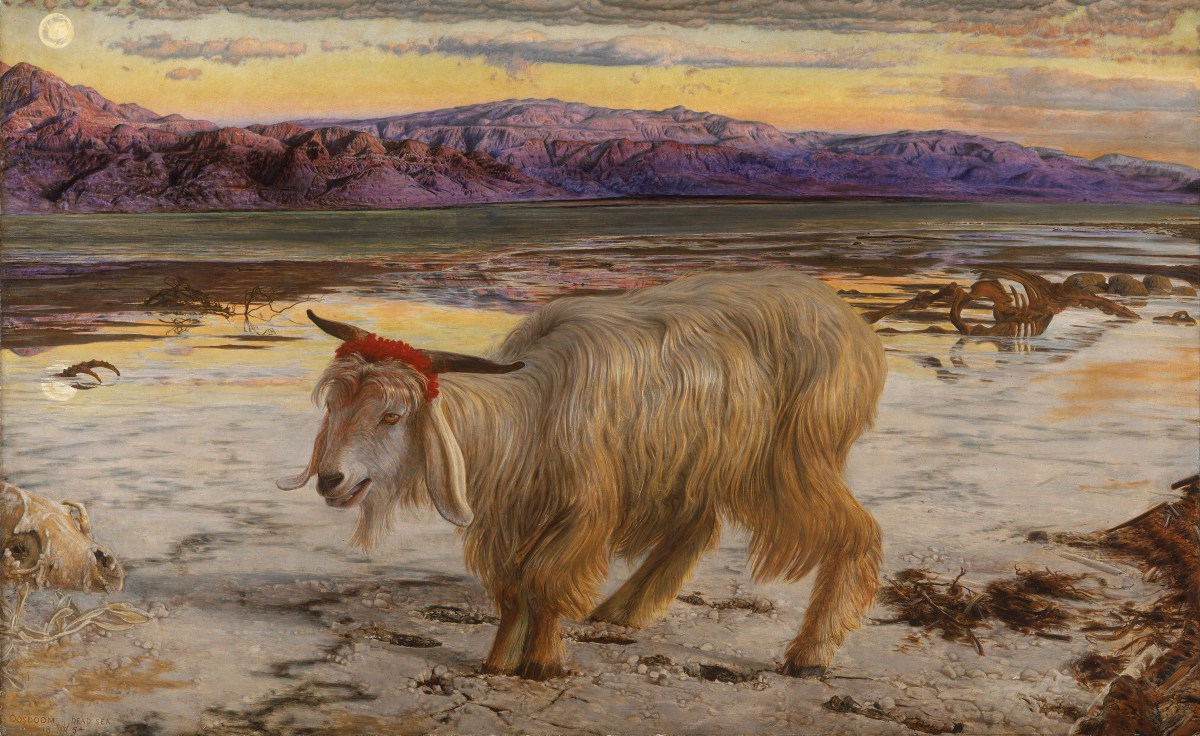
The High Priest was to perform certain rituals for himself and Israel on the Day of Atonement, but one fascinating is the scapegoat, one of two goats chosen by lots upon whom the High Priest would recite all the sins of Israel and then send it out into the wilderness. This is how many English translations render this term, but in Hebrew, it’s “Azazel” (Lev. 16:8–10), a name likely meaning something along the lines of “El is strong” or “the rage of El.” “El” is a name often used for God in the Hebrew Scriptures, but El was also the chief Canaanite deity. That’s not to say that the two are the same. They share a name; that’s all. The Canaanite El was associated with the epithet “bull” (cf. Num. 23:22; 24:8). It makes you wonder about that golden calf Aaron made to appease Israel (cf. Gen. 35:2; Josh 24:14–15; 2 Kings 23:24)! In Canaanite mythology, Baal is El’s son, for a point of reference. 

There’s uncertainty about whether Azazel is a goat, demon, place, or deity (of a neighboring mythology). One interpretation is that the scapegoat is sent into the wilderness because the desert is associated with the chaos before God gave order to creation. One goat is given to God, and the other to Azazel. In Hebrew, the phrasing is that the goat is given to Azazel. Aaron does this for himself and Israel (Lev. 16:21). This goat to be sent to Azazel is, first, presented to God, showing the latter’s superior status (Lev. 16:7). God receives the other goat as a sacrifice, whereas no sacrifice is given to Azazel. God resides in his tabernacle/temple, and Azazel is in the desert. The two aren’t on equal footing. 

I found it interesting how the Septuagint translates this corresponding term: “the one who eliminates” or “the one who wards off evil.” In Greek literature, the phrase hoi ampopompaioi typically denoted divine agents. In 1 Enoch, he is said to teach humans to make instruments of war, jewelry, and cosmetics, leading to war and fornication (8:1–2). The angel Raphael is said to have banished him to the desert, where the scapegoat goes (1 Enoch 10:4–8). In some versions of Enoch, the sins carried by the scapegoat are written upon him. Philo refers to Azazel as “the banished creature” and “the scapegoat” (Her. 179). 

Later, in the second century AD, in Midrash Avkir, Azazel is identified as Azael. Other texts say more about him. For example, the Apocolypse of Abraham says he is the devil (31:5). The Talmud refers to it as “Azazel—the land” (b. Yoma 67b). In the same passage, the goat is supposed to be pushed off a jagged, rocky cliff; Azazel is said by another rabbi to be connected to two wicked angels, Uzza and Azael, who were believed to have been a part of the story in Genesis 6:1–4. 

To complicate matters further, some early Christian amulets and jewelry depicted him as a figure who could protect them by having the power to avert evil. Who or what Azazel is remains unsolved. It is a versatile creature that takes on many forms at different times. This is one instance where a “clear reading of Scripture” isn’t always all that clear. We have relied on translators to do the best for us, but since the Septuagint, “scapegoat” seems to have been the preferred translation, thus overlooking a critical aspect in the context. 

Does Luke’s Research Nullify Inspiration?

The past few years have been ripe with disinformation, misinformation, alternative facts, etc. Facebook has become a catalyst for spreading such, with algorithms set to pop up what suits one’s fancy. We have no certainty about what is trustworthy anymore, but truth-seekers can sift through the material—identifying both the true and false. Using our preferred sources is easy because they validate our preconceptions, but we should use caution because they may blind us in the process.

When Luke wrote his good news account (see Luke 1:1–4), he wrote against the backdrop of other circulating versions. He carefully investigated the matter, knew eyewitnesses, and drafted an orderly arrangement to straighten the record. Since he indicates research, does that nullify inspiration given by the Holy Spirit? I don’t believe so. Since research was an element of this writing, who is anyone to say that the Holy Spirit didn’t tell Luke to consult with certain people or documents? After all, Luke emphasizes the work of the Holy Spirit (Luke 1:15, 35, 41, 67), and that could have included talking with certain people. Remember, God directed Saul of Tarsus to Ananias, who then told him the gospel when God could have told it to him (see Acts 9:6).

Luke followed things closely and used various sources, one of whom might have been Mary, the mother of Christ. The first two chapters contain information she would have known (Luke 2:19, 51). Peter (cf. Luke 6:14) and Mark might have also been a source for Luke, given the call for Mark—Peter’s companion—in 2 Timothy 4:11 and his presence in Colossians 4:10 and Philemon 24 with Luke.  As Paul’s travel companion, Luke would have undoubtedly received information from him. Paul quoted from Luke 10:7 in 1 Timothy 5:17–18 and referred to his gospel (Rom. 2:16; 16:25; 2 Tim. 2:8).

Luke noted that “many” had tried to write narratives (Luke 1:1), so he wrote in response to inadequate or false gospels. His own, however, was from “eyewitnesses and ministers of the word” (Luke 1:2)—neither of which he was as far as we know. The other accounts contributed to confusion rather than clarity. Luke wanted to give an orderly arrangement (Luke 1:3). His meaning of “orderly” differs from what we might initially think. He doesn’t give a chronological but a topical account. His arrangement differs from Matthew’s and Mark’s but contains some of the same material, though placed in a different order. 

Reading Judges

King David reigned in 1000 BC, and Moses flourished around 1450 BC. Archaeological evidence shows that the Promised Land was densely populated around 1300 BC, so between then and 1000 BC would have been the period of the Judges. The term translated as “judges” is shofet and would be more appropriately translated as “chieftain,” though “judge” isn’t always an inaccurate translation (Deut. 16:18). When we envision a judge, we think of someone wearing a black robe, sitting behind the bench, and ruling according to the law. These figures, however, rarely judge—Deborah being one exception to this. They are more like charismatic guerilla warfare leaders. Othniel (Judg. 3:9) and Ehud (Judg. 3:15) are referred to as “deliverers.” 

Many scholars believe the final edition of the book was compiled in the late eighth century BC, some years after the northern kingdom fell to the Assyrians and before the reforms of King Josiah (cf. Judg. 18:30). Until then, it would have been common oral history. One key to dating this work is that Judges 5 is an older style of Hebrew than the rest of the Hebrew Scriptures. It and Exodus 15 have stylistic patterns that resemble Ugaritic, a language from Northwestern Syria dated to 1200 BC. This is why the final compilation is believed to have been around the late eighth century BC. Yet, it’s fascinating that Judges 5 was preserved in its more ancient style. It’s like how you and I may recite the Lord’s Prayer in the King James language while having it in more modern English. 

This book tells about subsequent generations of Israelites after the death of Joshua, many of whom didn’t know Yahweh (Judg. 2:10). It follows a cycle: Israel does evil, God delivers them into the hands of oppressors, and after being oppressed, they cry out for God’s salvation, He appoints a judge, and they enjoy liberty (Judg. 2:11–19). Because this book is monarchical, it points out the shortcomings of no monarchy: everyone does what they deem is best (Judg. 17:6; 21:25). Yet, Yahweh is the ultimate “judge” (Judg. 11:27) because he raises these deliverers and gives them his Spirit to equip them for their tasks (Judg. 3:10; 6:34; 11:29; 14:6, 19; 15:14). 

However, as we progress through the book, we notice the waning effect of the judges. Initially, they are interested in delivering Israel from her oppressors and restoring fidelity to God and his law. By the time we get to Samson, he’s motivated by personal lusts and vendetta, and there doesn’t appear to be any national interest in his actions. As we near the end of the book, Israel is in civil war with the Benjamites due to their treatment of a Levite’s concubine. The degeneration of the judges eventually led us to the monarchy in 1 Samuel. 

Judges 1–2

Now that Joshua has died, who is the mediator between God and Israel? This is how the book begins—the Israelites ask God what their next move will be. The highlight of Judah is remarkable because when the book was compiled, the northern tribes were conquered by the Assyrians. Judah, the tribe of David, and the monarchs are depicted as successful, while the northern tribes’ failures are highlighted. Adoni-Bezek means “master of Bezek” and is a hereditary title rather than a proper noun. Chopping off his thumbs and big toes was likely a form of humiliation as well as incapacitation. He couldn’t wield a sword or move on the battlefield any longer. 

The Jebusites occupied Jerusalem before the Judahites took it from them. They would possess it until King David conquered them (2 Sam. 5:6–16). Beginning in Judges 1:12 is a story repeated in Joshua 15:13–19. You note that there are subtle explanations throughout the book that only an earlier audience would appreciate because the compiler points out the former name of a place to the readers. The Town of Palms, in other occurrences, is Jericho. 

Oh, Gaza! We’ve heard a lot about this place in recent months, and one question that seems to surface is whether or not modern Palestinians are descendants of Philistines. The Minoans from Crete appear to have established colonies on these coastal lands, and activity is observed as early as 2000 BC. With Alexander the Great’s conquest, any semblance of them as a nation disappeared. The Greeks referred to the land as Palestine, and anyone who lived there was considered Palestinian, and this included Jews too. The late PM of Israel, Golde Meir, regarded herself as a Palestinian. Now, however, there’s a distinction between Palestinian and Israeli. Yet, Palestinians are Arabs who settled there during Islamic conquests of the region. Today, some of them are Muslim, and some are Christian. Chapter two sets the stage for the book’s cycle and the Israelites’ infidelity, beginning with the next generation (Judg. 2:10).

Living in the Kingdom (Matt. 7:6-29)

People today treat their dogs better than humans. I have three dogs, two of which live outside and one inside. I love them but would never grill a steak or pork chop for them. If anything, they might get the leftovers. Jesus’ phrase “what is holy” could refer to meat because it necessitated a banquet whenever an animal was sacrificed. Eating what had been sacrificed to God was considered holy, and to give it to dogs was unthinkable. Also, no one would throw pearls to pigs because they don’t understand their value. Therefore, the gospel, represented as what’s holy and pearls, shouldn’t be wasted on those who scorn them. We want to share the good news, but some people don’t like it. Don’t waste it on them. If anything, pray for them to be receptive, but you can lead a horse to water. 

There are several ways to interpret the ask, seek, and knock passage. The first is relative to prayer, and the second to the kingdom of God as the church. When you look at Acts, the latter is understood in the context by some and see how all resources are pooled together so that no one is lacking. This interpretation focuses on verses 9–11 regarding basic needs and that God, through his church, provides for the saints. It’s not a flawed interpretation, but prayer is truer to the context given Matthew’s usage of “ask” concerning it(cf. Matt. 18:19; 21:22) and Jesus’ focus on prayer in the sermon (Matt. 5:44; 6:5–13). Compared to God, who is the absolute good (Matt. 19:17), parents, regardless of how loving they are of their children, are evil. If evil parents can give good gifts to their children, how much more will God? This doesn’t mean that every prayer we pray is answered “yes.” God gives us good things, and not everything we ask for is 1) a necessity (“bread” and “fish”) and 2) good. 

The golden rule was meant to guide the interpretation of the Law (7:12). It parallels similar statements from other civilizations. 

Watch yourself, my son, in everything you do, and discipline yourself in all your conduct. And what you hate, do not do to anyone. (Tobit 4:14–15; second century BC)

Let us show our generosity in the same manner that we would wish to have it bestowed on us. (Seneca, De Beneficiis 2.1.1; contemporary of Jesus)

What is hateful to you, do not do to your neighbor. That is the whole Torah. The rest is commentary. Go and learn! (Hillel, b. Sabb. 31a; 70 BC–AD 10)

Do not do unto others what you would not want others to do unto you. (Confucius, Analects 15.23)

Anything that might seem like we should treat another in a certain way must be turned on ourselves and asked whether or not we’d wish to be treated that way. 

Verses 13–14’s two ways have parallels in other passages (Deut. 30:15; Ps. 1:1–2). The false prophets of whom Jesus speaks (7:15–20) must be set in the backdrop of how he said we should regard our enemies. In the decades following Jesus, prophets arose, leading revolts against the occupying Romans. Theudas (AD 44–46) led a band of people massacred by a squadron, the head of Theudas being paraded through Jerusalem. During Felix’s reign (AD 52–60), an Egyptian led several thousand people to the Mount of Olives, where he promised to command the city walls to fall and subsequently be installed as Israel’s king. Hundreds were killed, and hundreds were imprisoned, the Egyptian man having escaped. They could tell who the false prophets were by their fruits—if contrary to what Jesus taught them (non-violence), they were known to be untrue. 

Once more, he emphasizes proper action over confession (7:21–23). The false prophets would be known by their fruits. His disciples were to let their light shine through their good works (5:16). He wanted their righteousness to exceed that of the Pharisees and scribes (5:20). At every turn, Jesus wanted his disciples to show, by their actions, fidelity to God. They’re not to make a show of it for others but to quietly serve God, trusting in him. Their house will stand if they heed his instructions (7:24–27). The response to Jesus’ teaching as having authority stems from his teaching coming directly from himself. Pharisees and rabbis would have cited the collective wisdom of the rabbis, the Law, or other Jewish writings. Jesus alludes to them but speaks with authority and settles the matter. He taught, unlike any other teacher who lived, not citing different sources. 

Judge Not! (Oh, really?)

Everyone and their mother knows this verse (Matt. 7:1), and they use it—often inappropriately. Yet, there’s more to this passage than telling people not to judge. For example, just a few verses later, Jesus warns against false teachers. To dub a person a false teacher, you have to be willing to judge what they teach and how they live (Matt. 7:15–20). When a teacher grades an assignment, they are making a judgment. To call one thing good and another thing terrible is ultimately making a judgment. How did Jesus mean this? First, the term translated as “judge” denotes a habit of sharp, unjust criticism. The Greek term is krinete, from which our English word, “critic,” comes. We’re not talking about judging in the sense that we may think of it, but criticism. Notice what follows: how we judge is how we will be considered (7:2). This critical person sees only the fault in others but none in themselves (7:3–5; cf. Rom. 14:4, 10, 13).

We’re to judge righteously (John 7:24). Unrighteous judgment is according to appearance. Righteous judgment, however, is with grace, mercy, and God’s will as the standard. There’s always what we see and reality. Sometimes the two are the same, but sometimes they’re not. When we look for the worst, that’s what we’ll find every time. This was what the Pharisees did—look to find fault. They are the ones who are judged harshly and not with righteousness. In matters of righteousness, we’re to judge our brethren and not outsiders (1 Cor. 5:12). Judgment here isn’t a condemnation but discernment. When a Christian doesn’t bear the fruits of the Spirit but works of the flesh, we must address the issue. When you read the thought uninterrupted, it flows into the next chapter, which denounces lawsuits among brethren. This matter is one of discipline (cf. Deut. 17:6–7; Matt. 18:15–20).

A few standards of judgment would be good to avoid. The first would be judging someone by the worst thing they’ve ever done. This can be difficult because Jeffrey Dahmer did some pretty horrible things. Yet, you may not know that before he died, he became our brother, obeying the gospel while in jail thanks to Oklahoma minister Curt Booth and Wisconsin minister Roy Ratcliff. F.B. Meyer once said that when we see a brother or sister in sin, there are two things we do not know. First, we do not know how hard he or she tried not to sin, and second, we do not see the power of the forces that assailed him or her. We also do not understand what we would have done in the same circumstances. It can be challenging for some to fathom that a person like Dahmer could now be in heaven after all he did, but we cannot negate how powerful Jesus’ death was in comparison. If it isn’t powerful enough to wash away those sins, then it isn’t capable of anything. 

Another standard of judgment is imposing modern morals on the past. Slavery is agreed to be abhorrent. Yet, it has existed since the dawn of time, or pretty close to it. It still exists, believe it or not. The latest Global Estimates of Modern Slavery from Walk Free estimates that 49.6 million people live in slavery, either through forced labor or marriage. A quarter of those are children. North Korea has the highest percentage of slaves, and Africa and the Middle East have countries with considerably high numbers of slaves. Slavery didn’t begin with the trans-Atlantic slave trade. Yet, you don’t see activists caring much for these slaves, only those of the past. However, had we lived in that time and had the means, would we have had slaves? Would we have been slaves? We must remember that an evolving interpretation of Scripture led to its abolition in England and the United States. 

Our time would be better spent attending to our own blind spots (Matt. 7:3–5). How can we be a light to the world when we occupy our time with the judgment of others as if it were a spiritual gift given by the Holy Spirit? For some of us, being judgmental comes easy. It’s an all-too-tempted way to operate. Yet, how we judge is the same way we shall be judged. If we are harsh, we will receive harsh judgment. If we are gracious, we can receive God’s grace in judgment.  

Treasures in Heaven (Matt. 6:19-34)

Who hasn’t worried? We all do it, and sometimes with good reason. Worrying is not a sin, as some might persuade us to believe. There is, however, a component of faith that is absent when we worry because we have forgotten the sovereignty of God over all things. Yet, before worrying, fasting and prayer are things you’ll note in the sermon that were observed in the church a lot (cf. Acts 10:30; 13:1–3; 14:23). Psychologists teach such methods as meditation, mindfulness, breathing, and so on. These are grounding techniques when, in a moment of anxiety, someone centers themselves to face whatever worries them. Sometimes, we live in a lane so long that it becomes home, but neuroplasticity suggests that our brain is equipped to rewire itself. Praying the Our Father reminds us that God is outside time and space and greater than us and our worries. Plus, when we pray for his will to be done on earth as in heaven, we must submit to his will, whatever it may be. When we place our worries in the context of prayer and fasting, we give ourselves to God and entrust him in the process. 

We have contrasted riches and necessities. The two are different. If we are fortunate enough to amass wealth, Jesus says, it should be in heaven, where it cannot be destroyed or diluted in value. We are acquisitive by nature. It’s easier to accumulate things than to give them. In high school, I returned home one day—the first to leave and return home—to find the door ajar. I knew I had closed it all the way, but I went in to discover the house ransacked and robbed. My great-grandfather’s 12 gauge shotgun was gone. He used it when he was young, so I prized that possession. That robbery taught me then and there that placing meaning in things is meaningless. The relationship we had and the love we shared were more valuable than the shotgun. It was sentimental, and that’s why the loss hurt so much. However, that taught me not to lay up treasures on earth because thieves break in and steal. 

No matter how much you have, it’s never enough (Eccl. 5:10; cf. 1 Tim. 6:10). No one can serve two masters. No one can serve God and mammon. That word is Aramaic; some translations render it “riches” or “wealth.” The root of the term means “trust” or “reliance.” We cannot trust or rely on stuff against God. This point is no better illustrated than in the parable of the rich fool (Luke 12:13–21). This man did what Jesus warns against here—he “stored” up treasures for himself. The very word Matthew uses as “lay up” (Matt. 6:19–20) appears at the end of this parable (Luke 12:21). Cyril of Alexander (ca. AD 412–444) described being rich toward God as having one’s “hand … open to the needs of the poor, comforting the sorrows of those in poverty according to his means and the utmost of his power. He gathers in storehouses that are above and lays up treasures in heaven” (Luke, Homily 89). Another example of trusting in riches is illustrated differently than the rich young ruler (Matt. 19:16–22).

The relationship of the eye to the soul has been a staple of philosophy for centuries. When I used to live in Central Kentucky, there was an Amish man people went to because he was an iridologist. He could look into your eyes and tell you if you’ve had your gallbladder removed or diagnose other issues you may have. In antiquity, people believed your eyes projected light, hence the eye/lamp connection. We now know that the eye’s receptors convert light into electrical signals that our brains interpret. We’ve heard phrases such as the all-seeing eye, the evil eye, and the stink eye. What is it that we will set our gaze upon? That determines whether it is good or bad. 

Saying not to worry is easier sometimes than actually doing it. If we fast, we won’t worry about food and drink. If we pray, we give our worries to God (cf. Phil. 4:6–7). Paul knew what it was to suffer from want, so he replaced his worry with contentedness (Phil. 4:12–13). In the community of Jesus, we share our bread and drink. We look out for one another to ensure everyone isn’t lacking (Matt. 25:34–45). Plus, when we look at nature, we see that everything is provided for nature, so why wouldn’t we have faith that God will provide for us? Unlike nature, we sow and reap but can learn a lot from it. So, strive for God’s kingdom, and all else falls into place. Years ago, a college student was preparing for a nursing degree, and she was a cheerleader and belonged to a sorority. She hadn’t been at church, so my wife and I met her for lunch, and I told her that if she prioritized God, her worries and pressures would be resolved. It’s human nature to sacrifice Bible study, worship, and fellowship to ensure things are handled. However, when we prioritize them, we are saying to God that he is more important, and we trust that all we have to face is something he will tend to.