The Seven Seals

I grew up a fan of wrestling, or “wraslin” as it’s pronounced in the South. When I think about the Four Horsemen, I envision Ric Flair, Arn Anderson, Ole Anderson, and Tully Blanchard. However, as popular as the image is of Four Horsemen, it has nothing to do with wrestling, but with the Apocalypse of John. Remember that in the hand of God was a scroll sealed with seven seals (Rev. 5:1). This scroll would have somewhat been reminiscent of the Torah scroll unraveled in the synagogue service, from which the Word of God was read and an explanation given. In heaven, this scroll contains the message of the future relevant to the Christians in Asia. In the ancient world, a scroll that was sealed often held the impression of the one who wrote the message. Depending on who that was determined who was capable of opening the document. Here, only one person is found worthy to open the scroll and loose its seals—the Lamb of God, Jesus Christ, our Savior (Rev. 5:2–5). Only He could approach the God of heaven, take the scroll from His hand, and loose the seals.

The Messages of the Seals 

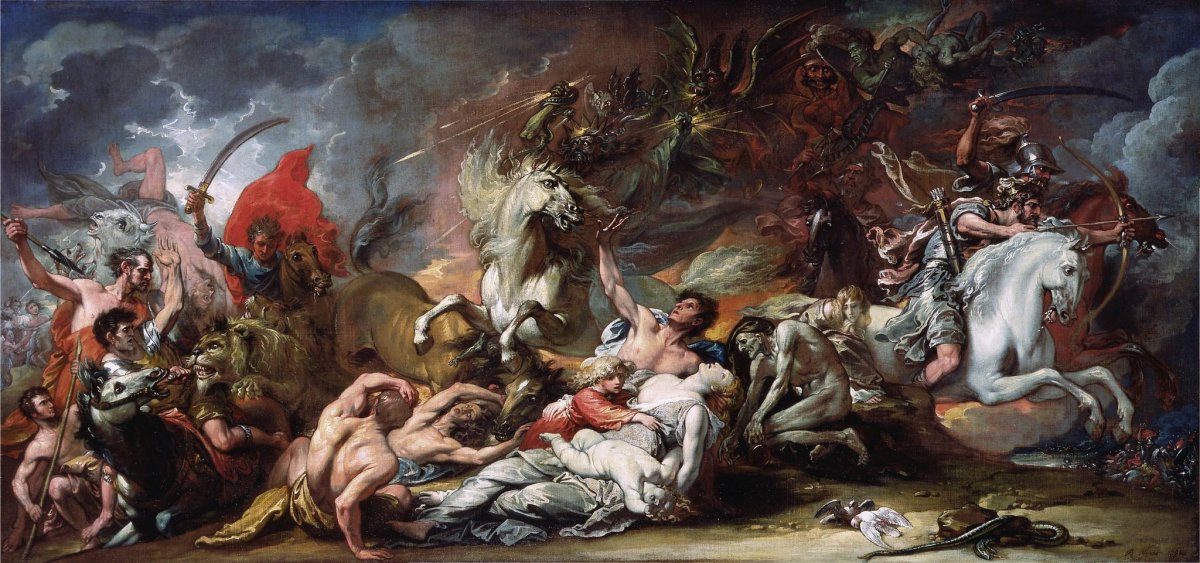
The vision of the four horsemen derives from Zechariah 1:8–11 and 6:1–8. In Zechariah, the horsemen are angelic creatures who report to the Lord regarding the state of affairs among the nations. Their coloring indicated the different countries to whom they were sent. In the Revelation, they are images of judgment posted throughout all the earth.[1] The first horseman represents warfare, and this as a judgment of God, we must remember (Rev. 6:2). The second, bloodshed since that’s what results from war (Rev. 6:4). The third horseman represents the economic fallout as a result of war and bloodshed—rationing due to famine (Rev. 6:5–6). The fourth horseman is pale or ashen. The Greek term here is chloros from which we get “chlorine.” This is a rather grim image because this is the color a person appears to be shortly after death. If you’ve ever been with someone who’s just passed away, their eyes turn this ashen, green sort of color. Because war, bloodshed, and famine are kissing cousins, and because those who are slain or die due to war and bloodshed may be left exposed, disease and plague may follow (Rev. 6:7–8). This black horseman has given us the common expression, “Black Death” to mean the bubonic plague.[2]

Next, sadly, we see that even some saints were not immune. The altar of heaven has beneath it the souls of the martyrs (cf. Lev. 17:11). They are at this place because they sacrificed themselves for the sake of the confession of faith in Jesus as Lord, and this is also where priests poured the blood of sacrifices (Lev. 4:7, 18, 25, 34). This would have entailed those who died for the faith up until this point in time—Stephen (Acts 7:57–60), those who died at the hands of Paul before he was a Christian, James the brother of Christ (Acts 12:2), and Antipas (Rev. 2:13) among others. Their cry to God wasn’t new, but a lamentation from the psalms where the psalmist pleads with God as to how long they must endure (Ps. 13:1; 79:5). The martyrs wanted the vengeance of God on those who’d put them to death. This isn’t an unholy request. We Christians sometimes cry so much for forgiveness, which is right to do, that we forget that justice has its place too. There’s nothing at all wrong for invoking the Lord’s vengeance upon those who’ve done such horrible acts. In the absence of immediate retribution, the martyrs are given a white robe to rest, because more would, sadly, join them. The white robes given to them are garments of having overcome (Rev. 3:5), and they’re the same garments in which the twenty-four elders are clothed (Rev. 4:4).

The fifth seal’s anticipatory measure, as well as the sixth seal, may entail eschatological material. There seems to be a decreation before the great day of the wrath of the Lamb. However, is it for the vindication of what they then faced, or what all Christians would share in until the end? I confess to not knowing the answer because the Bible often uses such language to denote the punishment of God at the end of an era. However, I tend to view this more as an end-times language than I don’t, but history records several such issues even in the first century:

These afflictions were visited on the world that John knew. In AD 62 the Roman legions were defeated by the Parthians to the east, and there were shortages of food, such as those recorded in Acts … and Seutonius. In addition, there were earthquakes, such as those in Asia Minor itself in AD 60, volcanic eruptions, such as Vesuvius, civil war in Rome following the suicide of Nero in 68, and the war in Judea that culminated in the destruction of Jerusalem in AD 70.[3]

Early commentators were evenly divided on the interpretation of parts of the book. For we who are so many centuries removed from then, in comparison to early church leaders, can’t expect to grasp what even they struggled with understanding.

The 144,000 

According to Jewish thought, four winds stood at each corner of the compass. These winds could destroy a nation (Jer. 49:36) or bring new life (Ezek. 37:9). Zechariah portrays these winds as chariots pulled by different teams of horses, which leave the Lord’s presence and go out into all the earth (Zech. 6:5–7). Jesus taught that at His coming during the destruction of Jerusalem that the angels would gather the elect from the four winds (Matt. 24:31).

Ezekiel 9 sets the backdrop for the sealing of God’s faithful. This imagery of seven executioners is present in Babylonian literature as well. There they punish those having committed religious offenses as is the case here (Ezek. 9:4). The imagery of Ezekiel’s seven would have reminded the audience steeped in idolatry about impending punishment that comes from Yahweh. The mark of their forehead in Hebrew was the taw. This was the last character of the paleo-Hebrew alphabet, and it looked like a modern “X” or cross.

Moreover, the Greek letter “chi” was equivalent to taw and was the first letter in Christ’s name in Greek. The church father Origen (185–254 CE) wrote, “A third [person] one of those who believe in Christ, said the form of the Taw in the old [Hebrew] script resembles the cross, and it predicts the mark which is to be placed on the foreheads of Christians.” In Revelation, the seal separates God’s faithful from the faithless.

Pseudepigraphical writing called the Psalms of Solomon was composed in the first century BCE (it details Pompey’s capture of Jerusalem in 63 BCE), and it gives a little insight as well on the marking of God’s people: “For the mark of God is upon the righteous for salvation. Famine and sword and death shall be far from the righteous, for they shall pursue sinners and overtake them, and those who do lawlessness shall not escape the judgment of the Lord” (15:6–8). Sometimes branding in antiquity was also a sign of a slave (3 Macc. 2:29). In Christianity, sealing became symbolic. The Holy Spirit sealed the Asian churches (Eph. 1:13; 4:30). This wasn’t a physical mark, as some might think. It was a mark distinguishable only by God and His agents of wrath (cf. 2 Cor. 1:22), and it distinguished the faithful from the wicked (cf. 2 Tim. 2:19). This seal in Revelation is to protect God’s faithful, as in Ezekiel (Rev. 7:3).

This list in Revelation of the 12 tribes differs from other records (see Gen. 35:23–26; 49:3–27; Deut. 33:6–25): Reuben usually heads the list, but Judah does here likely because this is the tribe from whence Jesus, the lion of the tribe of Judah, came (Rev. 1:5; 5:5). John included Manasseh while omitting Ephraim and Dan (see 1 Kings 12:29–30). Since this group is spared divine wrath, but not human persecution, it may be that they are among those who complete the number of the slain souls under the altar (Rev. 6:9–11). These twelve tribes are used figuratively of Jewish Christians (James 1:1). Jewish Christians were predominant over the first decade of the early church. Staying with the Jewish identity, their being “firstfruits” (Rev. 14:4) was also well-founded as spoken of by the Jews (Jer. 2:3; Rom. 11:16; James 1:18). If this is talking about Jewish believers, the great multitude in Revelation 7:9ff were Gentile believers. This could also be a reference to the church—God’s new Israel (Gal. 6:16; cf. Gal. 3:7–9, 29). Whomever they were, they sang a new song described as the roar of rushing waters, a loud peal of thunder, and harpists playing their harp. No heavenly creature could learn this song because participation is limited to those redeemed from the earth (cf. 1 Peter 1:12; Eph. 3:10), which centered on redemption by the Lamb from the beast. They were “virgins” (cf. 2 Cor. 11:2) who were blameless (Rev. 14:4). This may mean that they maintained ritual purity before battle (Deut. 23:9–10; 1 Sam. 21:5; 2 Sam. 11:11). Later on, Babylon (Rome) is referred to as the mother of harlots (Rev. 17:3–5), and those who consort with her would have defiled themselves (cf. Rev. 2:22).

The final seal serves as a prelude to the seven trumpets which are to follow. One round of judgment has been explained, and those in first-century Asia would have understood these matters far better than we could have. Here, however, is the comfort for those Christians: God judges those who do evil. In a court of law here on earth, humans attempt to execute justice as best as fallible beings can. Lawyers build cases, and it is prosecuted and defended before a group of peers who determine what the best evidence is. They hand in their verdict based on the available information, and a judge passes sentencing if guilty, or releases the accused if innocent. In the courtroom of heaven, no case has to be made, and the only defense anyone can ever have is the blood of the Lamb. Jesus Christ defends those bought with His blood, but those who are not faithful to Christ will be prosecuted according to divine law for their deeds. There is no escaping. There is no putting off what will pass.


[1] Farley, Apocalypse, 82.

[2] Reardon, Revelation, 55.

[3] Ibid., 55–56.

On Earth as in Heaven

“Pay no attention to that man behind the curtain,” so said the mighty Wizard of Oz. Dorothy and her companions stood before the scary scene of peels of thunder, lightning, and an impressive visage when they believed that they were before the Wizard of Oz. Once Toto pulled the curtain back, they saw the reality for what it was. The Christians suffering and about to suffer in Asia saw the spectacle of terror before their eyes, but John the Divine was given a chance to see reality for what it was by peering into heaven. He did so by going through the open door into heaven (Rev. 4:1). Earthly events have their origin in heaven, so if we’re to understand real insight into the history, we have to see the matter from a heavenly vantage point. Scripture is replete with examples of this. Jacob’s impending reunion with his brother was something not untouched by heaven (Gen. 28:17). When Ezekiel sat in exile among an encampment of his fellow Israelites, the vision he saw lent itself to the reality he experienced (Ezek. 1:1). The baptism of our Lord was overseen by heaven (Mark 1:10), and upon his martyrdom, Stephen revealed to the crowd that would put him to death what was occurring in heaven at that very moment (Acts 7:56). Understanding the demands of our current situation entails understanding it from a heavenly perspective, and this was what John would see and inform those in Asia regarding.

What we’re going to notice from Revelation 4–5 only makes sense if we’re acquainted with Isaiah 6 and Ezekiel 1, 10. Isaiah saw the God of Israel in his magnificent glory, as well as the angels that attended Him. The seraphim were either fiery or serpent-like creatures. The term seraph is indicative of burning and serpents (Num. 21:6–9), respectively. They are depicted as above the throne of God, while in Ezekiel, cherubim have a single pair of wings and are associated with the throne of God (Ezek. 1). A thorough reading of these two prophets and all that they saw in heaven helps make better sense of what one will read in Revelation 4–5. John participates in the prophetic history of seeing the throne-room of God, just like Isaiah, Ezekiel, Zechariah, and others before his time. What takes place in heaven directly affects the events on earth, but, also, what occurs in heaven is the model for what should happen on earth in some part.

Derivative Worship 

Not but a couple of decades earlier, a Jewish Christian wrote a letter to the Hebrew believers wherein he noted the superiority of Jesus above all that the Jews held dear—angels, Moses, the law, etc. Among the many considerations of the letter to the Hebrews is what appears when the author informed his audience that Christ was High Priest of God’s people, taking His own blood to offer for the sins of the world (Heb. 9:11–15). He goes, not into the copy and shadow of what is to come, but into heaven itself—the true tabernacle, after which the one on earth and temple were patterned (Heb. 8:1–2; 9:24). Consider this: from Hebrews 8–10, the author compares what Christ does with what the priests did at the temple. Christ was in the heavens, and the temple and tabernacle were patterned after what occurs in heaven. Therefore, earthly worship is a heavenly activity. If we are to truly worship in a manner pleasing to God, our worship must be patterned after what occurs in heaven. In Revelation 4–5, we see just what takes place.

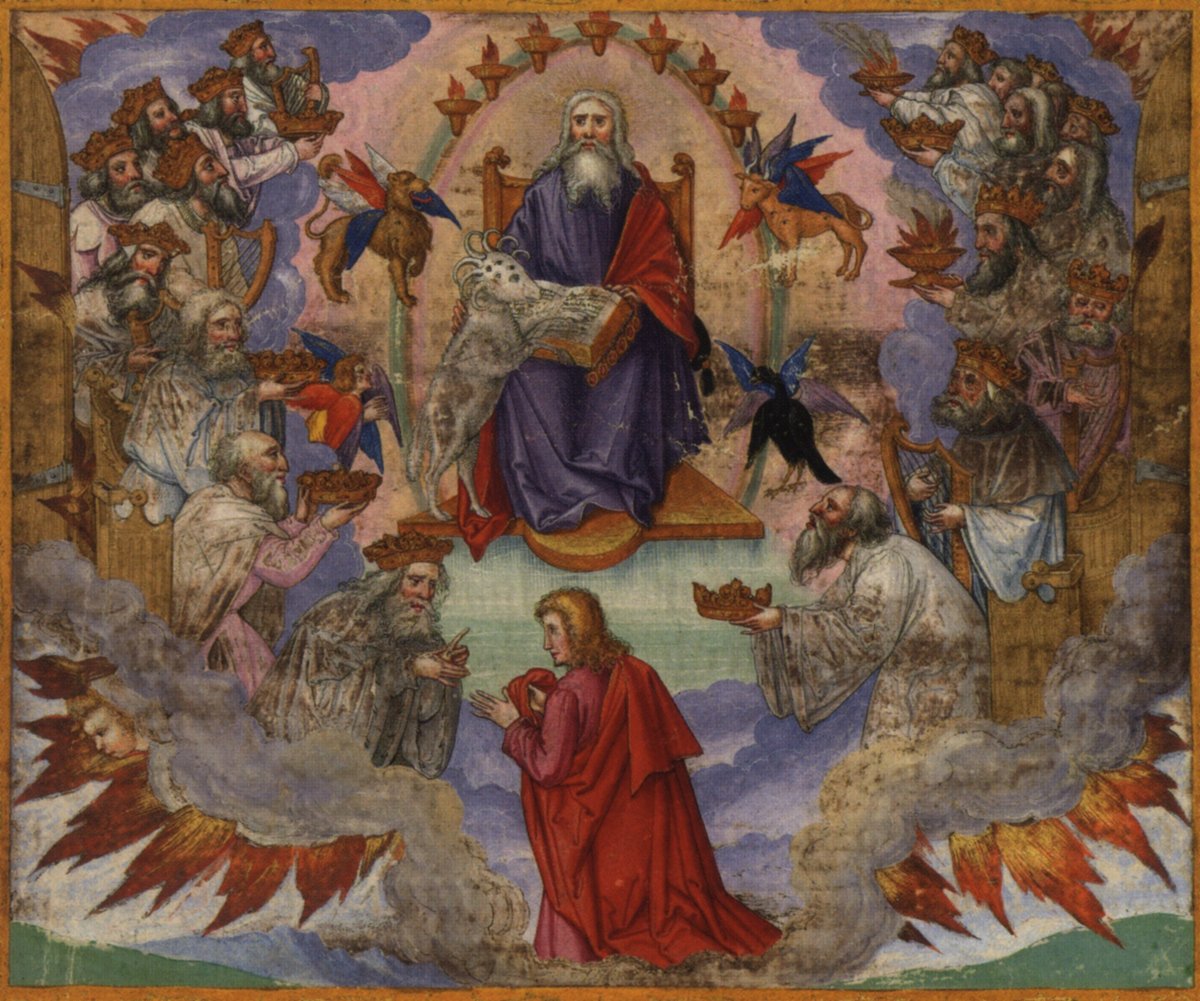
What’s most important to note, from the start, is that these things happen before the presence of God. John, first, sees a throne and the one who sat upon it (Rev. 4:2–3). He’s surrounded by a rainbow—the sign of God’s covenant with humanity to never flood the earth again (Gen. 9:12–17). Next, there are twenty-four thrones which are believed to represent the twelve tribes of Israel and twelve apostles of the New Testament, or both covenants. Seated and crowned upon them are twenty-four elders who fall before God in worship (Rev. 5:14; 11:16; 19:4). Not only do they fall before God, but they do so while simultaneously praising Him (Rev. 4:11; 5:9–10; 11:17–18; 19:4).

Next, we have the angels who unceasingly praise and pray to God (Rev. 4:6–8). They would appear to be a hybrid of cherubim and seraphim from the description and what we know from Isaiah and Ezekiel. Nevertheless, their hymn is tightly worded to what we see the seraphim sang in Isaiah 6:3. This particular doxology was a staple in synagogue praise in the first century,[1] and it even became a part of early Christian worship, as seen here and in 1 Clement 34.6. It has been a part of hymnody since Isaiah’s time, in the eighth century BCE all the way through today, making it the most ancient of hymns. The elders, in turn, prostrate themselves before the Lord, casting their crowns before Him in recognition of their honor and glory deriving from Him alone.

When looking at this scene, we note a few truths about Christian worship. It is before God and according to the covenant under which we willingly entered. When we worship the Lord, we join the procession of divine worship already ongoing, something that occurs night and day and is unceasing. It’s our opportunity to return to God and attribute to Him whatever we may think are worth is and blessings are, because what we all are we have because of who He is and how richly He’s bestowed it on us. Thus far, worship has been binary, including the Father and Spirit, respectively (Rev. 4:2–5).

Next, however, we see the Son, the Lamb slain for the sins of the world. He’s standing because that’s what priests did when they ministered to the Lord (cf. Acts 7:55–56; Heb. 10:11). The scroll in the hand of the Father has to do with events happening on earth, and the Lamb of God will be the only one worthy to break the seals, which will be discussed in the next lesson. Nevertheless, His appearance is as a slain lamb, but the elders told John that He’d prevailed (enikesen). The taking of the scroll to Jewish Christians was reminiscent of the manuscript of God’s word being taken, opened, read, and then explained as in the synagogue services. Because He who sits on the throne has a scroll to be opened and read, we have to understand that early Christians believed, as we should today, that the Word of God is a symbol of what Christ has accomplished.[2] Upon taking the scroll, the angels and elders do to Him what they had done to He who sits on the throne. He, too, receives praise and prayer (Rev. 5:8–10).[3] Next, we see heaven and earth united in the worship of God and the Lamb (Rev. 5:13). When we worship in song and prayer, we join with heaven in worship. What we sing here, they sing there.

As we progress, it will be incumbent upon the reader to note that as the drama unfolds, this occurs in heaven, on the Lord’s Day, in the worship of God and the Lamb. The stage has thus far been set, but one may ask how this might have brought any comfort to the suffering Christians in Asia. First, their God and His kingdom haven’t been thwarted. Because it isn’t of this world doesn’t mean that it has nothing to do with this world. God reigns upon His throne in majesty, and the Lamb who died holds history in His hands, even as it unfolds. Second, the most comfort that can be found will be in worship. When we correctly understand worship, we’ll come to find that in worship, we are with God the Father, Son, and Spirit. The angels are singing and rejoicing. In a tumultuous world with its troubles, we can find consistency and solace in the worship of our Lord and Savior. When correctly done, our focus can turn to God on the throne, and the Lamb who’s prevailed. He reigns, and as He has overcome, we can fix our hope on Him in the darkest of times, because He isn’t surprised by what surprises us. He isn’t overwhelmed by what causes us anxiety. He has a plan that’s working to the good of us who love Him and are called by His name.


[1] Craig S. Keener. Revelation: The NIV Application Commentary (Grand Rapids: Zondervan, 2000), 175.

[2] Patrick Henry Reardon, Revelation: A Liturgical Prophecy (Yonkers: St. Vladimir’s Seminary Press, 2018), 51.

[3] In churches of Christ, who are known for acapella praise, a matter of the mention of harps here often arises as contention for including instruments in earthly worship. The reason we refrain from using instruments is simply that the early church didn’t use them. This isn’t to negate harps in heaven, but to acknowledge what occurred on earth in the first century. Harps are mentioned here in Rev 5:8 as well as 14:2 and 15:2, but as much as the golden bowls of incense are explained as the prayers of the saints in Rev 5:8 (cf. 8:3–5), so we may assume that the harps represent the praise of the saints as well (Farley, Apocalypse, 76).

Is Revelation About the End-Times As Much As We Think It Is?

In addition to being a minister, I’m also a Sheriff’s Deputy, albeit reserve. I receive no remuneration, and I haven’t gone through the academy. I qualify annually with my firearm to carry it on duty. I have a badge, and for all intents and purposes, I have the same powers as full-time deputies with a few exceptions: those being warrantless arrests in domestic violence scenarios and DUI’s, since the latter requires specialized training. Nevertheless, our Sheriff is cautious that we Reserve Deputies are always with a road unit, and in special details, we often are in the background as secondary support. I’ve worked at the judicial building for security, schools as a resource officer, and have ridden along with road units. When I’ve ridden along, there have been a few times that I’ve been with a deputy, and we’ve been in what’s to me a sticky situation. In one particular detail, we were working an area where a party was ongoing. As the party dispersed into the wee hours of the morning, gunshots rang out. I’ve heard gunfire many times, but this time was different. We were facing a possible stand-off. My adrenaline rushed, and honestly, I became a little anxious because I’d never been in that situation before. I won’t lie, I was worried. What gave me comfort, however, was that I was with an experienced deputy who’s also a man of faith and what we might call a hard-charger. He’s a good man dedicated to justice and peace, and if I was ever in a dangerous situation, he’s the guy I’d want nearby. That was comforting.  

Anytime we as Christians enter uncharted, disastrous waters, we can rest assured that we’ve not been abandoned by the Lord. We can face hardship, and sometimes our difficulties may lead us to feel this way. The Christians in Asia undoubtedly must have felt this way. Some were in prison (Rev. 2:10), and one particular saint, Antipas, had already been put to death (Rev. 2:13). History has it that Antipas was a bishop in Pergamum. Remember when I said that the persecution usually began with the leaders of Christianity? This is one such case in point. The sad tradition of his death is that he was roasted to death inside a brazen bull in 92 CE, during Domitian’s reign. This traumatic event would have led many of the Christians to believe they were next since one of their leaders had been put to death for the faith. Jesus told the Philadelphians that they were going to be kept from the trial that was coming upon the world (Rev. 3:10), the beheaded souls cried for vengeance (Rev. 6:9–10), and the harlot was drunk with the blood of the saints and martyrs (Rev. 18:24; 19:2). Things were terrible indeed. Comfort was needed, and John would see what the saints needed most to hear.   

A Heavenly Perspective  

Paul wrote to the Ephesians, “For we do not wrestle against flesh and blood, but against the principalities, against powers, against the rulers of the darkness of this age, against spiritual hosts of wickedness in the heavenly places” (Eph. 6:12). However, it’s hard to keep this in mind when the battles we seem to face are waged in the flesh. If we as Christians turn our thoughts heavenward, as we should, we will be less fearful and more faithful. First, we note that God is sovereign over time and history. Therefore, anything that occurs on earth at any time does so under the enthroned Lord whose rule supersedes even the kings of the earth, the very officials who afflict you. We reign with Him in His kingdom, and we minister to Him in His kingdom (Rev. 1:4–6). Now, as we cull through Revelation, this won’t be a verse-by-verse, exposition, so while some of the symbols can be explained, my goal isn’t to explain each and every symbol, but to capture the overall message which is one of comfort and hope amid trial.  

Second, what John sees after being instructed to write the book is genuinely marvelous. Jesus is standing, dressed as high priest, alongside a menorah (Rev. 1:12–13). He’s with and among His people in their suffering, and He’s both powerful enough to hold the constellation in the same hand that is gentle enough to comfort a frightened John (Rev. 1:16–17). This Lord lived, died, and is alive to never die again. His resurrection was death’s deathblow, and His ascension and enthronement give Him power over even Hades and Death itself (Rev. 1:18). The horrific things happening right now that are to happen are not so great that Christ the King is defeated. He has already won the victory, and He’s with and among not only His bride but the messengers of each of them (Rev. 1:20).   

It Won’t Be Long 

One thing we all wonder is how long the horror will last. There are always so many questions that arise during struggles and hard times. No one but God Himself knows the answer. All we can do is look at what God told the Christians in Asia. He said to them that “the time is near” (Rev. 1:3; 22:10), these things “must shortly take place” (Rev. 1:1; 22:6), and that He was “coming quickly” (Rev. 22:7, 12, 20). This doesn’t sound like something that’s to occur over two-thousand years beyond the time John gave this Revelation. Daniel was told to seal up his vision because it referred to many days from his time (Dan. 8:26): “Therefore seal up the vision, for it refers to many days in the future.” He was also told that the book was to remain sealed “until the time of the end” (Dan. 12:4). As time went on, knowledge would increase as to the culmination of these prophecies. He was urged to go his way because the words of his prophecy were “sealed till the time of the end” (Dan. 12:9). Studying history, along with Daniel’s prophecy, reveals that it was not for another four hundred years that those kingdoms came, which he had been told of (cf. Dan. 2). Therefore, Daniel would not live to see the fulfillment of the prophecies, hence his being instructed to seal the book. So the sealing of a book of prophecy looked ahead to a distant period. When John wrote Revelation, the angel told him to not seal the words of his book (Rev. 22:10). Why? Because “the time [was] at hand.” If Daniel’s prophecy saw fulfillment some four hundred years later, and he was told to seal the book, would not John’s prophecy have been fulfilled long before the same period since he was told to not seal his book? 

A concern arises: “But Christ said He was coming quickly.” Does this mean that Jesus lied? No, because God cannot lie (Titus 1:2; Heb. 6:18). What it means is that we’ve misunderstood what Jesus was saying. We’ve always taken this phrase and applied it to His second coming, but Christ didn’t always use it this way. He used it concerning the destruction of the Temple, which occurred in 70 CE (Mark 13:26; Matt. 24:30; Luke 21:27). This particular phrase was borrowed from Daniel 7:13–14, and it didn’t envision the Son of Man coming to the earth, but ascending to the Ancient of Days, God Himself. Throughout the gospels, Jesus is poised against the Temple establishment of the time and often contends with the Temple priests and ways. His foretelling of the destruction of the Temple would be His vindication, proof that He was Lord and Christ and seated at the right hand of Majesty. It wouldn’t be that one would peer out their window and see the Lord descending, but that the destruction of the Temple would be proof of His kingship. Similarly, the soon coming of Christ in Revelation would be His vindication and that of His kingdom, the church.  

Put it this way, just a chapter earlier in Daniel, the prophet was in the lion’s den. He was clearly among beasts for devouring. The next morning when the king came to see if he’d survived, he noted that the lions had not harmed him at all. The king ordered Daniel to be lifted from the lion pit, and once he ascended from the lion’s pit, he was given the status of ruler of the kingdom. Similarly, Christ would ascend to heaven at the right hand of Majesty, and those who doubted who He was would find out that He had in truth been exalted once the Temple was destroyed. That was His vindication. In Revelation, He uses this same turn of phrase from the gospels which derived from Daniel, and it isn’t speaking about His literal second coming, but His vindication among those who persecute His church. This is the language that especially Jewish Christians would understand, and they would know that it derived from Daniel and pointed to an exaltation, not the actual second coming.  To answer the question: Revelation is somewhat about the end times, but not as much as it’s often made out to be. 

When John Received the Revelation

Years ago, in my first ministry, I was mid-stride of my sermon on a Sunday evening when I noticed that one of my elders, an elderly man, was head-back, mouth-opened, and, to me, looked dead. “What do I do? What if he’s dead? What if he isn’t dead? All these questions ran through my mind as my cadence slowed. What made matters worse, he couldn’t hear thunderclap if it were right on top of him. What was I to do? As I continued preaching, I happened upon a point in my sermon that I could build. Nay, I could crescendo! For those unaware, a crescendo is when in music, the score may start soft, or piano, and build and build. My voice built and built as with passion, I preached the Word! Nothing. “Oh no, he’s died in worship!” I thought. What could be worse? Do I stop preaching and point this out? His wife was right beside him but so fixed on what I was saying she didn’t even notice. “I know: I’ll pound on the pulpit!” As I’d reached the heights of my vocal projection, I worked in a timely “pound!” on the pulpit like a gospel preacher of old. Slowly, he revived. “He’s not dead! Thank you, God!!!”  

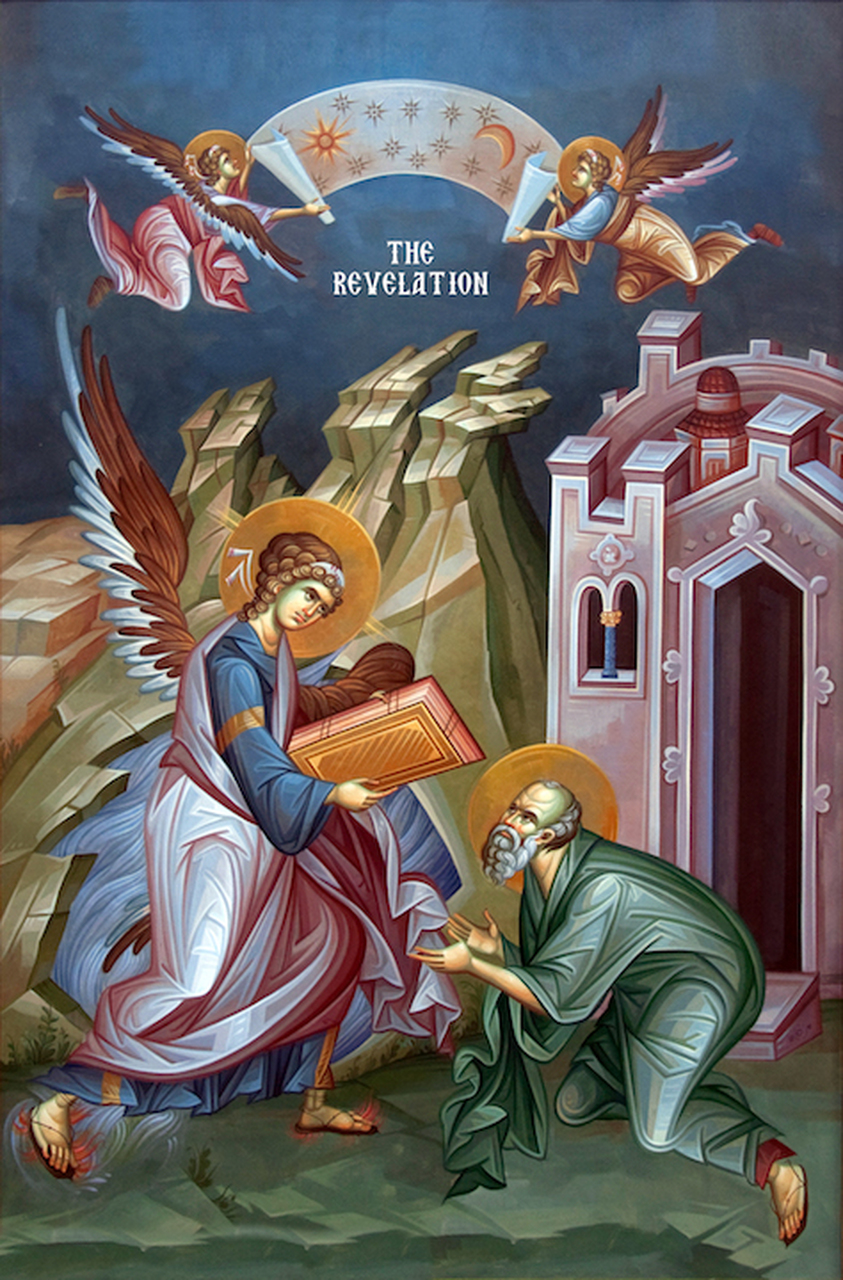
You could ask any preacher about the things they’ve seen from the pulpit, and you’ll hear some exciting stories. Some would be funny, others just sad. Imagine, however, you’re on an island in worship one Sunday, and God gives you a revelation. This is what happened to John the Divine, as he’s later called in church history. Tradition has it that John worshipped in a cave which is today referred to as The Cave of the Apocalypse, a popular pilgrimage site for those who would visit Greece. When he received his vision, John is reported to have dictated it to Prochorus, his disciple, and one of the first seven deacons from Acts 6:5What was John doing when he received this Revelation? Was he alone or with other Christians? These are all questions that interest us, and some to which we have nothing but to speculate, so we’ll stick with what we know.    

Setting the Scene  

We know that John was on the island of Patmos when he received the Revelation (1:9). How he came to be there isn’t altogether clear, but the most plausible explanation has been that he was sent to the island due to his evangelistic endeavors, which were perceived as a threat to the Roman Empire. One might wonder how the good news of Jesus might appear to threaten the mighty Roman Empire, but such a query is quickly answered by the fact that preaching Christ as Lord as much pitted Him against Caesar (Acts 17:7). The conversion of citizens amounted to an uprising, so the leaders of Christians, among whom was John, were targeted with the hopes that the movement would be quelled.  

We know that political opponents, or those out of favor with Caesar, were often exiled (Tacitus, Ann. 14.50; 15.71), and many have offered that Patmos was one such island to which they were sent, the Apostle John himself being one.1 That it was the apostle and not some other John that wrote the work is attested to as early as 166 CE by Justin Martyr (Trypho 81.15).2 Irenaeus, in 202 CE, offered that John received his revelation “towards the end of Domitian’s reign”3which was from 81–96 CE. If this is, in fact, accurate as many scholars suggest it is, we have a general time frame in which to set the writing, which may explain much of the material contained therein.4 Domitian was hostile to not only Christians, history records, but to even several senatorial families—murdering and exiling a number of them. This eventually led to his assassination and a formal condemnation from the senate, but, first, let’s back up a little farther 

The first formal Emperor of Rome, Augustus, undertook many religious reforms that resulted in an exaltation of the emperor cult. All first-century emperors favored it too, and Caligula, Nero, and Domitian provoked marks of adoration. Domitian insisted on having the title Dominus et Deus (“Lord and God”). Such worship proved one’s loyalty to the emperor as well as the wellbeing of Rome herself, and where of all places was the most robust center of the imperial cult but in Asia—the very place where John addressed the Revelation. In the ancient world, Asia had been the epicenter of emperor worship since Augustus, and these issues are likely what prompted the persecution and Revelation of John to surface.5  

We know where John was—in exile on Patmos—and we now turn to what he was doing when the Revelation came: he was ministering to the Lord, likely through prayer (Rev. 1:10; cf. Acts 13:1–3). Why do we surmise that he was ministering to the Lord? Because he notes that it occurred on the Lord’s Day or Sunday as we’d call it.6 On any given Sunday, Christians assembled to worship God. Since John was in exile, he might have only been with a small group, so the formal assembly, as we regard it, was somewhat absent. John, nevertheless, was still capable of worshiping God and while exiled and in worship, he likely was facing East as was the custom of the Jews and early Christians, and he “came to be in the Spirit” (cf. Acts 10:10; 22:17). John uses this phrase four times altogether in the Revelation: here in 1:10, when he’s taken to see the heavenly throne in 4:2, the prostitute Babylon in 17:3, and the New Jerusalem in 21:10. These visions follow the motif of Ezekiel, who also in exile received visions (Ezek. 11:24; 37:1).  

 What John Gave Us  

The next question is what John gave us: a blueprint of the end times as some believed? Or a message to those in the first century that they clearly would have understood? I certainly favor the latter. John told us at the very beginning what he was giving us: a book of prophecy (Rev. 1:3; cf. 22:7, 10, 18–19). In the first century, we know that prophets were in the church because they are listed second behind only the apostles who were heads of the church on earth in the Lord’s place (cf. 1 Cor. 12:28; Eph. 4:11). John makes reference to the prophets several times in this letter (Rev. 10:7; 16:6; 18:20, 24; 22:6, 9). Since John gave a book of prophecy, though confusing it may be at times, we must treat it as we would any other book of prophecy: historically and literarily.  

On the Western Front during the Great War, the allies were struggling against the Germans. Germany had tapped the allies’ phone lines and was able to break their codes. As American forces are working on a solution, a captain heard two of his soldiers speaking in a strange language. These two soldiers were Choctaw, and they were speaking their mother language. When the captain confronted them, they probably thought they were in trouble because, at the time, such was actually forbidden. They could have been sent to a reeducation program to rid them of using that mother language, but the captain figured that if he couldn’t understand them, then the Germans wouldn’t be able to either. As it turned out, the Germans couldn’t break the code. The war ended not too long after using the Choctaw Code Talkers, and in WWII, the Navajo Code Talkers would take center stage.  

Similar to how the Germans couldn’t break the Choctaw code, understanding Revelation is somewhat of a mystery. Because the visions are so mesmerizing and overwhelming shouldn’t mean that we should make the book say something it doesn’t. John inasmuch told us that these things were “signified” (Rev. 1:1). I know folks hold sincerely held beliefs about this speaking about the end times and the signs of the times, but here’s a reality we must face: we cannot use this book to determine when Jesus will come, because no one knows (Acts 1:7; 1 Thess. 5:2; 2 Peter 3:10). What we know with certainty is that Jesus will come, and when He does, we best be ready.