Does Luke’s Research Nullify Inspiration?

The past few years have been ripe with disinformation, misinformation, alternative facts, etc. Facebook has become a catalyst for spreading such, with algorithms set to pop up what suits one’s fancy. We have no certainty about what is trustworthy anymore, but truth-seekers can sift through the material—identifying both the true and false. Using our preferred sources is easy because they validate our preconceptions, but we should use caution because they may blind us in the process.

When Luke wrote his good news account (see Luke 1:1–4), he wrote against the backdrop of other circulating versions. He carefully investigated the matter, knew eyewitnesses, and drafted an orderly arrangement to straighten the record. Since he indicates research, does that nullify inspiration given by the Holy Spirit? I don’t believe so. Since research was an element of this writing, who is anyone to say that the Holy Spirit didn’t tell Luke to consult with certain people or documents? After all, Luke emphasizes the work of the Holy Spirit (Luke 1:15, 35, 41, 67), and that could have included talking with certain people. Remember, God directed Saul of Tarsus to Ananias, who then told him the gospel when God could have told it to him (see Acts 9:6).

Luke followed things closely and used various sources, one of whom might have been Mary, the mother of Christ. The first two chapters contain information she would have known (Luke 2:19, 51). Peter (cf. Luke 6:14) and Mark might have also been a source for Luke, given the call for Mark—Peter’s companion—in 2 Timothy 4:11 and his presence in Colossians 4:10 and Philemon 24 with Luke.  As Paul’s travel companion, Luke would have undoubtedly received information from him. Paul quoted from Luke 10:7 in 1 Timothy 5:17–18 and referred to his gospel (Rom. 2:16; 16:25; 2 Tim. 2:8).

Luke noted that “many” had tried to write narratives (Luke 1:1), so he wrote in response to inadequate or false gospels. His own, however, was from “eyewitnesses and ministers of the word” (Luke 1:2)—neither of which he was as far as we know. The other accounts contributed to confusion rather than clarity. Luke wanted to give an orderly arrangement (Luke 1:3). His meaning of “orderly” differs from what we might initially think. He doesn’t give a chronological but a topical account. His arrangement differs from Matthew’s and Mark’s but contains some of the same material, though placed in a different order. 

Judge Not! (Oh, really?)

Everyone and their mother knows this verse (Matt. 7:1), and they use it—often inappropriately. Yet, there’s more to this passage than telling people not to judge. For example, just a few verses later, Jesus warns against false teachers. To dub a person a false teacher, you have to be willing to judge what they teach and how they live (Matt. 7:15–20). When a teacher grades an assignment, they are making a judgment. To call one thing good and another thing terrible is ultimately making a judgment. How did Jesus mean this? First, the term translated as “judge” denotes a habit of sharp, unjust criticism. The Greek term is krinete, from which our English word, “critic,” comes. We’re not talking about judging in the sense that we may think of it, but criticism. Notice what follows: how we judge is how we will be considered (7:2). This critical person sees only the fault in others but none in themselves (7:3–5; cf. Rom. 14:4, 10, 13).

We’re to judge righteously (John 7:24). Unrighteous judgment is according to appearance. Righteous judgment, however, is with grace, mercy, and God’s will as the standard. There’s always what we see and reality. Sometimes the two are the same, but sometimes they’re not. When we look for the worst, that’s what we’ll find every time. This was what the Pharisees did—look to find fault. They are the ones who are judged harshly and not with righteousness. In matters of righteousness, we’re to judge our brethren and not outsiders (1 Cor. 5:12). Judgment here isn’t a condemnation but discernment. When a Christian doesn’t bear the fruits of the Spirit but works of the flesh, we must address the issue. When you read the thought uninterrupted, it flows into the next chapter, which denounces lawsuits among brethren. This matter is one of discipline (cf. Deut. 17:6–7; Matt. 18:15–20).

A few standards of judgment would be good to avoid. The first would be judging someone by the worst thing they’ve ever done. This can be difficult because Jeffrey Dahmer did some pretty horrible things. Yet, you may not know that before he died, he became our brother, obeying the gospel while in jail thanks to Oklahoma minister Curt Booth and Wisconsin minister Roy Ratcliff. F.B. Meyer once said that when we see a brother or sister in sin, there are two things we do not know. First, we do not know how hard he or she tried not to sin, and second, we do not see the power of the forces that assailed him or her. We also do not understand what we would have done in the same circumstances. It can be challenging for some to fathom that a person like Dahmer could now be in heaven after all he did, but we cannot negate how powerful Jesus’ death was in comparison. If it isn’t powerful enough to wash away those sins, then it isn’t capable of anything. 

Another standard of judgment is imposing modern morals on the past. Slavery is agreed to be abhorrent. Yet, it has existed since the dawn of time, or pretty close to it. It still exists, believe it or not. The latest Global Estimates of Modern Slavery from Walk Free estimates that 49.6 million people live in slavery, either through forced labor or marriage. A quarter of those are children. North Korea has the highest percentage of slaves, and Africa and the Middle East have countries with considerably high numbers of slaves. Slavery didn’t begin with the trans-Atlantic slave trade. Yet, you don’t see activists caring much for these slaves, only those of the past. However, had we lived in that time and had the means, would we have had slaves? Would we have been slaves? We must remember that an evolving interpretation of Scripture led to its abolition in England and the United States. 

Our time would be better spent attending to our own blind spots (Matt. 7:3–5). How can we be a light to the world when we occupy our time with the judgment of others as if it were a spiritual gift given by the Holy Spirit? For some of us, being judgmental comes easy. It’s an all-too-tempted way to operate. Yet, how we judge is the same way we shall be judged. If we are harsh, we will receive harsh judgment. If we are gracious, we can receive God’s grace in judgment.  

Treasures in Heaven (Matt. 6:19-34)

Who hasn’t worried? We all do it, and sometimes with good reason. Worrying is not a sin, as some might persuade us to believe. There is, however, a component of faith that is absent when we worry because we have forgotten the sovereignty of God over all things. Yet, before worrying, fasting and prayer are things you’ll note in the sermon that were observed in the church a lot (cf. Acts 10:30; 13:1–3; 14:23). Psychologists teach such methods as meditation, mindfulness, breathing, and so on. These are grounding techniques when, in a moment of anxiety, someone centers themselves to face whatever worries them. Sometimes, we live in a lane so long that it becomes home, but neuroplasticity suggests that our brain is equipped to rewire itself. Praying the Our Father reminds us that God is outside time and space and greater than us and our worries. Plus, when we pray for his will to be done on earth as in heaven, we must submit to his will, whatever it may be. When we place our worries in the context of prayer and fasting, we give ourselves to God and entrust him in the process. 

We have contrasted riches and necessities. The two are different. If we are fortunate enough to amass wealth, Jesus says, it should be in heaven, where it cannot be destroyed or diluted in value. We are acquisitive by nature. It’s easier to accumulate things than to give them. In high school, I returned home one day—the first to leave and return home—to find the door ajar. I knew I had closed it all the way, but I went in to discover the house ransacked and robbed. My great-grandfather’s 12 gauge shotgun was gone. He used it when he was young, so I prized that possession. That robbery taught me then and there that placing meaning in things is meaningless. The relationship we had and the love we shared were more valuable than the shotgun. It was sentimental, and that’s why the loss hurt so much. However, that taught me not to lay up treasures on earth because thieves break in and steal. 

No matter how much you have, it’s never enough (Eccl. 5:10; cf. 1 Tim. 6:10). No one can serve two masters. No one can serve God and mammon. That word is Aramaic; some translations render it “riches” or “wealth.” The root of the term means “trust” or “reliance.” We cannot trust or rely on stuff against God. This point is no better illustrated than in the parable of the rich fool (Luke 12:13–21). This man did what Jesus warns against here—he “stored” up treasures for himself. The very word Matthew uses as “lay up” (Matt. 6:19–20) appears at the end of this parable (Luke 12:21). Cyril of Alexander (ca. AD 412–444) described being rich toward God as having one’s “hand … open to the needs of the poor, comforting the sorrows of those in poverty according to his means and the utmost of his power. He gathers in storehouses that are above and lays up treasures in heaven” (Luke, Homily 89). Another example of trusting in riches is illustrated differently than the rich young ruler (Matt. 19:16–22).

The relationship of the eye to the soul has been a staple of philosophy for centuries. When I used to live in Central Kentucky, there was an Amish man people went to because he was an iridologist. He could look into your eyes and tell you if you’ve had your gallbladder removed or diagnose other issues you may have. In antiquity, people believed your eyes projected light, hence the eye/lamp connection. We now know that the eye’s receptors convert light into electrical signals that our brains interpret. We’ve heard phrases such as the all-seeing eye, the evil eye, and the stink eye. What is it that we will set our gaze upon? That determines whether it is good or bad. 

Saying not to worry is easier sometimes than actually doing it. If we fast, we won’t worry about food and drink. If we pray, we give our worries to God (cf. Phil. 4:6–7). Paul knew what it was to suffer from want, so he replaced his worry with contentedness (Phil. 4:12–13). In the community of Jesus, we share our bread and drink. We look out for one another to ensure everyone isn’t lacking (Matt. 25:34–45). Plus, when we look at nature, we see that everything is provided for nature, so why wouldn’t we have faith that God will provide for us? Unlike nature, we sow and reap but can learn a lot from it. So, strive for God’s kingdom, and all else falls into place. Years ago, a college student was preparing for a nursing degree, and she was a cheerleader and belonged to a sorority. She hadn’t been at church, so my wife and I met her for lunch, and I told her that if she prioritized God, her worries and pressures would be resolved. It’s human nature to sacrifice Bible study, worship, and fellowship to ensure things are handled. However, when we prioritize them, we are saying to God that he is more important, and we trust that all we have to face is something he will tend to. 

The Lord’s Prayer (Matt. 6:9-13)

We must remember that when Jesus spoke about prayer, he urged that it be private and not as a show-off. He also adds that we shouldn’t presume that wordy prayers avail more than simple, concise prayers. In this context, Jesus gives his disciples a prayer to pray, something rabbis often gave their followers. Unlike our prayers today, there were and are liturgical prayers. These are prayers worded verbatim and not extemporaneously as we tend to do today. In synagogues, the shema is prayed on the Sabbath. This is the first word of Deuteronomy 6:4, “Here!” Jewish prayers are often named after the first word or words. The mi shebarach (“May the one who blessed”) has become increasingly common in synagogue meetings. The Lord’s Prayer would have been prayed verbatim. While modern Christians say it’s a model prayer to base our prayers on, the disciples would have repeated precisely these words. 

Prayer is not a way to get God’s attention—we already have it. It is a way to express our feelings honestly and without reservation. Whether worry, anger, thanksgiving, or celebration, the Psalms reflect the various emotions expressed, from despair to joy, from repentance to gladness. Sometimes, the psalmist praises God above all that is, and at other times, lays blame at God’s feet. Prayer can strengthen our relationship with God just as any form of communication enhances a relationship. Muslims pray five times a day; Jews pray three times a day. Christians, however, have little to no discipline about prayer unless you’re in a specific branch that emphasizes it. 

There are three versions of this prayer—Matthew’s, Luke’s (11:2–4), and one in Didache (ca. 50–60). In Luke’s version, the disciples ask Jesus to teach them how to pray. Didache is very similar to Matthew, with a few differences. 

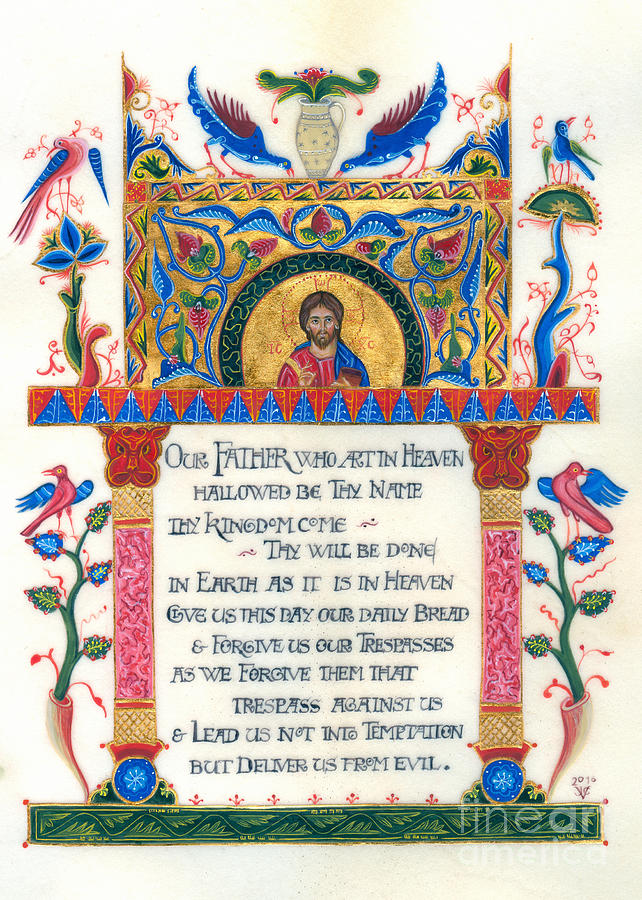
Our Father, who art in Heaven, hallowed be thy Name, thy Kingdom come, thy will be done, as in Heaven so also upon earth; give us today our daily bread, and forgive us our debt as we forgive our debtors, and lead us not into trial, but deliver us from the Evil One, for thine is the power and the glory for ever. Pray thus three times a day. (8:2–3)

The doxology at the end of Matthew’s version is a later addition. Interestingly, the earliest Greek and Latin manuscripts do not contain it. Even early church fathers knew of the shorter version. It makes you wonder why the doxology was added and kept in Matthew’s final version. Even a version of Luke contained, “May Your Holy Spirit come upon us and purify us,” instead of “Your kingdom come.” This is attested to by Marcion’s version of Luke (ca. 85–160); Gregory of Nyssa also wrote about this version. Several amulets have been found in Egypt on which the Lord’s Prayer was inscribed, so we see this prayer as transmitted through time. 

Many Jewish prayers address God with formality, “Blessed be the Name of the LORD our G-d,” though not exclusively (cf. Mal. 2:10). Here, however, Jesus makes it intimate, addressing God as our father, denoting paternal love, protection, and provision. God alone is one’s father (Matt. 23:9). Saying that God was in heaven, the text says “heavens,” speaks about his ability to transcend the physical world. Jews at the time believed in three heavens (2 Cor. 12:2). The third commandment of the Torah was to not use the Lord’s name in vain (Exod. 20:7), and the wording in Exodus means to take a vow or oath in God’s name, as well as in casual conversation. 

When Jesus prays for God’s kingdom to come, many say we should omit this portion of the prayer because the kingdom is already spoken of as something in the present tense (cf. Luke 9:27; 1 Cor. 15:23–25; Col. 1:13; Rev. 1:9). In this sense, I would agree; however, the kingdom has come in that God’s rule is on earth through the church. Yet, the fullness of his kingdom is to be realized after the judgment. Christians live in God’s kingdom, but there are still things on the earth, such as death, that occur that aren’t a part of God’s kingdom. 

When we follow God’s will as we know it on earth, we may also see it done in heaven. We can learn this from the Scriptures that have been preserved for us. Jesus used those Scriptures to combat the devil in the wilderness. He also said he didn’t come to destroy the law and prophets but to fulfill them. The wording about daily bread isn’t as truthful to the text as many English translations give it. In Greek, “daily” isn’t expressed, but giving us tomorrow’s bread today is more accurate to the language. On the one hand, it envisions the messianic banquet (cf. Matt. 8:11). On the other, it reminds us that Jesus is our bread of life (John 6:35, 48, 51). 

Sin is often regarded as a debt (cf. Matt 18:21–35; Luke 7:40–43). We accrue debts through our sins. These debts are too outstanding for our repayment, but the merciful God will forgive us our debts as we forgive our debtors. If we practice canceling debts rather than calling in repayment, we will have our debts canceled (Matt. 6:14–15). When we think about temptation, we think of something that entices us to sin. The term translated as “temptation” refers to outward tests of all kinds. You could render the term “trials” or “ordeal.” These can lead to temptations, but they are not in and of themselves (cf. Prov. 30:7–9). Jesus’ hunger in the wilderness could have turned to sin had he succumbed to Satan’s temptation to turn stones into bread. Judas was not delivered from the evil one, mainly because he did not seek God’s will. Because of this, he opened himself to Satan (cf. Luke 22:3; John 13:27). Just as Satan tempted Jesus through his trial, he can use our ordeals to tempt us, giving that we become weak or despairing in them. 

Praised by God, Not By Men (Matt. 6:1-18)

Jesus wants his disciples not to be show-offs. A balance must be struck between personal piety, the salt of the earth, and letting our light shine (Matt. 5:13–16). When we compare these, it all boils down to intention. To be the salt of the earth isn’t to show off but to be a blessing. Just as salt has taste and color affects whatever it touches when used. It can preserve, melt, season, and other such things. By being what we are, we are meant to be a blessing by being that salt. Just as there are various uses for salt, so there is for light. Many of us remember that plants require light to grow. Solar panels harness direct sunlight’s power, which can be stored in batteries. My house has several solar paneled motion lights and string lights. The string lights illuminate every night around our deck, and whenever the dog or someone walks by the motionlights, it illuminates. It’s very dark in the country, and these lights are helpful and cheaper than running electricity everywhere. You may have heard that darkness is the absence of light. When God ordered the cosmos, he commanded light as the first act of creation (Gen. 1:3).  When the final, heavenly Jerusalem appears, there will be no more night (Rev. 22:5). We’re told to let our light shine so that our good works are seen, and we glorify our heavenly Father. Where’s the balance?

Jesus mentions almsgiving, prayer, and fasting as three areas of piety. He stresses that we do things to be rewarded by our Father and not people (Matt. 6:3–4, 6, 18). So, here are the two areas of tension that will be resolved by noting the intention. Here’s an example that helps me: let’s say you’re out to eat at a restaurant. When your food comes, you and your family bow your heads and offer a prayer. You’re not doing it for attention but to give thanks. That’s letting your light shine because, let’s say, an elderly couple walks by and commends you for that, saying it’s nice to see a young family give thanks without shame. Your light has shone, but you have done it not for praise but out of personal devotion and commitment to God. On the other hand, if you prayed so loud that everyone around you was forced to notice, that’s not good, and the showing off is of concern here. In closing chapter five, Jesus said to be perfect as our Father is, so the instructions that came before and follow that statement show us how to do that. Our word, translated as “perfect,” doesn’t mean “without fault.” I advocate that it should be translated as “complete.” At least, that’s how we’d understand it today.  

The conclusion of intention is shown in each example. In almsgiving, don’t blow the trumpet (Matt. 6:2). In prayer, it’s to be seen by men (Matt. 6:5). With fasting, it’s appearing to men (Matt. 6:16). This is the motivation of the hypocrites. They want to be seen. However, as this chapter closes, we seek God’s kingdom and righteousness first (Matt. 6:33). The law made caring for the poor a central command (Deut. 15:11). What’s interesting is that the term translated “almsgiving” is tzadik. The word for righteousness is tzedakah, which shows the relationship between the two. Doing it for public recognition should not be our motivation. What we give isn’t so much a matter as well, but how we give (cf. Mark 12:41–44). 

Similar sentiments could be said of prayer. This doesn’t rebuke corporate prayer because that’s commanded (1 Tim. 2:1–3) and observed in the early church (Acts 12:5, 12). The emphasis should be on God and not the one praying. Sometimes, people use prayers as sermon times. They give a little sermon for those listening more so than addressing God himself. So, Jesus identifies the praying person who wants to be seen; then, he points out the one who uses vain repetitions. 

The Gemara asks: And one who prolongs his prayer; is that a virtue? … Anyone who prolongs his prayer and expects it to be answered, will ultimately come to heartache … How does he prolong his prayer? By increasing his supplication. (B. Ber. 55a)

A professor once corrected me in a paper by telling me to stop bloviating. I looked the word up because I didn’t know what it meant. Essentially, use fewer words rather than extra unnecessary words. Don’t say in fifty words what can be said in ten. This is why the disciples ask Jesus to teach them how to pray. Rabbis often gave their disciples prayers to pray verbatim. In the early church, the Lord’s Prayer was to be prayed thrice daily (Didache 8.2–3). The Psalms are also a good blueprint. Fasting is also to be private. This religious devotion was associated with mourning, repentance, discipline, or waiting upon the Lord. 

The Magna Carta of Christianity

In the year 1215, a very important document was issued. This document was the first to put into writing that the king and his government were not above the law, so it placed limitations on royal authority by establishing law as a power in itself. I’m talking about the Magna Carta. The pioneer law inspired legislation in the West from there on out. The Sermon on the Mount is the Christian version of the Magna Carta in that it sets forth the heart of God and the nature of his kingdom. Where misunderstandings existed, Jesus clarified. Where obscurities puzzled, Jesus explained. 

When we arrive at Matthew 5, we must recall how Jesus’ fame had spread through Syria, Galilee, and Judea at the end of the previous chapter. They undoubtedly follow when he ascends the mountain, but they may be more concerned with being fed or healed. Yet, Jesus is speaking to his disciples. What’s unsure is whether Matthew has in mind all twelve or just the ones he’s called thus far: Peter and Andrew, James and John. Jesus speaks to them, but anyone who overhears is welcome to listen. As Moses ascended Sinai to receive the Law from God, so God ascended a mountain to deliver his Sermon on the Mount. There’s a new lawgiver in town, and it’s God in the flesh. 

He inaugurates his sermon by pronouncing blessings. “Beatitude” comes from the Latin Bible, where the word beati is in the place of “blessed.” It denotes “blessed,” “happy,” and even “rich,” with the connotation that they are divine in nature. Many Jewish prayers begin with the Hebrew version, baruch, as in, “Blessed are you, Lord our God.” Examples abound in the Hebrew Scriptures (Jer. 17:7–8; Ps. 118:26). The situations in which Jesus pronounced this blessing seem like the most unlikely candidates for it. This is the nature of God’s kingdom—it turns the world right side up. The wisdom of God is wiser than the wisdom of the world, so we will have to overhaul our thinking to think as God does. 

“Poor in spirit” has always intrigued me. It doesn’t mean weak in faith. According to David Bentley Hart, the word describes a beggar who seems to be cowering. These folks lack pride and are beneficiaries of the help others offer. They will even pay it forward and help others in need. I believe they recognize their dependence on God and live with that realization in acting. Because this is in the present tense, it’s not something in the future but the present. The kingdom of heaven is theirs now, not in some distant time. In the next one, bereavement could describe not only those mourning loss but the state of women and children who were often destitute and impoverished if no male was present. Their comfort could come in the manner of material help as well as emotional support. Mourning shouldn’t be minimized, however. Trite sayings and platitudes aren’t helpful. To mourn means that you had someone in your life that you truly loved, whose absence now leaves a void. While a dreadful feeling, comfort is promised. 

You may have heard the saying, “Meekness is not weakness, but strength under control.” It’s a nice saying with some truth. This beatitude resembles Psalm 37:11, and the same word is used regarding Jesus in Matthew 11:29 and 21:5. There’s no weakness but strength under control. Jesus never lorded his power over his disciples. He served and led them by serving them (cf. Phil. 2:6–11). Environmentalists love the play on inheriting the earth and tying it to treating the world well. I’m not sure Jesus meant that, but caring for the planet is still good. I believe Jesus’ intention concerns the new heaven and earth (cf. 2 Peter 3:13; Rev. 21:1). Some usually take the next beatitude to mean Bible study or knowledge. After all, the will of God in Scripture is righteous and leads us to such, but that’s an internal reading. It’s more of a state of things—of justice. There needn’t be a qualifier placed on the word “justice” (i.e., environmental, gender, etc.). We should desire it on the personal, societal, and global levels. We see so many injustices, so our hunger and thirst for such are met in God’s kingdom.

The next one is misleading. From an initial impression, it means that a forgiving person is blessed and they will be forgiven. However, the term translated as merciful denotes sympathy felt towards another, leading to action. This would be like seeing an elderly person struggling to open a door, so you open it for them. We call it common courtesy, which can be in little or big things. When I envision someone that’s pure in heart, several people come to mind. They were good people who wanted only good and didn’t wrap themselves with worldliness. God was at the forefront of their very being. 

The peacemaker beatitude has been popularized and applied to law enforcement, but the idea is more about one who isn’t a tattler or busybody. We all can do things to stir up trouble, but as peacemakers, we don’t offer to do so. In the first century, a group called the Zealots were a revolutionary group that wanted to restore the kingdom of Israel using violence. They aimed to depose the Roman oppressors. Their influence penetrated all Jewish society (cf. John 6:15; 18:10–11), but this wasn’t what Jesus wanted (cf. John 18:36). This was not the kingdom of God. 

The beatitudes are closed out by blessings pronounced on those who will suffer for righteousness’ sake (1 Peter 4:14–16). “Revile” is an antiquated term. It’s better to think of “insult,” as we understand it. Physical harm, ostracizing (cf. Luke 6:22), verbal abuse, and false accusations may occur. If it’s the result of being a Christian, Jesus says we are blessed.