Praised by God, Not By Men (Matt. 6:1-18)

Jesus wants his disciples not to be show-offs. A balance must be struck between personal piety, the salt of the earth, and letting our light shine (Matt. 5:13–16). When we compare these, it all boils down to intention. To be the salt of the earth isn’t to show off but to be a blessing. Just as salt has taste and color affects whatever it touches when used. It can preserve, melt, season, and other such things. By being what we are, we are meant to be a blessing by being that salt. Just as there are various uses for salt, so there is for light. Many of us remember that plants require light to grow. Solar panels harness direct sunlight’s power, which can be stored in batteries. My house has several solar paneled motion lights and string lights. The string lights illuminate every night around our deck, and whenever the dog or someone walks by the motionlights, it illuminates. It’s very dark in the country, and these lights are helpful and cheaper than running electricity everywhere. You may have heard that darkness is the absence of light. When God ordered the cosmos, he commanded light as the first act of creation (Gen. 1:3).  When the final, heavenly Jerusalem appears, there will be no more night (Rev. 22:5). We’re told to let our light shine so that our good works are seen, and we glorify our heavenly Father. Where’s the balance?

Jesus mentions almsgiving, prayer, and fasting as three areas of piety. He stresses that we do things to be rewarded by our Father and not people (Matt. 6:3–4, 6, 18). So, here are the two areas of tension that will be resolved by noting the intention. Here’s an example that helps me: let’s say you’re out to eat at a restaurant. When your food comes, you and your family bow your heads and offer a prayer. You’re not doing it for attention but to give thanks. That’s letting your light shine because, let’s say, an elderly couple walks by and commends you for that, saying it’s nice to see a young family give thanks without shame. Your light has shone, but you have done it not for praise but out of personal devotion and commitment to God. On the other hand, if you prayed so loud that everyone around you was forced to notice, that’s not good, and the showing off is of concern here. In closing chapter five, Jesus said to be perfect as our Father is, so the instructions that came before and follow that statement show us how to do that. Our word, translated as “perfect,” doesn’t mean “without fault.” I advocate that it should be translated as “complete.” At least, that’s how we’d understand it today.  

The conclusion of intention is shown in each example. In almsgiving, don’t blow the trumpet (Matt. 6:2). In prayer, it’s to be seen by men (Matt. 6:5). With fasting, it’s appearing to men (Matt. 6:16). This is the motivation of the hypocrites. They want to be seen. However, as this chapter closes, we seek God’s kingdom and righteousness first (Matt. 6:33). The law made caring for the poor a central command (Deut. 15:11). What’s interesting is that the term translated “almsgiving” is tzadik. The word for righteousness is tzedakah, which shows the relationship between the two. Doing it for public recognition should not be our motivation. What we give isn’t so much a matter as well, but how we give (cf. Mark 12:41–44). 

Similar sentiments could be said of prayer. This doesn’t rebuke corporate prayer because that’s commanded (1 Tim. 2:1–3) and observed in the early church (Acts 12:5, 12). The emphasis should be on God and not the one praying. Sometimes, people use prayers as sermon times. They give a little sermon for those listening more so than addressing God himself. So, Jesus identifies the praying person who wants to be seen; then, he points out the one who uses vain repetitions. 

The Gemara asks: And one who prolongs his prayer; is that a virtue? … Anyone who prolongs his prayer and expects it to be answered, will ultimately come to heartache … How does he prolong his prayer? By increasing his supplication. (B. Ber. 55a)

A professor once corrected me in a paper by telling me to stop bloviating. I looked the word up because I didn’t know what it meant. Essentially, use fewer words rather than extra unnecessary words. Don’t say in fifty words what can be said in ten. This is why the disciples ask Jesus to teach them how to pray. Rabbis often gave their disciples prayers to pray verbatim. In the early church, the Lord’s Prayer was to be prayed thrice daily (Didache 8.2–3). The Psalms are also a good blueprint. Fasting is also to be private. This religious devotion was associated with mourning, repentance, discipline, or waiting upon the Lord. 

The Magna Carta of Christianity

In the year 1215, a very important document was issued. This document was the first to put into writing that the king and his government were not above the law, so it placed limitations on royal authority by establishing law as a power in itself. I’m talking about the Magna Carta. The pioneer law inspired legislation in the West from there on out. The Sermon on the Mount is the Christian version of the Magna Carta in that it sets forth the heart of God and the nature of his kingdom. Where misunderstandings existed, Jesus clarified. Where obscurities puzzled, Jesus explained. 

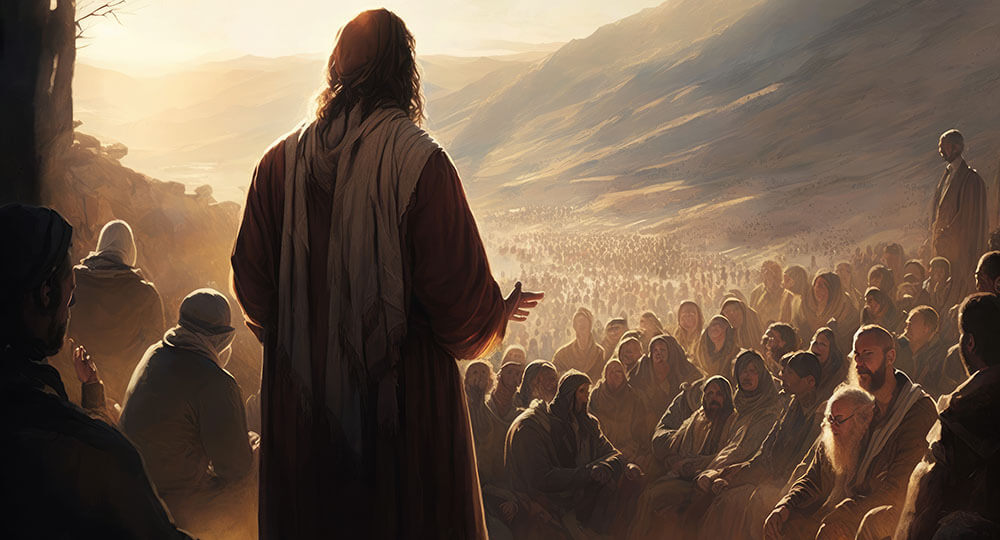
When we arrive at Matthew 5, we must recall how Jesus’ fame had spread through Syria, Galilee, and Judea at the end of the previous chapter. They undoubtedly follow when he ascends the mountain, but they may be more concerned with being fed or healed. Yet, Jesus is speaking to his disciples. What’s unsure is whether Matthew has in mind all twelve or just the ones he’s called thus far: Peter and Andrew, James and John. Jesus speaks to them, but anyone who overhears is welcome to listen. As Moses ascended Sinai to receive the Law from God, so God ascended a mountain to deliver his Sermon on the Mount. There’s a new lawgiver in town, and it’s God in the flesh. 

He inaugurates his sermon by pronouncing blessings. “Beatitude” comes from the Latin Bible, where the word beati is in the place of “blessed.” It denotes “blessed,” “happy,” and even “rich,” with the connotation that they are divine in nature. Many Jewish prayers begin with the Hebrew version, baruch, as in, “Blessed are you, Lord our God.” Examples abound in the Hebrew Scriptures (Jer. 17:7–8; Ps. 118:26). The situations in which Jesus pronounced this blessing seem like the most unlikely candidates for it. This is the nature of God’s kingdom—it turns the world right side up. The wisdom of God is wiser than the wisdom of the world, so we will have to overhaul our thinking to think as God does. 

“Poor in spirit” has always intrigued me. It doesn’t mean weak in faith. According to David Bentley Hart, the word describes a beggar who seems to be cowering. These folks lack pride and are beneficiaries of the help others offer. They will even pay it forward and help others in need. I believe they recognize their dependence on God and live with that realization in acting. Because this is in the present tense, it’s not something in the future but the present. The kingdom of heaven is theirs now, not in some distant time. In the next one, bereavement could describe not only those mourning loss but the state of women and children who were often destitute and impoverished if no male was present. Their comfort could come in the manner of material help as well as emotional support. Mourning shouldn’t be minimized, however. Trite sayings and platitudes aren’t helpful. To mourn means that you had someone in your life that you truly loved, whose absence now leaves a void. While a dreadful feeling, comfort is promised. 

You may have heard the saying, “Meekness is not weakness, but strength under control.” It’s a nice saying with some truth. This beatitude resembles Psalm 37:11, and the same word is used regarding Jesus in Matthew 11:29 and 21:5. There’s no weakness but strength under control. Jesus never lorded his power over his disciples. He served and led them by serving them (cf. Phil. 2:6–11). Environmentalists love the play on inheriting the earth and tying it to treating the world well. I’m not sure Jesus meant that, but caring for the planet is still good. I believe Jesus’ intention concerns the new heaven and earth (cf. 2 Peter 3:13; Rev. 21:1). Some usually take the next beatitude to mean Bible study or knowledge. After all, the will of God in Scripture is righteous and leads us to such, but that’s an internal reading. It’s more of a state of things—of justice. There needn’t be a qualifier placed on the word “justice” (i.e., environmental, gender, etc.). We should desire it on the personal, societal, and global levels. We see so many injustices, so our hunger and thirst for such are met in God’s kingdom.

The next one is misleading. From an initial impression, it means that a forgiving person is blessed and they will be forgiven. However, the term translated as merciful denotes sympathy felt towards another, leading to action. This would be like seeing an elderly person struggling to open a door, so you open it for them. We call it common courtesy, which can be in little or big things. When I envision someone that’s pure in heart, several people come to mind. They were good people who wanted only good and didn’t wrap themselves with worldliness. God was at the forefront of their very being. 

The peacemaker beatitude has been popularized and applied to law enforcement, but the idea is more about one who isn’t a tattler or busybody. We all can do things to stir up trouble, but as peacemakers, we don’t offer to do so. In the first century, a group called the Zealots were a revolutionary group that wanted to restore the kingdom of Israel using violence. They aimed to depose the Roman oppressors. Their influence penetrated all Jewish society (cf. John 6:15; 18:10–11), but this wasn’t what Jesus wanted (cf. John 18:36). This was not the kingdom of God. 

The beatitudes are closed out by blessings pronounced on those who will suffer for righteousness’ sake (1 Peter 4:14–16). “Revile” is an antiquated term. It’s better to think of “insult,” as we understand it. Physical harm, ostracizing (cf. Luke 6:22), verbal abuse, and false accusations may occur. If it’s the result of being a Christian, Jesus says we are blessed.