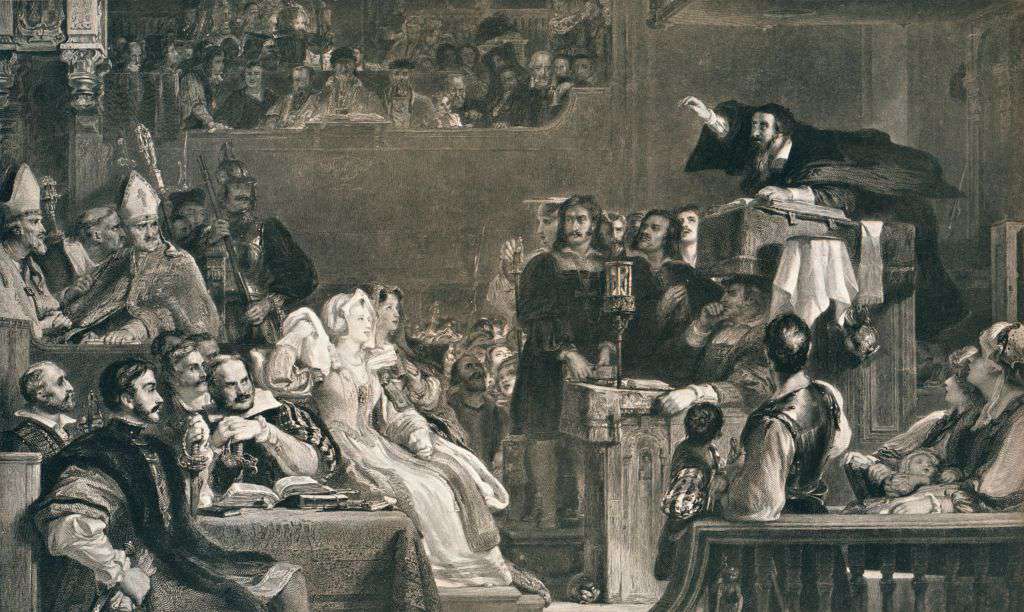
Last week, we concluded with the Lutheran Church and the Church of England (Anglicanism). We must understand that our separation of church and state exists for the reasons we’ll see as we go along. When King Henry VIII died, there was a bit of an issue with succession. At the time, the king’s male heir was to become king regardless of birth order. The late King Henry VII’s great-granddaughter was the Queen of the Scots, Queen Mary Stuart. This is important because of the line of succession: it went Edward, Mary Tudor, Elizabeth, and Mary Stuart (Queen of the Scots). Why this is important is discussed below.
The reformer John Knox had spread the Reformation wide over the English island. Knox was located in Scotland and was the leader of the Scottish Reformation. While Edward reigned, Knox was given liberty from the French, who had pinned the reformers down at St. Andrews. Edward died at fifteen due to tuberculosis. Edward had named his mother his successor, but it didn’t work like that. Mary Tudor became monarch and was named “Bloody Mary” by protestant opponents for the apparent reason of persecution. So, Henry VIII left Catholicism. His son Edward was the first king raised as a protestant, but Mary Tudor was Catholic. She was the remaining daughter of his first wife, Catherine of Aragon. Elizabeth was the daughter of his second wife, Anne Boleyn, and Edward was the son of his third wife, Jane Seymour.
Mary Tudor resumed the persecution of protestants, and Knox fled to Switzerland, where he met and learned from John Calvin. Mary Stuart, Queen of Scotland, wed the heir to the French throne and, at the age of sixteen, was queen consort of France and queen of Scotland. When Mary Tudor died in 1558, her half-sister Elizabeth succeeded her. Catholics claimed that Elizabeth was illegitimate, which would nullify her claim to the throne. If this was the case, the throne belonged to Mary Stuart, who began proclaiming herself the queen of England while in France. The protestants who had organized among Scotland and England sent word for Knox to return.
Knox returned to Scotland while Elizabeth reigned. Mary Stuart’s husband died, and she was requested to return to Scotland to reign since her regent had also passed. Mary had mass celebrated in her private chapel, and Knox preached against the “idolatry” of the “new Jezebel.” He and other reformed leaders organized the Reformed Church of Scotland. Each congregation elected elders and a minister, the latter examined by fellow ministers before being appointed. They were governed by the Book of Discipline, the Book of Common Orders, and the Scots Confession. Mary’s meddling in affairs alienated her from her lords so much that her army refused when she attempted to use them against the lords. Forced into exile, her cousin, Queen Elizabeth, gave her a castle residence. Yet, she conspired to have Elizabeth murdered so that she could sit on the English throne and restore Catholicism. She went so far as to include Spanish troops to aid her cause, but when the conspiracy was discovered, Mary was tried and condemned to death.
Years later, when Elizabeth died, her nephew, who was already the King of Scotland, became king of England. He united the two crowns in the act of unification, but the church looked different in each country. In Scotland, it was called Presbyterian because each congregation had elders, presbyteros being the Greek term translated as “elder.” In England, their leadership style was called episcopal, episcopos translated as “bishop.” King James, after whom the King James Bible was given, favored the episcopal form because it better supported the king as the head of the church, while Presbyterians did not.
Presbyterianism was among the most prominent denominations in early American history, with Baptists and Methodists equally present. The theology of John Calvin primarily led to Presbyterian dogma. An acronym arose to sum up his doctrine: TULIP. These stand for total depravity, unconditional election, limited atonement, irresistible grace, and preservation of the saints. The sovereignty of God overshadows the doctrine of them all. His magnum opus is Institutes of the Christian Religion, wherein he repeatedly quotes Augustinian views.
Their central tenets revolve around their definition of the sovereignty of God, the authority of Scripture, justification by grace through faith, and the priesthood of all believers. They traditionally lived by the Westminster Confession of Faith, but today, they have The Book of Confessions and The Book of Order. The former contains:
- The Nicene Creed
- The Apostles’ Creed
- The Scots Confession
- The Heidelberg Catechism
- The Second Helvetic Confession
- The Westminster Confession of Faith
- The Shorter Catechism
- The Larger Catechism
- The Theological Declaration of Barmen
- The Confession of 1967 (a revision of the Westminster Confession)
- The Confession of Belhar
The latter is regarded as the Constitution of the Presbyterian Church and contains the foundations of polity, form of government, directory for worship, and church discipline. The Presbyterian Church practices infant baptism has female clergy and uses instruments in worship. Recent activity has included social justice issues.
 A Minister's Study