Ancient Interpretations (Acts 8:16)

In Acts, Luke uses a similar phrase for different meanings. Given the context, it’s up to the reader to discern what he means by what he says. Let’s lay the groundwork. In Acts 2:38, we’re told that when one repents and is baptized, they receive forgiveness of sins and the Holy Spirit. This is stated with a promise to those present, those who come after them, and all who are far off, as many as the Lord calls to Himself by preaching the gospel. We conclude that everyone who repents and is baptized, obeying God, receives forgiveness and, more pointedly, the gift of the Holy Spirit. Some folks disagree as to what the gift of the Holy Spirit is. Still, I interpret it as the believer being given the Holy Spirit himself. If you disagree, that’s a discussion we can have another time since that isn’t the focus of this article.

As we read through Acts, we come to Acts 8, where Philip is preaching to the Samaritans. We read that after Philip preached and worked wonders, many people, men and women, believed the preaching and were baptized (Acts 8:12). We read a couple verses later that Peter and John are sent to Samaria to pray “for them that they might receive the Holy Spirit” (Acts 8:15–16). Have we misunderstood our earlier interpretation? Many brethren interpret as I do as a double entendre (a word or phrase open to two interpretations). In Acts 2:38, we don’t see Christians working signs and wonders. Only the apostles could work signs and wonders (Acts 2:43; 4:33; 5:12). Even in Acts 8:18, the laying on of apostolic hands conferred the ability to work signs and wonders. What are we to make of these two interpretations?

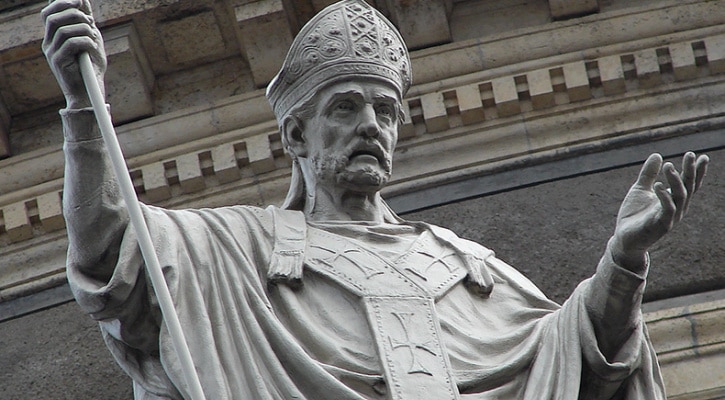
 Let’s ask an ancient Christian by the name of John Chrysostom. He flourished around the end of the fourth century and was Bishop of Constantinople. While we may have many disagreements about how church was done in his time, we must credit him for being a great expositor of Scripture. That second name, Chrysostom, wasn’t a surname but an honorarium given to him by many people. It means “Golden-mouthed” in Greek because John was a gifted orator who captivated audiences with his eloquent speaking style. He preached a series of homilies in the book of Acts, and when he comes to Acts 8:16, here’s what he wrote: “How was it then that they did not receive the Spirit? They had received the Spirit of remission of sins but not the Spirit of the signs.… To show that this was the case and that it was the Spirit of signs that they had not received, notice how Simon, once he saw the result, came and asked for this.” It would seem that John agrees with our conclusion, and he did centuries before we opened the Word.

The Holy Spirit Told Me

Some Christians will say, “The Holy Spirit told me.” I never doubt a person’s sincerity, but I don’t quite know what to make of this. I have a lot of questions. For example, how did He tell you? What did He say? What do you mean that he told you? Was it a dream? An email? Help me understand this. 

If you read it in Scripture, fair enough, I can understand that. I recommend you see a counselor if you’re hearing voices. Others have listened to voices in their heads, sometimes leading to awful things (e.g., drinking the Kool-Aid, Waco). Sometimes, you and I intuit or suspect a specific path or action should be followed. I urge caution about attributing something that might have arisen in our minds to the Holy Spirit. Along with this is often the statement that “God called me to do x, y, or z.” The only semblance of a divine calling is the call all Christians receive through gospel preaching (cf. 1 Peter 2:9–10; 1 Cor. 1:9; 2 Thess. 2:13–14). 

We have the indwelling of the Holy Spirit as promised by God (Acts 2:37–39). By the way, please refer to Him as Him and not as “it.” That’s how He’s referred to in Scripture. What, precisely, does He do for us?

  • He comforts us (Acts 9:31). 
  • He pours out the love of God (Rom. 5:5).
  • He helps with our prayers (Rom. 8:26–27). 
  • He causes hope to abound (Rom. 15:13). 
  • He transforms us (2 Cor. 3:18). 
  • He produces fruit (Gal. 5:22–23). 
  • He strengthens us (Eph. 3:16). 

As God’s children, His Holy Spirit can lead us, but only if we so choose (Rom. 8:12–14). When we live according to the Holy Spirit’s teachings, we are led by Him. These teachings are attested to in Scripture since he is the Divine Author. Being led by the Spirit depends primarily upon surrendering to Him (cf. Gal. 5:16, 18, 25). 

Aside from Scripture, I’m unsure how He might lead a person in our time. I don’t presume that He does now as he did in the apostolic era. There are non-micaculous things he does for us, as mentioned above. I haven’t the knowledge to explain how He does these things, but it’s in Scripture, and I’m content to accept what He has told us—without understanding all the ins and outs. He was given to us as a pledge (2 Cor. 1:21–22; 5:5) to be redeemed when Jesus returns. He seals us to show we belong to God (Eph. 1:13–14; 4:30). Going beyond what Scripture says is in many people’s sentiments. Though they are well-meaning, I would need clarification on what they mean by this type of talk. There are times when coincidences occur. We sometimes say, “That’s a God thing.” Could it have been the Holy Spirit? There’s the possibility, but it could also be providence. I’m just cautious about attributing something to the Holy Spirit without certainty that it was Him.

If people through whom the Holy Spirit directly acted can misuse His gifts, we’re not better off. Take the Corinthians Church. Paul commanded that an interpreter be present for those who spoke in tongues so that the church might be edified (1 Cor. 14:10–14). Moreover, tongues were a sign for unbelievers, not believers (1 Cor. 14:20–23). Is this how we see the alleged use of tongues today? No. Instead, those who claim to speak in tongues today behave as the Corinthians Church whom Paul rebuked. Then, he limits the number of the tongue speakers for the sake of order (1 Cor. 14:27–28). He wraps a bow around this by reminding them that the spirits of the prophets are subject to the prophets (1 Cor. 14:32–33), so any accusation that they cannot exercise control when the Spirit is working is something Paul would not have accepted.