The Law in the Intertestamental Period

Thus far, we’ve established that with Moses living around 1500 BCE, the books attributed to him date between 1450–00 BCE. These books were vested with authority  by the command that they are read every seven years (Deut. 31:10–13), and they were read by Joshua in the 13th century BCE (Josh. 8:34–35).[1] The 8th century BCE prophet Isaiah urged the reading of prophetic books (Is. 34:16). By the 7th century BCE, King Josiah’s court had discovered a copy of the law, likely the book of Deuteronomy (2 Kings 22:3–20), and read from it and inquiring of Huldah what such things meant. Jeremiah (6th cent. BCE) urged something to read of his scroll as authoritative (Jer. 36:6–26). During Jeremiah’s tenure, Judah was exiled to Babylon.

When the exiles returned Maccabean Revolt’s time to their land after decades of absence, they did so under one journey where the scribe Ezra led them. Ezra was one who “set his heart to study the Law of the LORD, and to do it and to teach his statutes and rules in Israel” (Ez. 7:10; cf. 7:6, 25; Deut. 16:12). Ezra’s knowledge of the Law enabled him to advocate for the Law in the reestablishment of Israel, so when the people assembled for a reading of the law, their response was remorse and weeping. The return from exile and covenant renewal did not prohibit a lukewarm response to the Law. By the prophet Malachi, the priests had turned from the Law (Mal 4:4). Their neglect of the Law, perhaps a response to unfulfilled prophetic expectations, led them to apathy towards religious observance. They were neglecting their duties manifested in the lack of reverence towards God so that instead of teaching the Law, they turned from it (Mal. 2:1–9).

The Law taking center stage is assumed to have been ongoing by the time of the Maccabean Revolt when the books of the Law were seized from the temple and any who possessed copies. The seizure was followed by a subsequent destruction of the law documents, which gave rise to Jewish zeal for the customs of their ancestors (1 Macc. 1:56–57). The Jews had formed the habit of searching the Law’s book when faced with national threats (1 Macc. 3:48), and they’d read from their holy books even before going into battle (2 Macc. 8:23). Following Ezra and Nehemiah’s example, they became stringent in their observance of studying the Law and turning to it. This was a dramatic shift from their pre-exilic mindset.

The Essenes dwelt around the Dead Sea while some lived in cities.[2] The Qumran community mandated a third of every night for reading the book and studying the law as a community.[3] Their study and reading of the law were likely oral rather than silent because of the Maccabees’ customs. 

For just as it is harmful to drink wine alone, or, again, to drink water alone, while wine mixed with water is sweet and delicious and enhances one’s enjoyment, so also the style of the story delights the ears of those who read the work. And here will be the end. (2 Macc. 15:39)

In the time of my maturity I remained with my husband, and when these sons had grown up their father died. A happy man was he, who lived out his life with good children, and did not have the grief of bereavement. While he was still with you, he taught you the law and the prophets. He read to you about Abel slain by Cain, and Isaac who was offered as a burnt offering, and about Joseph in prison. (4 Macc. 18:9–11)

Baruch read the words of this book to Jeconiah son of Jehoiakim, king of Judah, and to all the people who came to hear the book…. And you shall read aloud this scroll that we are sending you, to make your confession in the house of the Lord on the days of the festivals and at appointed seasons. (Baruch 1:3, 14)

The Essene’s method of interpretation was to not depart from the commandments and not add anything to them. The preservation of God’s commands in their most accurate form was a significant concern for this community.[4] Hence, they believed that their interpretation of the law was the last.[5] Their proper, communal study of the Law was thought to atone for the land, whereas earlier generations had ignored the Law’s reading and hearing.[6] Since the community also had priests and Levites as members, and these clerics read the text aloud in the assemblies that required a minimal number of ten.[7]

By the time of Philo, the Jews were regularly meeting in synagogues where they would read the scriptures and, after that, explain whatever was unclear.[8] However, scripture reading was not restricted to the synagogue or scribal community.[9] Among the Therapeutae, Philo recorded that scripture readings and the sermons that followed were common at banquets.[10]

While the origin of the synagogue is widely debated as originating with Moses or sometime during or after the exile, the literary value of its activity as it is observed in the New Testament would give greater weight to sometime after the removal. Nevertheless, the synagogue rose during the Intertestamental Period. The earliest New Testament reference to a synagogue meeting came in Luke’s Gospel when Jesus read from the prophets and gave a sermon. The synagogue meetings were not for worship per se but religious instruction. Synagogues were institutions of religious education;[11] to speak of synagogue worship negates the temple’s place in the life of the ancient Jew. The temple was where worship was rendered, as well as Scripture read at times too.[12]

There were at least two readings in a synagogue meeting—one from the Law and the other from the prophets.[13] The latter was followed by the synagogue ruler asking if anyone had a message after the reading.[14] The Law was read on a liturgical calendar and in its entirety every three years.[15] Had a priest or Levite been present, and they would have been given preference over an educated Israelite reading, [16] so Jesus’ reading infers the absence of both.[17] The reading of the prophets formed the conclusion of the synagogue service known as the Haftarah. Since this portion of the reading was not preselected, the reader, at their discretion, could select the passage to read.[18]

When the church was born, it was not considered distinct from Judaism, so synagogue and temple meetings continued until apostolic preaching went to the Gentiles. Upon conversion of the Gentiles and before their conversion, the early Christians primarily met in houses.[19] Within, the worship of the early church became defined as separate from the temple or synagogue. Still, the early church’s house meetings shared many organization and style practices with those of the synagogue.


[1] What’s unclear is if all Deuteronomy, or Exod. 21–23, or some other portion of the law was intended by this command. We call Torah Gen–Deut., but that may not have been what Moses meant.

[2] Josephus seemed to posit that some might have lived in cities (Wars 2.8.4), but Philo posited that they lived in isolated villages (Quod Omn. Prob. xii [76]) and cities (Hyp. [11.1]).

[3] 1QS vi, 7–10; cf. Wars 2.8.6, 12; Quod Omn. Prob. xii (75).

[4] 1QS I, 13–15.

[5] 4Q266 fr. 11; 270 fr. 7 ii.

[6] 1QS viii, 6.

[7] Quod Omn. Prob. xii (82, 84); 1QS vi, 7–10; cf. Wars 2.8.5.

[8] Philo Som. 2.18; cf. Contra Apion 2.18. The Theodotus Inscription on a first-century Judean synagogue read that the synagogue was “for the reading of the Torah and studying the commandments.”

[9] Cf. Bab. Tal. Taan. 4.2–3; 4 Macc. 18:10–11.

[10] Philo Vit. Cont. 9–10; Cf. Eccl. Hist. 2.18.

[11] Contra Apion 2.7; Mosis 3.27

[12] Bab. Tal. Sot. 7.7, 8; Bab. Tal. Yoma 7.1–3.

[13] Bab. Tal. Megillah 4.1–5; cf. 3.4–6; Acts 13:15; 2 Cor. 3:14.

[14] Acts 13:15; 15:21

[15] Megillah 29b

[16] Bab. Tal. Gittin 5.8

[17] Cf. John 7:14–15. On the literacy of Jesus see Tor Vegge, “The Literacy of Jesus the Carpenter’s Son: On the Literary Study in the Words of Jesus,” Studia Theologica 59, no. 1 (2005): 19–37.

[18] Megillah 4.4

[19] Acts 12:12; 17:5; 1 Cor. 16:19; et. al.

Reading Genesis 1 with Ancient Eyes

Imagine opening a puzzle box, only to dump out all the pieces. It’s a 1,000 piece puzzle. Your table looks like pure chaos, so you begin arranging the pieces, turning them face up. You arrange your outer perimeter. Then, you begin filling in the middle. It takes you time, but by the time you’ve finished, you’ve recreated the beautiful painting—da Vinci’s masterpiece, The Last Supper. You affix it to a backboard, then you frame it and hang it on the wall. You’re finished, and you can admire your labor. This is something like what God did with creation. He had pure chaos, arranged it in order, put it together, and once it was complete, He stopped to appreciate it. 

Isaac Newton gave us the scientific method, which was a way of evaluating data to arrive at a conclusion of facts. One begins with a hypothesis, tests the hypothesis through experiments, and modifies it based on the tests and experiments’ outcomes. This method was then carried from science into various other disciplines—law, history, and sacred history (theology). In some sense, our manner of biblical interpretation, known as “hermeneutics,” borrows from this method. However, at times this is to our peril. 

Allow me to unequivocally say that Genesis is not a scientific textbook by which we determine the age of the earth, the viability of a worldwide flood or the ark which bore creatures in pairs, and other such things. Our understanding of the cosmos differs from theirs. We have made advances in knowledge that they didn’t have then. They know what they know, and we know what we know. Genesis is a very sophisticated book, but we shouldn’t try to make it say something based on what we know when it wasn’t an issue for them. Now, someone might ask, “So you don’t believe God created the earth in seven literal days?” I believe God can do that, but that’s not the point of Genesis 1. To draw that conclusion is to focus on a few details of an entire story whose aim wasn’t to answer that question in particular, and I doubt Moses and the ancient Israelites could have envisioned our time and technology. This is a sacred book, not a scientific methodology, so we must read it as if we were ancient easterners living in the first millennium BCE. 

Genesis is a story. It’s the telling of a nation’s history about the land where they were situated and the God who had brought them to that land. This book must be read literarily and then theologically. We must understand the type of literature this is before we can properly understand the book as a whole. When we recall that Moses is recording this as Israel’s national epic, we can conclude that some of the information will have to do with rebutting competing nations and their narratives. Remember, these folks just came from polytheistic Egypt, so Moses will have to deconstruct some of their beliefs in order to fully turn them to their God. 

A Genesis of Genesis

At some point during his last eighty years of life, Moses, maybe on Sinai, recorded the beginning of Israel’s national history as angels mediated the law to him (Acts 7:53; Gal. 3:19; Heb. 2:2), or he received the revelation at some other time. Moses’ life is sectioned off into three blocks of forty years: the first being his life as in Egypt, the second with him as a shepherd, and the third as Israel’s leader. We may soon forget that we’re reading about a man who’s over 80. However, whenever he received the information on Genesis, we know that it was to tell Israel’s national story about the relationship they had with God and the land. He wasn’t an eyewitness. No one in that time was, but they likely had oral traditions and stories about the things he’d record. 

The entirety of the story centers on land and people: Canaan and the people of Israel. They had long been immersed in slavery, so they had little to no personal identity. Their entire identity had been as slaves, and breaking the mindset of being a slave was what Moses aimed to do. You can only go from being a slave to a free person when you have your own national story, and not your master’s. When you have your own God, and not the gods of your master. Rather than the plethora of temples, you want to know about Yahweh’s temple, and this is the story Moses tells. 

Sacred Space

We’re taken back to the beginning where God creates. To the original audience, everything was made for functionality and not merely as material, so we have to think about function over the material. For example, were I to hold up a pencil and ask you to describe it, you’d likely say that it was made of wood, give its color, and describe it based on its appearance. The ancient easterners would have described it as something they write with rather than how it appeared. The function was at the forefront of their mind more so than appearance or material, so this will shift us in our thinking. 

Elohim, so God is called, is creating order out of the formless, void earth. He’s arranging space for what’s to come by putting things in order on days 1–3, but beginning day 4, He fills it: the earth with light, the water with creatures, and the skies with birds. The world is filled with animals as well, and then God creates a human. At first, one human is made, but then two, a male and female, appear (Gen. 1:27). His crowning achievement is these humans. 

Unlike other creation accounts, or myths, Israel’s God creates everything to function a particular way. He’s Lord over it all. Also unlike other creation stories, when He creates humans, it’s not as His playthings or to entertain Himself, but to rule over His creation. Humanity bears His image and likeness. Whenever ancient deities faced a dilemma, they began arranging things to sort out the dilemma. Upon fixing everything, they rested in their temples. That’s why temples were built—not for humans to go to for worship and sacrifice, necessarily, but for the deity to occupy after a catastrophic issue that they resolved.

Given the literature and language of this passage, God built a temple for Himself. Let’s note some of the architectural language in the creation account. First, the “firmament” could also be translated as a “vault” (raki‘a) in verses, 6–8 and so on. Second, everything enclosed by this vault, the seas and earth, would have been akin to the floors of a temple and the lights for day and night may have been natural light for the day and candles or oil lamps for nights. Many temples contained elements of creation in them. The ceilings would have had sun, moon, and starts, though to many cultures those were gods in and of themselves, but here they are created by Elohim for a function, and not to be worshipped. Trees of some sort might have adorned the walls. In Solomon’s temple pomegranate and fig trees adorned the golden walls to remind the priests of the Garden. Within temples were images of the god, but in this case, the image of God resides in living beings, humans.  

Upon finishing His work of bringing order out of chaos, He stops and takes up residence in this new temple He formed. Once the existence of disorder, He’s ordered it, and now that His work was done, He inhabits it. This would have been how ancient audiences understood this story. We think merely in terms of the world, but they would have understood that a deity rested in a temple after some troubling event had been settled and peace reigned. The humans He created bore His image and likeness. Hence, their job is to embody God’s qualities and do His work, much akin to how the Vice-Regent in India was regarded as the King-Emperor himself in the early twentieth century. This is what we do: we tend the earth and its various parts while representing God. 

The heavens and earth were created as a sacred space where God dwelt with his creation, among whom were humans. While more time will be given to this in the next lesson, we should keep in mind the sacred space theme. A lot of Scripture is about sacred space and God being with His creation—humanity. This is how the Bible begins and, for all intents and purposes, ends. Everything in between shows us the love God has for creation. He continually pursues humanity who violates sacred space, pushing God away. Yet God, in His infinite power and mercy, cannot be kept from us. He does everything possible to draw near us, culminating with Him coming to the earth in the flesh, a doctrine known as the incarnation. God willingly sacrifices Himself in our stead, so He can have us with Himself. We must decide whether we shall keep pushing Him away or be drawn in by His warm embrace and love. 

The Scribe in the ANE

The first instance of recording Scripture occurs at Moses’s hand at the covenant’s inauguration between YHWH and Israel (Exod. 24:4–8). Scholars mostly agree that the Book of the Covenant mentioned there entailed chapters 21–23 of Exodus, but opinions vary.1 Moses’ upbringing in Egypt explains how he became a scribe in the first place,2 because they placed a high amount of esteem and respect on the scribe. They believed that a scribe was his own boss and the highest of trades to which one could aspire.3 Moses obviously had scribal training in Egypt in the first forty years of his life in the higher echelons of society, and that skill would serve him well as the leader of Israel. 

Even in Israel’s later history, we see the scribe as one moving in royal circles ( 2 Chron. 24:11; Esth. 3:12). The scribal chamber was within the palace (Jer. 36:12), and their work often detailed the exploits of the monarchs they served (1 Kings 11:41) as well as the reign of the monarchy itself (1 Kings 14:19, 29). They also served by writing the decrees ordered (Dan. 6:8) and taking dictation (Jer. 36:32). Some might be sent to record the military skirmishes the realm was engaged in (Jer. 52.25), and a useful skill for the scribe to possess in later times was to be bilingual (2 Kings 18:26).4 Following the station of Moses as a prophet were other prophets who recorded books or records here or there (Josh 24:26; 1 Sam 10:25). Later, we even read about some later holy people referring to what had been written (Dan. 9:2; Neh. 8:1). 

This process led what we know as the Old Testament to be formed around 400 BCE,5 with some arguing that the Law, or Pentateuch (first five books of the Bible), itself was authoritative by that time if not earlier. By 200 BCE or earlier, the prophets were canonized (cf. Is. 34:16; Jer. 36:6ff).6 Unlike our Christian Bibles where the Old and New Testaments are major divisions, the Hebrew Bible (Tanakh) grouped its books differently. There are three groupings of books: 

  1. The Law (Torah)
    1. Gen–Deut. 
  2. Prophets (Nevi’im)
    1. Josh, Judg., Samuel and Kings (Former Prophets)
    2. Isaiah, Jer., Ezek., and the Twelve (Latter Prophets)
  3. Writings (Ketuvim). 
    1. Song of Songs, Ruth, Lamentations, Ecclesiastes, and Esther (Five Megillot)
    2. Daniel, Ezra and Nehemiah, and Chronicles. 

This tripartite division is reflected from Ben Sira, who was the first to refer to it in this way (180–175 BCE), but may be earlier than him. 

Centuries before this time, King Josiah (622 BCE) found a copy of the Law in the temple, and his subsequent reverence of it as such demonstrates its authority in the life of Israelite society (2 Kings 22:3–20). After captivity, Ezra had a copy of the Law in which to lead the nation (Ezra 7:6; Neh. 8:1ff). Centuries before them, Joshua (13th century BCE) read the same (Josh 8:34–35), and King David was to have had a personal copy (Deut. 17:18–20; cf. Deut. 31:9, 25–26). We know David consulted it after Uzzah died (2 Sam. 6:1–10; cf. 1 Chron. 15:1–13), but it’s obvious that it wasn’t central at all times.  

The interlude from the reading of Joshua until the next reading is a noted period of silence of public readings. During that time, the united kingdom of Israel was divided, and the northern kingdom following an idolatrous path while the southern kingdom sinned as well, but with periods of reformation. The next public reading came after the high priest Hilkiah found the Book of the Law in the temple during the reign of King Josiah of Judah. Hilkiah took the book to the king’s secretary who then took it to the King. Upon hearing the words of the Book of the Law, King Josiah grieved and sent to inquire of the Lord because all the curses of the book were to be rendered to the unfaithful people of Judah (2 Kings 22–23; 2 Chron. 34). When Josiah assembled the people to have the Book of the Law read in their hearing, Josiah led a covenant renewal to which the people consented. However, because of so many years of apostasy that began with King Solomon, changing the trajectory of Judah was unrealized because of so many years of neglecting to read the Law. Therefore, the land was purged of its inhabitants so that it could undergo a period of cleansing (cf. Lev. 18:28; 20:22).

This points us to the authority the Law and Prophets had. What we find was that those who were well regarded, adhered to the Law. We also note that the absence of it from the life of Israel resulted in an ignorance that permitted apostasy.  


1 Robert Alter, The Five Books of Moses: A Translation with Commentary (New York: W. W. Norton & Company, Inc., 2004), 456.

2 The education of Moses is recorded in Philo, De Vita Mosis I 20–24, 32.

3 Christopher A. Rollston, Writing and Literacy in the World of Ancient Israel: Epigraphic Evidence from the Iron Age (Atlanta: Society of Biblical Literature, 2010), 87.

4 Ibid., 88–89.

5 Neil R. Lightfoot, How We Got the Bible, rev. ed. (Abilene: Abilene Christian University Press, 1986), 8.

6 Jack P. Lewis, Between the Testaments (Nashville: 21st Century Christian, Publishing, 2014), 92–93.

The Genesis of How the Bible Was Created

We have in our possession a sacred book that is nonetheless a book. Scripture was written over 1,400 years by various authors. The Bible wasn’t put together until centuries after all the writings were collected, but some writings remained together as a corpus (e.g., Torah). How did this process occur? That’s what many wonder. How and who created the Bible is remarkable and something that isn’t required to know but is very enlightening. 

Allow me, first, to give you a timeline of pertinent events as it relates to writing altogether and the Bible.  

3200 BCE — Writing began in Sumer through pictographic means. You might look up Samuel Kramer’s work, History Begins in Sumer.  

3000 BCE — Egyptian hieroglyphs were developed. 

2100 BCE — Abraham lived around this time. 

1800 BCE — An alphabet is created in Egypt. 

1500 BCE — Moses lived around this time. 

1200 BCE — Ugaritic, a language from Ugarit—a northwestern area in Syria—is used, and Exodus 15 and Judges 5 have stylistic patterns that resemble it. These similarities lead linguists to conclude that these two chapters are the oldest in the Bible and date to 1100–1200 BCE. 

1000 BCE — The monarchical period of Israel’s history begins. 

1000–900 BCE — The earliest Hebrew inscription on  a potsherd is discovered (Khirbet Qeiyafa ostracon). 

516→ BCE — We have manuscripts dating to this time period, known as the Second Temple Period, with the oldest dating to the late 4th century BCE. 

250→ BCE — Dead Sea Scrolls 

This timeline provides us a rough idea and overview of what we know about written communication. This information is the result of linguists, philologists, archaeology, and other related areas of study.1  

Materials used in writing were stone (Exod. 34:1, 28; Deut. 27:2–3), clay (Ezek. 4:1), wood (Is. 30:8; Hab. 2:2), and leather (Jer. 36:23). Additionally, papyrus leaves were mostly that upon which the New Testament was written. These plants grew along the Nile River and had been used as far back as 3000 BCE, but became common among the Greeks and Romans for making a book (codex) or books (codices). The average roll was 30 feet long and 9–10 inches high. Scribes would write on one side mostly, and occasionally on both sides (cf. Rev. 5:1).2 Animal skins, referred to as either vellum or parchment, were another common material used in the making of a letter. 

Whenever you hear about the discovery of a manuscript or something that scholars date to thus-and-such a period, they base this off the material upon which it was written, the language, dialect and syntax, and even carbon dating. Because we know that certain materials were used by particular people during a specific time period, this allows archaeologists to pinpoint a general time frame which contributes to our overall knowledge of the history of a text. 

The Birth of the Bible

It’s difficult to fix a date as to when the Bible was written, or began to be written. Believing that Moses lived around 1500 BCE, the books attributed to his authorship would have been written sometime in the second half of the fifteenth century, with redactions throughout the centuries (cf. Num. 12:3; Deut. 34:5–6). However, the book of Job is believed to have been written in the second millinium BCE, or it at least is about that period if it was written later. To put it in perspective, Job is believed to have been a patriarch akin to Abraham, Isaac, and Jacob and in their time. 

When it comes to what’s extant, the tenth century BCE potsherd known as Khirbet Qeiyafa ostracon is the eldest. This find dates to the reign of King David and was found was on the north side of the valley of Elah (1 Sam. 17:1–3). Differing interpretations as to what it says exists,3 so to suggest it is Scripture may not be altogether true. This discovery also can’t be ruled out as unreflective of Scripture though.4 The Ketef Hinnom amulets, however, are among the oldest find that contain on them language akin to the priestly blessing of Numbers 6:24–26 and date to the seventh century BCE. Since many scholars believe that the Old Testament is primarily a product of Israel’s post-exilic period, these two finds cast that conclusion into doubt given the language they each demonstrate.

Behind these fragmentary pieces, the Dead Sea Scrolls are the oldest full-manuscript evidence of the Old Testament we have. They are a collection of over 900 manuscripts discovered around Qumran from 1947–56. Copies of every Old Testament book except for Nehemiah and Esther were found in 11 caves around the Dead Sea and the oldest dates to the third century BCE. Before this discovery, the Leningrad Codex was the oldest Old Testament manuscript, dating to 1008 CE. Scholars compared the two texts, being greater than a millennium apart, and found that little had changed. This attests to the accuracy of the Hebrew Bible transmission.The notion supported by the likes of Bart Ehrman that we can’t fully trust Scripture because of the lack of original copies is a bit of a farce when one considers the accuracy between these two texts.


1 I recommend a listening to The Bible for Normal People (episode 150).

2 Neil R. Lightfoot, How We Got the Bible, rev. ed. (Abilene: Abilene Christian University Press, 1986), 4.

3 Alan Millard, “The Ostracon from the Days of David Found at Khirbet Qeiyafa,” Tyndale Bulletin 62, no. 1 (Jan. 2011): 1–13.

4 Ralph K. Hawkins and Shane Buchanan, “The Khirbet Qeiyafa Inscription and 11th–10th Century BCE Israel,” Stone-Campbell Journal 14, no. 2 (Fall 2011): 219–34.

Paul’s Use of a Scribe

Years ago, while working on my Ph.D., I was on a university campus in Nashville, TN, for a journal conference where I had presented a paper. After my presentation, I attended other presentations until the evening break. As I walked behind two other graduate students talking, I heard one remark that he didn’t believe that Paul authored the “pastoral epistles” either. I perked up because I was clueless about what they meant and why. Perhaps I misunderstood them?

I began reading background material regarding the New Testament, specifically about 1 & 2 Timothy and Titus. I don’t refer to them as the “Pastoral Epistles” because that term isn’t once used in either of these three letters. That’s something that began in the eighteenth century and has stuck ever since. Nevertheless, many scholars believed these letters to have been pseudepigraphical: written in Paul’s name, but by someone else. Why did they think this, I wondered? Historically speaking, the early church did not like this custom. On several occasions, letters were rejected for this very reason (e.g., Gospel of Peter), and Christians who did so were reprimanded (Tertullian, On Baptism 17.4–5). The oldest list of New Testament books, dating from AD 180 or thereabouts, censured letters forged in Paul’s name.

As I gave this issue more study, I learned that the letters’ syntax did not match any of Paul’s other letters. This isn’t the only factor that scholars relied upon, but the one with which I’m concerned here. I believe Paul used a specific scribe to compose these letters; however, I couldn’t necessarily prove it until now, thanks to Ben Witherington III. First, Scripture didn’t hide that Paul used a scribe to compose his letters. Tertius wrote his letter to the Romans, so we’re told in Romans 16:22. Second, some commentators have inferred from Galatians 6:11 that Paul might have had eye-sight issues, or that he may have only written a line or two of his letters (1 Cor. 16:21).

I recently listened to a podcast that featured Ben Witherington III and Jason Myers about views on Paul. Witherington made a statement on this issue towards the end of the episode. He challenged many scholars’ consensus on this claim regarding 1 & 2 Timothy and Titus. Witherington argued that he believed that Luke wrote these letters and that Paul may have granted him a level of freedom to write them, which would account for the differences in syntax. He offered this for two reasons: 1) Luke alone was with Paul (2 Tim. 4:11) and 2) several phrases and terms appear only in these three letters as well as Luke-Acts. We already know that Paul quoted from Luke’s gospel account in 1 Timothy 5:17–18 (see Luke 10:7), so this makes Witherington’s point all the more plausible.

Is it the Truth?

I recorded a devotional for our congregation that centered on how we Christians share and perpetuate information on social media and in general conversation. Given the increase of fake news that’s shared, and many of such by Christians, I thought it appropriate to urge the body of Christ where I serve to “buy the truth and not sell it.” You can watch it below.

For Where Two or Three Are Gathered In My Name

“For where two or three are gathered together in My name, I am there in the midst of them,” so said our Lord. Usually, this passage is cited when a small number of people have gathered for some spiritual purpose. It’s a way of saying that the crowd’s size doesn’t matter because God’s with us, which is true, by the way, but is that what he meant when He said this?

 Leading into this passage was Christ’s instructions on handling when a fellow believer had sinned against a person. Jesus gave a three-step process where the first attempt was that the believer goes to the person and attempt to rectify the matter in private. If that step failed, they were to take two or three witnesses to help adjudicate the case. If that failed, the ordeal was to have been brought before the assembly (church). Were the person to ignore the church’s ruling, the offender was to have been excommunicated.

Following this, Jesus said that whatever they bound on earth was bound in heaven. Whatever they loosed on earth was so regarded in heaven. This is a continuation of judicial thought from the previous verses (15–17). Jews then believed that the Jewish high court had the authority on earth of God’s tribunal in heaven so that whatever they did on earth was done with God’s approval. Using His law as their guide, they were His representatives on earth and acted with His authority. The binding and loosing were understood as either imprisoning or releasing.

By the time we get to verse twenty, the two or three referred to the witnesses of 18:16. At a Jewish ex-communication case, a prayer of denunciation was offered for the person who was to be removed from fellowship. Prayer was also provided in the case of one who had repented. In Moses’ Law, the witnesses were first to execute the court’s judgment (Deut. 17:17). Here they are first to pray, so there was a great responsibility upon them. These weren’t always titled people within Israel or the church. However, faithful followers of God took part in this. When Christ says where two or three are gathered, He isn’t speaking about crowd sizes, but either the putting away or receiving back of an erring believer.

Abstain from Every Appearance of Evil

“Abstain from every appearance of evil,” so wrote Paul to the Thessalonians 5:22. I have read and heard brethren invoke this passage to denounce a host of bad habits that they may find evil, such as dancing, drinking, and so forth. Regardless of how we understand each of those issues and what Scripture has to say about them, is 1 Thessalonians 5:22 a passage to be applied to such matters when read in the context of the letter Paul wrote?


When placed in context, 1 Thessalonians 5:19–22 belong to the same thought. They weren’t to quench the Spirit and despise prophecies. They were to test all things and hold fast to what is right. After mentioning these things, Paul then urges that they abstain from every form, or appearance, of evil. I believe it’s safe to say that whatever the Scriptures define as evil can be applied to this passage. However, we should undoubtedly take caution where the Scriptures are silent. Were we to take, for example, dancing as it has often been applied to this passage, we must ask what the Scriptures say, if anything, about the matter. We can find that dancing appears in several passages in a positive light (Exodus 15:20; 2 Samuel 6:14; Ecclesiastes 3:4; Luke 15:25). Therefore, we cannot label dancing as a whole as evil when Scripture portrays it positively. Nevertheless, we can concede that there may be types of dancing that are indecent and lascivious. Scripture has something to say about that too if we can read between the lines (Mark 6:21–23; cf. Esther 1:10–12).


Paul had to say to the Thessalonians that the Holy Spirit was to be actively present in the church’s life, but that there was a constant need to discern and test the Spirit’s work and prophecies not to be misled (cf. 1 Corinthians 14:29). After trying such things, they held to what was right and abstained from every form of evil. We must, then, ask what they understood as evil in this context. First, a correct translation would be, “Abstain from every form of evil” (NKJV; NASB). Because the KJV renders it as “all appearance of evil,” some conclude that Paul was condemning what was evil and what appeared evil (cf. 2 Corinthians 8:19–21). However, that wasn’t Paul’s thought here. The Greek term eidos doesn’t signify “appearance” in this sense, but “form” or “type.” “Appearance” is very open-ended and subject to our tastes at times, so we could easily invoke this passage for what we believe to appear as evil. The “evil” Paul has in mind here is likely whatever doesn’t pass the test of God’s Word, such as false prophecy (Matthew 7:15), and then to every other wrong thing (Galatians 5:19–21).

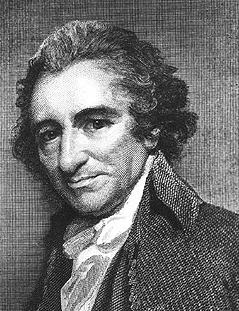
Now, More Than Ever, Americans Should Read Thomas Paine

Alongside Locke and Jefferson stood Thomas Paine in the advocacy of the natural rights of humanity in political and religious liberty. Robert Ingersoll wrote that Paine’s The Rights of Man “was the greatest contribution that literature had given to liberty.”[1] The sole thesis of Paine’s argument for humanity’s rights was an argument from nature—his natural philosophy having been influenced by Isaac Newton. Epistemologically, Paine believed that “He who takes nature for his guide is not easily beaten out of his argument.”[2] Therefore, the greater breadth of his writings utilized the argument from nature to support his conclusions.

Paine wrote that he had obtained a general knowledge of natural philosophy as a child at which time he began to “confront” the evidence of Christianity.[3] He defined his natural philosophy as “the study of the works of God, and of the power and wisdom of God in his works.”[4] Therefore, Paine would retort, “Why then not trace the rights of man to the creation of man?”[5] Though Paine would later deconstruct the Bible as a whole, he borrowed from the Mosaic creation account for its “historical authority.”[6] Ingersoll wrote that despite Paine thinking that the Bible was “absurd and cruel,” he found that there were some good and useful things therein.[7]

On the surface, Paine seemed to only use the Bible in order to support his own suppositions and thereby reject the rest, but the same claim could be made of the apostle Paul quoting Greek poets in the Scriptures as well as Jude quoting 1 Enoch. Nevertheless, those particular passages that Paine found suiting to his views were those of a natural philosophic “nature” (i.e. Psalm 19). Considering Paine’s apparent study of comparative religions, he may have noted the natural elements throughout the various religions and thought of them as “historical” evidences of creation in order to employ the Mosaic creation account, but this is conjecture.

He pointed to the distinction of sexes as the only recorded distinction, and the Mosaic creation account of “the equality of man” was, to Paine, “the oldest upon record.”[8] Man’s natural rights were the foundation for his civil rights. The two were distinguished by Paine as thus:

Natural rights are those which appertain to man in right of his existence. Of this kind are all the intellectual rights, or rights of the mind, and also all those rights of acting as an individual for his own comfort and happiness, which are not injurious to the natural rights of others. Civil rights are those which appertain to man in right of his being a member of society.[9]

What must be understood of Paine is that when he refers to man’s natural rights he refers to “the natural dignity of man.” This dignity is “the honour and happiness of its character.”[10]

How these views, and the doctrine of natural rights, shaped the views of Paine is evident throughout his pamphlets. Governments “un-made” men by their activities which denied the natural rights of man. Hereditary succession was one of the most disputed notions by Paine in his writings, because hereditary succession was unnatural. While the monarchs claimed that their authority came from God, the truth was that kings and kingdoms were actually not God’s will according to the biblical account that Paine referenced in Common Sense. Therein, Paine argued that God reluctantly granted Israel a king. Prior to their history as a monarchical state, Israel was governed by judges and the elders of the tribes—a form of government that Paine identified as a “kind of republic.” Ergo, since the monarchs of Paine’s time argued for heavenly sanction, Paine went further into Heaven’s decrees in order to refute hereditary succession. He would also state that virtue is not hereditary, so to claim that one man’s rule would be in tandem with another’s who was virtuous was to ignore the “natural” truth about human nature.

One of the strongest NATURAL proofs of the folly of hereditary rights in kings, is, that nature disproves it, otherwise, she would not so frequently turn it into ridicule by giving mankind an ASS FOR A LION.[11]

Another view for which Paine argued on nature’s basis was the freedom of a person’s mind. This argument was especially useful in dissolving the notion of an established church, because one should practice their religion “according to the dictates of conscience.”[12] The natural rights of man’s intellect belonged to one’s religious choice as long as it did not impede the natural rights of another.[13]

With respect to what are called denominations of religion, if every one is left to judge of its own religion, there is no such thing as a religion that is wrong; but if they are to judge of each other’s religion, there is no such thing as a religion that is right; and therefore all the world is right, or all the world is wrong. But with respect to religion itself, without regard to names, and as directing itself from the universal family of mankind to the Divine object of all adoration, it is man bringing to his Maker the fruits of his heart; and though those fruits may differ from each other like the fruits of the earth, the grateful tribute of every one is accepted.[14]

At the time that Paine argued for religious liberty, the country supported a state church. The result of dissenting groups such as Puritans, and from them Quakers, and later Baptists, was persecution. Paine believed that in man’s natural state to make up his own mind, he should choose that sort of devotion that he believed was his “conscientious” devotion to the Almighty as long as it did not obstruct or violate another’s choice.

Paine would argue that persecution was not an original feature of religion, but that it was always the feature of all law-religions, or religions established by law. If the lawfulness of a religion was taken away, then every religion would assume its own “benignity.” As a testimony to the detriments of the union of the state and religion, Paine cited the effects that such union had on Spain.[15]

Eventually, as history records, liberty would be won both politically and religiously. The poet Joel Barlow reflected on Paine’s contribution to the Revolution. He wrote that “without the pen of Paine, the sword of Washington would have been wielded in vain.”[16] While the actual fight took place on the battlefield with Washington, Paine’s battlefield was in the mind. Barlow aptly noted this sentiment by realizing that minds had to change more than battles could win.

Now, more than ever, Americans should read the works of Paine, especially The Rights of Man. With so many elected officials acting as kings dictating to people how to live in the era of COVID-19, were the American populace aware of the founders’ belief about human rights, none of this would be acceptable. In my own Commonwealth of Kentucky, the governor has unilaterally ruled the state since March and came out with new restrictions as recent as yesterday. Rumors abound that he will make “suggestions” to churches today. Nevertheless, from my recollection, he was silent while protests and demonstrations abounded around the state—a right acknowledged and protected by the very same amendment that addresses religious liberty.

Congress shall make no law respecting an establishment of religion, or prohibiting the free exercise thereof; or abridging the freedom of speech, or of the press; or the right of the people peaceably to assemble, and to petition the Government for a redress of grievances.

Amendment 1, United States Constitution

He has earlier advised churches to not meet, and the first amendment clearly states that the free exercise of religion shall not be prohibited. The mantra in response is usually, “Your rights end where my life begins,” and as a premise, this is factual. However, the way it’s employed is manipulative. No one forces those concerned for their lives to go out into the public. If they are so concerned, they should do the responsible thing and assume whatever risk exists if they decide to go into public. Otherwise, their fear is violating the rights of others who simply want to live their life in pursuit of happiness. That’s what’s liberty is all about: assuming your own risk.


[1] Robert G. Ingersoll, “Thomas Paine,” The North American Review 155, no. 429 (Aug., 1892): 181–95.

[2] Common Sense  (Appendix). 

[3] The Age of Reason 1.11.

[4] Ibid., 1.8. Cf. Thomas Paine, “A Discourse Delivered to the Society of Theophilanthropists, at Paris”; and “The Existence of God: A Discourse at the Society of Theophilanthropists, Paris.”

[5]Thomas Paine,  The Rights of Man, in Thomas Paine Collection (Forgotten Books, 2007), 88.

[6] Ibid., 89.

[7] Ingersoll, 189-90.

[8] Paine, Ibid. 

[9] Ibid., 90.

[10] Ibid., 92. Paine’s theories on happiness and being a member of society are reminiscent of Aristotle (cf. Ethics 1.13).

[11] Common Sense (Of Monarchy and Hereditary Succession).

[12] Ibid. (Thoughts on the Present State of American Affairs).

[13] The Rights of Man, 90.

[14] Ibid., 107. 

[15] Ibid., 108. 

[16] Harvey J. Kaye, Thomas Paine and the Promise of America (New York: Hill and Wang, 2005), 5.

Women Serving At the Door of the Tabernacle of Meeting?

I’m currently studying 1 & 2 Samuel (1 & 2 Kingdoms; LXX) for my own personal benefit, and I have two resources upon which I’m relying. The first is Robert Alter, The David Story and Robert Bergen’s commentary on 1 & 2 Samuel in The New American Commentary series. Now, 1 & 2 Samuel isn’t anything new to me, but the last time I gave them a good study was several years ago. Since I’ve grown and learned more in the years since, it’s always nice to revisit an old friend to see what more one can learn.

Thus far I’m through the second chapter, but something has caught my attention that I’d not noticed before.

Now Eli was very old; and he heard everything his sons did to all Israel, and how they lay with the women who assembled at the door of the tabernacle of meeting.

1 Samuel 2:22

Alter translates the term “assembled” as “flocked,” but Bergen translates it as “served.” While Alter’s translation more resembles the idea of what the NKJV has, Bergen’s piqued my interest. I set out to investigate this term that can be rendered as “assemble” or “serve,” because the two notions are significantly different ideas. How did these two come to different translations and renderings that are miles apart?

Our Hebrew term rendered as “assembled” here in 1 Samuel 2:22 appears in Exodus 38:8 as “serving” in the NKJV, so in one instance they give it as “assemble” while in another as “serve.” In Robert Alter’s work, The Five Books of Moses, his note on Exodus 38:8 reads,

Although most modern interpreters opt for the sense of service, there are two difficulties with that construction. The cult was administered by males, and there is scant evidence of a quasi-sacerdotal function performed outside the sanctuary by women.

Bergen also suggests that these women may have been Nazarite women involved in volunteer service at the Tent (cf. Num. 6:2). Upon further investigation, the term under question is often employed regarding military service and troops, though as an idiom it’s applied to the Levites. When we survey the Septuagint, the translators substituted the term “fasting” for this one whereas the Vulgate has them “keeping watch.” A comparative study undertaken has yielded the possibility that the women in question from Exod and 1 Sam were cultic prostitutes who may have aged out of prostitution and, therefore, offered their mirrors as votive offerings, though it isn’t necessary that we view them as retiring prostitutes.1

One thing is for sure, there have been numerous comments made on the matter and a variety of opinions as to who these women were and whether they “served” or “assembled” at the Tabernacle. Scholars disagree as a whole what to make of this. In Exod the women appear with mirrors while in 1 Sam they appear without mirrors, but the majority of articles that I’ve perused connects the women of 1 Sam 2:22 with those of Exod 38:8, given the similarities. What are we to make of it?

Notes

1 Laura Elizabeth Quick, “Through a Glass, Darkly: Reflections on the Translations and Interpretation of Exodus 38:8,” CBQ 81, no. 4 (Oct. 2019): 595–612. Consider also Janet S. Everhart, “Serving Women and Their Mirrors: A Feminist Reading of Exodus 38:8b,” CBQ 66, no. 1 (Jan. 2004): 44–54.

Why Does God Demand Worship?

Watching a debate between a theologian and an atheist (Christopher Hitchens), once years ago, the latter claimed that God was an egotistical maniac because of how the former talked about God deserving to be worshipped and humanity having been made for His glory. The theologian stated something along the lines of a man having to worship God, praise Him, and adore Him, and the atheist said that God sounded like an attention-starved teenager—a divine narcissist; that He’s vain. 

I’d never thought of it in these terms. I believe humanity is naturally wired to worship and adore. However, what we cherish and value can be God Himself or an idol. No one bats an eye when sports fans, concert-goers, or political rally attendees hoot and holler praise and adore the one on the stage. They aren’t worthy of such, yet we give it to them anyway. We admire them in a way meant to be reserved to God alone. Even when the national anthem is played, we assume a specific posture, remove our hats, salute, or either put our hand on our heart in a manner of veneration. Humanity is made to worship. 

Our English term “worship” isn’t likely the best because it’s pretty much a catch-all word. Augustine depicts this reality in his work, The City of God.

For this is the worship which is due to the Divinity … and to express this worship in a single word as there does not occur to me any Latin term sufficiently exact, I shall avail myself, whenever necessary, of a Greek word. Latreia, whenever it occurs in Scripture, is rendered by the word service. But that service which is due to men, and in reference to which the apostle writes that servants must be subject to their own masters … is usually designated by another word in Greek, whereas service which is paid to God alone by worship, is always, or almost always, called latreia [cf. Matt. 4:10] in the usage of those who wrote from divine oracles. (10.1.2; c. 413–426 CE)   

Latreia is but one term used to denote worship of God and is often translated as “serve.” The word from John 4:23–24 is proskuneo—which usually indicates knee-bending or prostrating worship (Matt. 2:11; cf. Rev. 19:10). We might use the term “grovel” to best understand this word, and it would be out of adoration or even fear, but not with the negative connotation it often carries today. When we turn to Romans 12:1, the NKJV renders “reasonable service” for logiken latreian. Other translations might have “spiritual [rational] worship.” 

First, let’s establish one truth: God doesn’t need our worship (Acts 17:24–25). Unlike other deities in other ancient religions, God does not need our worship. If we worship Him, nothing is added to Him. If we fail to worship Him, nothing is taken away from Him. If either of those propositions were true, then He couldn’t be God. Second, the common objection is that the tyrants [e.g. Kim Jong Un] of the world demand adoration and praise, so God can be no different from them by His demand for such, right? Wrong! God is morally perfect, uniquely pure, and stands alone. Unlike tyrants and dictators, He did not come into being and will not cease to be as they do. Unlike them, he wishes nothing but the best for His creation rather than, like them, having their self-serving desires. Unlike them, he doesn’t do what He does to maintain power or conquer because the world is already His. He will not be demoted. He shall never be defeated. 

God created this world, and He made you and me. As a loving Father—which is how we often view Him—He considers the relationship between Him and us as akin to a marriage. He regarded Israel as His bride, and there’s no more explicit description of this reality than in the book of Hosea. He is the bridegroom of His bride, the church. Imagine if we are to be as a bride to Him love, adore, and stand in reverent awe of something created rather than Him. Put it another way, imagine if your spouse lavished praise and adoration, gave loving glances to another person than you. You and I are naturally moved to jealousy, and God is no different. He is a jealous God (Exod. 20:5). We’ve seen how we humans are natural beings that admire, praise, and worship, but God alone is worthy of it. God alone is deserving of it, and it’s to Him alone; we should give it.

Being Christian During Election Season

When I was twenty-five years old, I had become politically active. I’d formed my basic political philosophy and posted incessantly on Facebook a host of articles and links that I believed would help everyone convert to my side. Then, one day, I received a letter in the mail from an elder minister whom I respected much. His message’s greatest takeaway was that he noted that not everyone would share my views—my Christian faith supported ideas that I happened to believe. Because this was a reality, he encouraged that I weigh the possibility that by being so politically active aloud, I may risk alienating someone by my views, which I might otherwise be able to share the gospel with. While it seems an obvious point, it was one I hadn’t considered, and the most important thing to me was the work that I do for Jesus above and beyond any political view that I might hold. 

Since then, I’ve sought to maintain a separation of church and state, if you will. I still have opinions, and I keep up with things, but I don’t always express my feelings because my allegiance to Jesus is the most valuable commitment I’ve ever made. Therefore, I endeavor to preach the Kingdom of God’s politics exclusively. If I’m to be known for where I stand relative to anything, I want it to be concerning my Christianity and not necessarily my political views. There are indeed issues here or there that are guided by my Christianity—such as the sanctity of life—so I’m never fearful of speaking about individual matters. They may be fleshed out in Scripture, but not partisan platforms.

One sad reality is how some brethren think their party’s platform is equivalent to Christianity. The two major parties aren’t perfect because they aren’t the Kingdom of God. They are servants of the citizenry, and their main concern always seems to be the next election. Here’s what concerns me—politics is seeping into the church in a way that some brethren believe their opinions on matters here or there are akin to the will of God. This is creating a division among us. It may not be as apparent to some, but a division is beginning to surface. 

Were Paul to write 1 Corinthians 1:12–13 today, here’s how it would read: 

Now I say this, that each of you says, “I am of the Republicans,” or “I am of the Democrats,” or “I am of the Libertarians,” or “I am of Christ.” Is Christ divided? Were the Democrats crucified for you? Or were you baptized in the name of the Republicans?

Brothers and sisters, I am not willing to become divided because you may see something different than I do, especially earthly politics. Neither will I frame my prayers in such a way that they seem partisan. Prayer isn’t a sounding board for politics. We’re indeed commanded to pray for our governing leaders, but how we pray for them needs to square with God’s will. Notice what Paul urged Timothy: 

Therefore I exhort first of all that supplications, prayers, intercessions, and giving of thanks be made for all men, for kings and all who are in authority, that we may lead a quiet and peaceable life in all godliness and reverence. For this is good and acceptable in the sight of God our Savior, who desires all men to be saved and to come to the knowledge of the truth. (1 Tim. 2:1–4)

Today, in congregational prayers, we typically reserve a more significant part of our praying to ask God for things. This is an aspect of prayer (cf. James 5:13–16; 1 Peter 5:7), but there’s also the focus, as Paul points out here, of praying for specific things for others and simply giving thanks. 

These categories of prayer focus on “that we may lead a quiet and peaceable life in all godliness and reverence” (1 Tim. 2:2). Therefore, the subject of such prayers was to have been everyone, even those in authority. Perhaps Paul has in mind those who incorrectly taught the Law and Hymenaeus and Alexander, whom he’d already mentioned in this letter. Praying for those who we find troublesome is an excellent way to order our hearts toward them rightly. Paul isn’t saying anything new, but admonishing Timothy as Jesus would have: “But I say to you, love your enemies, bless those who curse you, do good to those who hate you, and pray for those who spitefully use you and persecute you, that you may be sons of your Father in heaven” (Matt. 5:44–45; cf. Rom. 12:7–21). Timothy was to have prayed for all people because God wants all to be saved (1 Tim. 2:4).

In addition to remembering everyone in prayer, there’s also the mention of kings and authority. Our American society’s climate is so politically charged that I doubt very much that we Christians are prayerful of our governing leaders as we should be. Instead, we embroil ourselves in “gotcha” politics wherein we are the most ungracious and partisan. If I were to judge by what so many brethren post on Facebook and Twitter, we follow not the Prince of Peace, but the Devil of Division. Were we to pray for our governing leaders as God would have us, we would likely not be so vitriolic against them despite agreeing or disagreeing with policy decisions. Let’s face it—we’re a prosperous nation, the likes of which the world had not seen until our country became its own. Any discomfort we experience is a high-class problem that a decent portion of the world will never share, but we moan and groan as if it’s the world’s end. 

As we think about corrupt, unjust rulers, and who most would say deserve what they got coming to them, let’s remember that as Paul has already said, “Jesus came to save sinners.” He desires all men to be saved, and we should have that same desire too. Think about when David was fleeing the murderous intentions of King Saul. On a couple of occasions, David could have murdered Saul quickly. After all, Saul was a sinful man whom the Lord had rejected as king. God gave him an evil spirit to torment him, but when David had those chances to take Saul’s life, he refused to do so, saying, “The LORD forbid that I should do this thing to my master, the LORD’s anointed, to stretch out my hand against him, seeing he is the anointed of the LORD” (1 Sam. 24:6). All that David had done was to cut the corner off Saul’s robe because he’d gotten that close, but his heart troubled him since he did that. David said pretty much the same thing on another occasion, affirming that he would not harm Saul despite how evil and rejected he was because he was anointed by God (1 Sam. 26:11). No one would have blamed David had he done such, but he didn’t because Saul was God’s anointed no matter how sinful he’d been. 

I think it striking that David maintained respect and reverence towards the man who occupied the same position that God had rejected him from being and sought to end his life. Nevertheless, David took God’s anointing seriously so that even after being rejected by God, Saul was still one worthy of respect in David’s mind. We see Paul later acting similarly when he was on trial before the Sanhedrin. After beginning to address those present, the high priest ordered him stricken, and Paul replied by reviling the high priest. After it was disclosed to Paul that he’d cursed the high priest, Paul repented with the invocation of a passage from Exodus, “You shall not speak evil of a ruler of your people” (Acts 23:1–5). Despite the high priest acting contrary to the law, Paul still knew that he was worthy of respect because of his position. Perhaps instead of saying that we respect the office but not the person, we could look at the office occupying. As Paul instructs Timothy, pray for those occupying it and not separate the occupier from the station itself. 

God is not so detached from creation that He doesn’t play any part in it. It is He who establishes and tears down kingdoms (Jer. 18:7–10). Interestingly enough, kings’ hearts are like streams in the Lord’s hands, and He turns them wherever He wants (Prov. 21:1). God can divert the channels wherever He chooses, so regardless of whoever is in power, He can do with them what He wishes for His ultimate purpose. If we spent our time prayerfully praying God’s blessings and best for our governing leaders (cf. 1 Peter 2:13–17; Rom. 13:1–7), we might not speak so unkindly of them. It would be somewhat hypocritical to pray for God to use those in authority for His good while at the same time criticizing everything they do.